


Published on Jan 09, 2026
The successful explortion of space requires a system that will reliably transport payloads into space and return back to earth; without subjecting them an uncomfortable or hazardous environment. In other words, the space crafts and its pay loads have to be recovered safely into the earth.
The space shuttle used at older times were not re-usable. So NASA invented re-usable space shuttle that could launch like a rocket but deliver and land like an aeroplane. Now NASA is planning to launch a series of air-breathing planes that would replace the space shuttle.
Near the end of the Apollo space program, NASA officials were looking at the future of the American space program. At that time, the rockets used to place astronauts and equipment in outer space was one-shot disposable rockets. What they needed was a reliable, but less expensive, rocket, perhaps one that was reusable. The idea of a reusable "space shuttle" that could launch like a rocket but deliver and land like an airplane was appealing and would be a great technical achievement.
NASA began design, cost and engineering studies on a space shuttle. Many aerospace companies also explored the concepts. In 1972 NASA announced that it would develop a reusable space shuttle or space transportation programme (STS).NASA decided that the shuttle would consist of an orbiter attached to solid rocket boosters and an external fuel tank because this design was considered safer and more cost effective.
At that time, spacecraft used ablative heat shields that would burn away as the spacecraft re-entered the Earth's atmosphere. However, to be reusable, a different strategy would have to be used. The designers of the space shuttle came up with an idea to cover the space shuttle with many insulating ceramic tiles that could absorb the heat of re-entry without harming the astronauts.
Finally, after many years of construction and testing (i.e. orbiter, main engines, external fuel tank, solid rocket boosters), the shuttle was ready to fly. Four shuttles were made (Columbia, Discovery, Atlantis, Challenger). The first flight was in 1981 with the space shuttle Columbia, piloted by astronauts John Young and Robert Crippen. Columbia performed well and the other shuttles soon made several successful flights.
The space shuttle consists of the following major components:
" Two solid rocket boosters (SRB) - critical for the launch
" External fuel tank (ET) - carries fuel for the launch
" Orbiter - carries astronauts and payload
A typical shuttle mission lasts seven to eight days, but can extend to as much as 14 days depending upon the objectives of the mission.
A typical shuttle mission is as follows:
1. Getting into orbit
1.1 Launch - the shuttle lifts off the launching pad.
1.2 Ascent.
1.3 Orbital maneuvering burn.
2. Orbit-life in space.
3. Re-entry.
4. Landing.
The SRBs are solid rockets that provide most of the main force or thrust (71 percent) needed to lift the space shuttle off the launch pad. In addition, the SRBssupport the entire weight of the space shuttle orbiter and fuel tank on the launchad. Each SRB has the following dimensions.
• Height - approximately 150 ft (46 m)
• Diameter - 12 ft (3.7 m)
• Weight:
o Empty - 192,000 lb (87,090 kg)
o Full - 1,300,000 lb(589,670 kg)
One of the space shuttle's main engines
Thrust - 2.65 million lb (11.7 million N wing dimensions, parameters and parts:
Because the SRBs are solid rocket engines, once they are ignited, they cannot be shut down. Therefore, they are the last component to light at launch.
The orbiter has three main engines located in the aft (back) fuselage (body of the spacecraft). Each engine is 14 feet (4.3 m) long, 7.5 feet (2. 3 m) in diameter at its widest point (the nozzle)
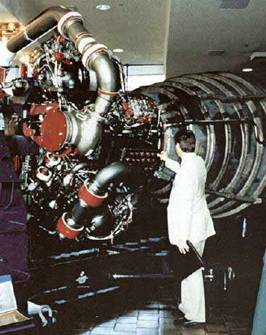
Photo courtesy NASA
The main engines provide the remainder of the thrust (29 percent) to lift the shuttle off the pad and into orbit.
The engines burn liquid hydrogen and liquid oxygen, which are stored in the external tank(ET), at a ratio of 6:1. They draw liquid hydrogen and oxygen from the ET at an amazing rate equivalent to emptying a family swimming pool every 10 seconds! The fuel is partially the burned in a pre-chamber to produce high pressure; hot gases that drive fuel pumps. The fuel is then fully burned in the main chamber and the exhaust gases (water vapor) leave the nozzle at approximately 6,000 mph (10,000 km/h). Each engine can generate between 375,000 and 470,000 lb (1,668,083 to 2,090,664 N) of thrust; the rate of thrust can be controlled from 65 percent to 109 percent maximum thrust. The engines are mounted on round bearings that control the direction of the exhaust, which controls the forward direction of the rocket.
As mentioned above, the fuel for the main engines is stored in the ET. The ET is 158 ft (48 m) long and has a diameter of 27.6 ft (8.4 m). When empty, the ET weighs 66,000 lb (30,000 kg). It holds about 1.6 million lb (719,000 kg) of propellant with a total volume of about 526,000 gallons (2 million liters). The ET is made of aluminum and aluminum composite materials. It has two separate tanks inside, the forward tank for oxygen and the aft tank for hydrogen, separated by an intertank region. Each tank has baffles to dampen the motion of fluid inside.
Fluid flows from each tank through a 17 in. (43 cm) diameter feed line out of the ET through an umbilical line into the shuttle's main engines. Through these lines, oxygen can flow at a maximum rate of 17,600 gallons/min (66,600 l/min) and hydrogen can flow at a maximum rate of 47,400 gallons/min (179,000 l/min). During the first few shuttle missions, the ET was painted white, but this was stopped to reduce the weight.
The two orbital maneuvering systems' (OMS) engines are located in pods on the aft section of the orbiter, one on either side of the tail. These engines are used to place the shuttle into final orbit, to change the shuttle's position from one orbit to another, and to slow the shuttle down for re-entry.
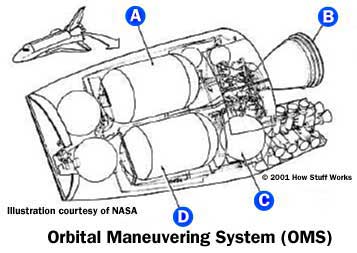
The OMS engines burn monomethyl hydrazine fuel (CH3NHNH2) and nitrogen tetroxide oxidizer (N2O4). Interestingly, when these two substances come in contact, they ignite and burn automatically (i.e., no spark required) in the absence of oxygen. The fuel and oxidizer are kept in separate tanks, each pressurized by helium. The helium is used to push the fluids through the fuel lines (i.e., no mechanical pump required). In each fuel line, there are two spring-loaded solenoid valves that close the lines. Pressurized nitrogen gas, from a small tank located near the engine, is used to open the valves and allow the fuel and oxidizer to flow into the combustion chamber of the engine. When the engines are shut off, the nitrogen goes from the valves into the fuel lines momentarily to flush the lines of any remaining fuel and oxidizer; this purge of the line prevents any unwanted explosions. During a single flight, there is enough nitrogen to open the valves and purge the lines 10 times.
| Are you interested in this topic.Then mail to us immediately to get the full report.
email :- contactv2@gmail.com |
