

Published on Jan 09, 2026
A Hovercraft is a vehicle that flies like a plane but can float like a boat, can drive like a car but will traverse ditches and gullies as it is a flat terrain. A Hovercraft also sometimes called an air cushion vehicle because it can hover over or move across land or water surfaces while being held off from the surfaces by a cushion of air.
A Hovercraft can travel over all types of surfaces including grass, mud, muskeg, sand, quicksand, water and ice .Hovercraft prefer gentle terrain although they are capable of climbing slopes up to 20%, depending upon surface characteristics.
Modern Hovercrafts are used for many applications where people and equipment need to travel at speed over water but be able load and unload on land. For example they are used as passenger or freight carriers, as recreational machines and even use as warships. Hovercrafts are very exciting to fly and feeling of effortlessly traveling from land to water and back again is unique.
In the beginning……
Hovercraft as we know them today started life as an experimental design to reduce the drag that was placed on boats and ships as they ploughed through water. The first recorded design for an air cushion vehicle was put forwarded by Swedish designer and philosopher Emmanuel Swedenborg in 1716. The craft resembled an upturned dinghy with a cockpit in the centre.
Apertures on either side of this allowed the operator to raise or lower a pair of oar-like air scoops, which on downward strokes would force compressed air beneath the hull, thus raising it above the surface. The project was short-lived because it was never built, for soon Swedenborg soon realized that to operate such a machine required a source of energy far greater than that could be supplied by single human equipment. Not until the early20th century was a Hovercraft practically possible, because only the internal combustion engine had the very high power to weight ratio suitable for Hover flight.
In the mid 1950s Christopher Cockrell, a brilliant British radio engineer and French engineer John Bertin, worked along with similar line of research, although they used different approaches to the problem of maintaining the air cushion. Cockrell while running a small boatyard in Norfolk Boards in the early 1950s began by exploring the use of air lubrication to reduce the hydrodynamic drag, first by employing a punt, then a 20 knot ex-naval launch as a test craft.
The principle of working of a Hovercraft is to lift the craft by a cushion of air to propel it using propellers. The idea of supporting the vehicle on a cushion of air developed from the idea to increase the speed of boat by feeding air beneath them. The air beneath the hull would lubricate the surface and reduce the water drag on boat and so increasing its speed through water.
The air sucked in through a port by large lifting fans which are fitted to the primary structure of the craft. They are powered by gas turbine or diesel engine. The air is pushed to the under side of the craft. On the way apportion of air from the lift fan is used to inflate the skirt and rest is ducted down under the craft to fill area enclosed by the skirt.
At the point when the pressure equals the weight of the craft, the craft lifts up and air is escaped around the edges of the skirt. So a constant feed of air is needed to lift the craft and compensate for the losses.
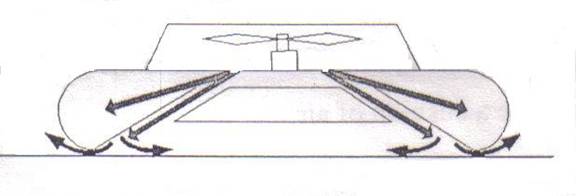
Thus craft is lifted up. After the propulsion is provided by the propellers mounted on the Hovercraft. The airs from the propellers are passed over rudders, which are used to steer the craft similar to an aircraft. Hovercraft is thus propelled and controlled and its powerful engine makes it to fly.
Lower hull- It is the basic structure on which the Hovercraft floats when the engine is stopped while moving over water. It supports the whole weight of the craft.
Skirts- They are air bags inflated by air are fitted around the perimeter of the craft hold air under the craft and thus upon a cushion of air. It enables to obtain greater Hover height. The material used is rib stop nylon or Terylene.
Lift fan-It is fitted to the primary structure of the Hovercraft. The air is pumped under the craft between the skirt space to produce a cushion of air.
Propeller-It is used to obtain the forward motion of the craft. It is fitted to the top of the craft and is powered by a powerful gas turbine or diesel engine.
Rudders-They are similar to that used in an aircraft. Rudders are moved by hydraulic systems. By moving the rudders we can change the direction of the craft.
Stability of the Hovercraft on its cushion of air remained a real problem despite some design efforts and new approach was needed. To solve these problems, plenum chamber with a momentum curtain was developed by Sir Christopher Cockrell.
His first experiments were conducted with the aid of two cans and a vacuum cleaner (with blower end). The cans were drilled and bolted so that one can was inside the other with open ends facing down to some weighing scales, the top of the larger can was open and had a tube connected to it so that air could be forced in to the top can and around the smaller can inside.
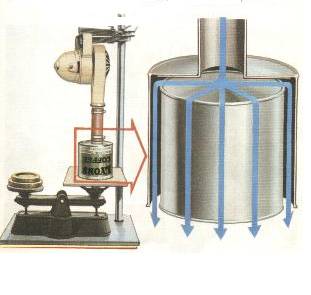
The air traveled around between the inside of the bigger can and outside of the smaller can and was then let out towards the scales in a narrow ring of air, the cans were mad4e so that it was possible to remove inner can so the air could be directed in two ways.
The experiment was conducted in two steps. First the smaller can was removed and blower switched on. The scales measured the amount of thrust the air from the one can produced down onto the scales. The smaller can was now replaced inside the larger can so that the ring of air was produced. Again the blower was switched on and the scales measured amount of thrust the ring of air produced down onto the scales. Here is the key discovery because Cockrell observed that the two cans nested inside each other produced more thrust onto the scales than the simple open can or plenum chamber did, he had discovered the momentum curtain effect and this was the key ingredient that he patented.
In the full size craft the plenum chamber was also filled in so that a slot round the bottom edge of plenum chamber wall was former where the air fed in at the top. The slot produced a curtain of flowing air that was inclined. The high pressure air from the slot angled inwards towards the centre of the craft helped to contains and sustains the air cushion. Using this method a stable air cushion could be created. The craft was still riding on a plenum chamber of sorts but it was created and maintained by the high pressure ring of air surrounding the lower pressure air in the center.
The momentum curtain arrangement achieved higher hover heights with less power. It also solved some of the stability problems. The box structure in the center of the craft around which air escaped was closed to form a buoyancy tank to enable the craft to float on water when it came to rest. The design was exactly what was used in first publicly demonstrated Hovercraft the SRN1, built by Saunders Roe in the United Kingdom it served as a test bed for many years during Hovercraft development.
| Are you interested in this topic.Then mail to us immediately to get the full report.
email :- contactv2@gmail.com |
