

Published on Jan 09, 2026
Over the past century, we have learned how to create specialized materials that meet our specific needs for strength, durability, weight, flexibility, and cost. However, with the advent of smart materials, components may be able to modify themselves, independently, and in each of these dimensions. Smart materials can come in a variety of sizes, shapes, compounds, and functions.
But what they all share- indeed what makes them "smart"-is their ability to adapt to changing conditions. Smart materials are the ultimate shape shifters.
They can also alter their physical form, monitor their environment, and even diagnose their own internal conditions. They can also do all of this while intelligently interacting with the objects and people around them. More boldly, it is highly likely that once smart materials become truly ubiquitous-once they are seamlessly integrated into a webbed, wireless, and pervasive network -smart materials will challenge our basic assumptions about, and definitions of "living matter."
A smart fluid developed in labs at the Michigan Institute of Technology
In certain respects, smart materials are an answer to many contemporary problems. In a world of diminishing resources, they promise increased sustainability of goods through improved efficiency and preventive maintenance. In a world of health and safety threats, they offer early detection, automated diagnosis, and even self-repair. In a world of political terrorism, they may offer sophisticated biowarfare countermeasures, or provide targeted scanning and intelligence- gathering in particularly sensitive environments.

In general, smart materials come in three distinct flavors: passively smart materials that respond directly and uniformly to stimuli without any signal processing; actively smart materials that can, with the help of a remote controller, sense a signal, analyze it, and then "decide" to respond in a particular way; and finally, the more powerful and autonomous intelligent materials that carry internal, fully integrated controllers, sensors, and actuators.
The components of the smart materials revolution have been finding their way out of the labs and into industrial applications for the past decade. As yet, they fall into several classes and categories: piezoelectrics, electrorestrictors, magnetorestrictors, shape-memory alloys, and electrorheological fluids. What these materials all have in common is the ability to act as both sensors and actuators. In some cases, when a force is applied to these smart materials, they "measure" the force, and "reverse" the process by responding with, or creating, an appropriate counter force.
In other cases, the materials are populated by sensors that detect environmental conditions within the material itself. When conditions cross designated thresholds, the materials then send a signal that is processed elsewhere in the system. For instance, "smart concrete"-under development at the State University of New York at Buffalo-would be programmed to sense and detect internal hairline fissures. If these conditions are detected, the smart material would alert other systems to avoid a structural failure.
Smart materials are currently used for a growing range of commercial applications, including noise and vibration suppression (noise-canceling headphones); strain sensing (seismic monitoring of bridges and buildings); and sensors and actuators (such as accelerometers for airbags). A number of companies, including The Electric Shoe Company and Compaq, are also exploring the use of smart materials. The Electric Shoe Company is currently producing piezoelectric power systems that generate electric power from the body's motion while walking. Compaq is investigating the production of special keyboards that generate power by the action of typing. Descriptions of applications for the smart materials mentioned above suggest that their impact will be broadly felt across industries.
Piezoelectric materials produce an electrical field when subject to a mechanical strain. Conversely, if an electrical field is applied to them, the material is stressed. Thus they can be used to generate low levels of power from simple mechanical motions or to deform surfaces in response to electrical signals. An excellent example of this is the application of smart materials in snow skis. Piezoelectric elements adjust the stiffness of the skis in response to conditions on the slope by damping shock and optimizing performance throughout a run.
These materials behave much like piezoelectrics, in that they are reciprocal devices that can both “receive” and “send” information within the systems that they inhabit. However, unlike piezoelectrics, magnetorestrictors respond to a magnetic field rather than an electric field. As such, they produce a magnetic field when strained. Applications for magnetorestrictors include machine tools, transducers, and sonar systems. Magnetorestrictors can also be used for vibration control (in factory equipment or automobiles), fuel injection systems, and the reconditioning (relining) of aged water and sewer pipelines.
This special class of adaptive materials can convert thermal energy directly into mechanical work. For example, smart shape memory alloys can be “pro- Institute for the Future grammed” to adopt a specific shape when the alloy reaches a designated temperature (say, 100º Fahrenheit). This same alloy can then be manipulated or mechanically deformed to adopt a different shape when not in this designated temperature (say, when the material is at 50º Fahrenheit). In turn, when the alloy is heated above a critical transition temperature (approaching 100º), the material will “remember” its earlier shape and restore it—effectively converting the heat into mechanical work.
Alternatively, SMAs can be trained to exhibit two shape-memory effects. In this case, heating the SMA results in one memorized shape while cooling results in a second, different shape (manipulation could then occur at a third, variable temperature).Shape Memory Alloys are currently used in various military applications. For instance, vibration-dampening SMAs, when deployed on supersonic fighter planes, decrease irrational stresses on materials, thereby increase the life and viability of the aircraft. SMAs can also be used preventively, to sense when materials are reaching critical failure limits. Commercially, SMAs can be used for vibration dampening effects on various factory machinery—say, within a component that holds a die-cutting laser.
In this case, the drop in vibration interference radically increases the laser’s accuracy. SMA devices could also enhance fire detection equipment, or any other component or situation in which a change in temperature could trigger a necessary mechanical action. Of particular interest is potential application in surgical situations where device longevity, simplicity (ease of use), and biocompatibility could all be benefited.
These materials represent fluid suspensions—emulsions wherein the smart material is dispersed, though not dissolved, within a liquid solution. When subjected to an electrical field, these suspensions experience reversible changes in rheological properties such as viscosity, plasticity, and elasticity. These reversible changes take place because of controllable interactions that occur between various micron-sized “smart-particles” suspended within the emulsion. Looking to the automotive industry, commercial advances in smart hydraulic fluids, networked car suspension systems, and smart shock-absorbers are already in development.
Applying the above described interactions to, say, the smart shock-absorber, a sensor at the front of the car detects variations in the road surface. That signal is sent to a processor that determines whether the shock absorber should be more or less stiff. By altering the electrical field in the shock absorber, the viscosity of the ER fluid inside is also changed, tuning the suspension within milliseconds to match road conditions. Technological applications have been proposed for ER fluids in automotive clutches and d valves, servo drives, dampers, and brakes.
Fibre optics is used as sensors that duplicate the action of conventional strain gauges. They respond to a change in transmitted light. This change could be in intensity, phase, frequency, polarization, wavelength or mode. They are highly sensitive, can detect minuscule variations and thus work very well. Three types of sensors are available: The Intensiometric type responds to any perturbation such as bending or twisting that changes the intensity of the transmitted light. These phase sensors come in a number of configurations and are highly sensitive to strains.
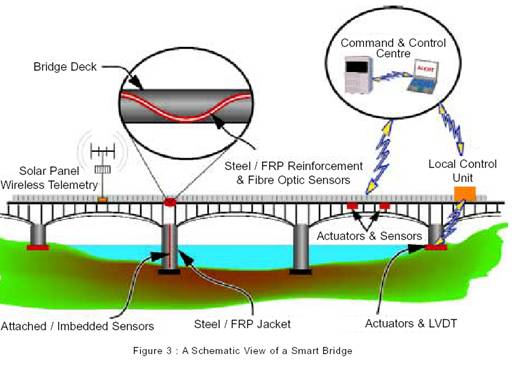
The Michelson and Mach-Zehnder types use two fibers, one to sense and one as reference. They can measure strain over lengths in the order of meters. The Fabry-Perot type, which employs a single Fibre and reflectors, is based on the interference of light between two closely spaced surfaces. The Bragg grating type exploits spectroscopy, which is based on the modulation in the index of refraction along a short length of the fibers.. Figure 3 presents in a schematic way, a section of a smart bridge8.
| Are you interested in this topic.Then mail to us immediately to get the full report.
email :- contactv2@gmail.com |
