


Published on Jan 09, 2026
Smart bombs are weapons capable of destroying enemy targets with out the need for a launch aircraft to penetrate the envelops of the air defense systems. These essentially comprise a terminal guidance unit that guides them in the last phase to achieve pinpoint accuracy. Increased accuracy means that a single, moderate-size bomb can give a better result than multiple strikes with larger, non-guided bombs.
Smart bombs are desirable both from ethical and tactical standpoints. On ethical grounds, the military desires that each warhead deployed should strike only its indented target so that innocent civilians are not harmed by misfire. From tactical standpoint, it wants weapons with pinpoint accuracy to inflict maximum damage on valid military targets and minimize the number of strikes necessary to achieve mission objectives. Gravity bombs with laser or GPS/INS guidance are smart bombs that have changed the face of modern warfare
Laser-guided bombs have an internal semi-active guidance system that detects laser energy and guides the weapon to the target illuminated by an external laser designator.Laser designators radiate a narrow beam of pulsed energy in the near infrared wavelength spectrum. These are semi active illuminators used to tag the desired spot. These can be aimed such that laser energy precisely designates the chosen spot on the target. Laser designator can be located in the delivery aircraft, another aircraft or on a ground source.
Typical LGB seekers comprise an array of photo diodes to decode the laser pulsed repetition frequency (PRF) and derive target position signals. Laser designators and seekers use a pulse coding system to ensure that a specific seeker and designator combination work in harmony. By setting the same code in both the designator and the seeker will track only the target designated by the chosen designator.
Laser designators provide precision target marking for air support. LGBs with TV or infrared seeker in their nose show the target to the attacking pilot on a screen in the cockpit. The pilot fixes cross hairs on the target and marks it for the weapon to aim at. The target scatters the received laser energy in all the directions. LGB seeker having a limited field of view receives a small part of the scattered energy and decodes it. If the received PRF code matches the preprogrammed code, the pilot fires the bomb. It then horns onto the reflected laser energy to attack the target
Some LGBs require laser target illumination before launch or release and/ or during the terminal portion of flight. The LGB flight path can be divided into three phases: ballistic, transition, and terminal guidance.
During the ballistic phase, the weapon continues on the unguided trajectory established by the flight path of the delivery aircraft at the moment of release. In this phase, the delivery altitude takes on additional importance, since maneuverability of the unguided bomb is related to the weapon velocity during terminal guidance. Therefore, airspeed lost during the ballistic phase equated to a proportional loss of maneuverability. So the closer to the target the release of the bomb, the more the accuracy of the bomb
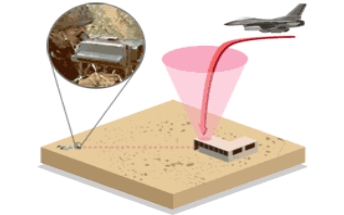
The transition phase is where initial acquisition of the designating laser takes place. During this phase, the weapon attempts to align its velocity vector with the line of sight vector to the target. Once a lock has been achieved, the guidance system uses the canards to try and keep the bomb within the cone of the reflected laser energy.
The terminal phase is when the reflected laser centers on the seeker causing the bomb to dive to the target. LGBs are excellent performers in dive deliveries initiated from medium altitude. A steep, fast dive attack increases LGB maneuvering potential and flight ability. Medium-altitude attacks generally reduce target acquisition problems and more readily allow for target designation by either ground or airborne designation platforms. Medium-altitude LGB dive delivery tactics are normally used in areas of low to medium threat.
LGBs miss the target if the laser is turned on too early: During certain delivery profiles where the LGB sees laser energy as soon as it is released, it can turn from its delivery profile too soon and miss by failing short of the target. To prevent this, the laser designator must be turned on at the time that will preclude the bomb from turning down toward the target prematurely. Normally, the pilot knows the proper moment for laser 'on'. The specific LGB and the delivery tactics of the attacking aircraft dictate the minimum designation time required to guide the weapon to the intended target.
The four basic requirements for effective use of laser designators with LGBs are:
1. The PRF code of the laser designator and the LGB must be compatible
2. A direction of attack must be determined because the LGB must be able to sense sufficient laser energy reflecting from the target being designated.
3. The laser designator must designate the target at the correct time.
4. The delivery system must release the weapon within the specific weapon's delivery envelope.
The pulse coding system ensures that only a specific designator and seeker combination works. It can be used effectively and securely with LGBs .LGB codes are set on the bombs before take off and cannot be changed in the air. Individual aircrafts may carry LGBs with different preset codes. Different preset codes allow for multiple aircraft attacks, multiple weapon release and a variation in codes for consecutive attacks.
Coding allows simultaneous attacks on multiple targets by a single aircraft, or flights of aircraft, dropping LGB set on different codes. This tactic may be employed when several high-priority targets need to be attacked expeditiously and can be designated simultaneously by the supported units. Selection of PRF code can affect the target engagement success. A higher pulse rate gives the seeker the best opportunity to acquire the target in the time available; it is appropriate for the most important targets and the most difficult operating conditions.
The normal gravity bomb, often referred to as ‘Dumb-Bomb’, can be converted into a smart bomb by adding an LGB kit to it. The kit significantly improves the accuracy of the gravity bomb, there by reducing the collateral damage. Thus all LGB weapons essentially comprise the normal cavity bomb, computer group, guidance canards and a wing assembly.
The computer control group is mounted on the nose of the bomb and is the front-end guidance system. The computer section transmits directional command signals to the appropriate pairs of canards. The guidance canards are attached to each quadrant of the control unit to change the flight path of the weapon. The computer control group detects the laser-illuminated target, decodes the laser PRF and provides weapon guidance signals to the movable guidance fins. The canards reacts to the signals received from the computer control group to direct the weapon to the target.
The wing assembly is mounted on the aft end of the bomb body. It adds necessary aerodynamic and lifts for in-flight maneuvering. An electric fuse is installed in the tail of the bomb. LGBs are maneuverable, free fall weapons requiring no electronic interconnect to the aircraft.
| Are you interested in this topic.Then mail to us immediately to get the full report.
email :- contactv2@gmail.com |
