


Published on Jan 09, 2026
Skid-steer loaders began catching on in the construction field in the 1980s because they offered contractors a way to automate functions that had previously been performed by manual labor.
Those were small, inexpensive machines that improved labor productivity and reduced work-related injuries. Their small size and maneuverability allows them to operate in tight spaces. Their light weight allows them to be towed behind a full-size pickup truck, and the wide array of work-tools makes them very flexible. They were utility machines, used for odd jobs ranging from work site clean up to small scale digging, lifting, and loading. In most cases, they logged far fewer hours of usage each year than backhoe loaders and wheel loaders, but they were cheap, and so easy to operate that anyone on a job site could deploy them with very little training.
Since then, the category has become wildly popular in all avenues of construction. They are the best-selling type of construction equipment in North America, with annual sales exceeding 50,000 units. They still tend to be low-hour machines, but, thanks to a virtually unlimited variety of attachments, skid-steer loaders can handle a huge array of small-scale jobs, from general earthmoving and material handling to post hole digging and landscaping to pavement milling and demolition.
As the machine has grown in popularity, it has become one of the hottest rental items in North America. Equipment rental houses consume roughly one-third of the new units sold each year, and most stock a wide array of attachments, too. The ready availability of rental attachments - especially high-ticket, specialty items like planers, vibratory rollers, tillers, and snow blowers and pushers - has turned the machines potential for versatility into a cost-effective reality.
As the skid-steer has become more popular in construction, the average size of the machine has grown, too. In the mid-1980s, the most popular operating load class was 900 to 1,350 pounds. By the mid-1990s, the 1,350 to 1,750 pound class was the most popular. Today, the over-1,750-pound classifications are the fastest growing.
Larger machines have dominated new product introductions, too, though our survey of recent new product announcements has turned up a spate of compact and sub-compact introductions, too. The smallest of these are ride-behind models aimed mainly at the consumer rental trade, but they are also used in landscaping and other types of light construction essentially to automate jobs that would otherwise be done by laborers with shovels.
Road contractors and government highway departments should find the new super-duty class of skid-steer loaders especially interesting. These units have retained the skid-steer's traditional simplicity of operation and compact packaging, while also boasting power and weight specifications that let them perform many of the tasks done by backhoe loaders and compact wheel loaders. Nearly all boast high-pressure, high-flow hydraulic systems to run the most sophisticated hydraulic attachments. They also feature substantial break-out force ratings for serious loading and substantial lifting capacities for material handling.
The skid-steer loader represents an interesting alternative for fleets that have low- hour backhoe loaders in inventory. Led by Bobcat, Gehl, Mustang, and other companies that make skid-steers but not backhoe loaders, skid-steer marketers have been pushing the proposition that it is more cost effective to replace a backhoe loader with a skid-steer and a mini-excavator. The rationale: for about the same amount of money, you can get more hours of utilization because you have two machines that can be working simultaneously at different jobs.
The skid steer concept was introduced by Bobcat in 1960, in response to demands for a loader that would be able to maneuver effectively in confined spaces. The method of steering and propulsion is conceptually similar to that of a tracked vehicle, the two wheels on the same side move in unison, with each pair on opposite sides capable of being driven independently. If both pairs are driven forward with the same speed, then the loader moves forward, but if they are driven in opposite directions, the loader will turn on itself. This flexibility allows incredibly compact maneuvers to be effected, and skid steer loaders are now found in a wide variety of applications including construction, agriculture and industry.
The clever aspect of the concept lies in the distribution of weight in the vehicle. When unlades, the centre of gravity lies towards the rear of the vehicle near the engine, which makes the centre of steering occur right in the middle of the rear axle, with the front wheels skidding around this. If the loader has significant weight in the bucket, the centre of gravity moves to the front of the vehicle making the rear wheels skid around the front axle. While useful in this regard, the offset distribution of weight can sometimes lead to instability, particularly when traveling up and down inclines and suddenly changing direction from reverse to forward. Counterweights are sometimes employed to help reduce this effect.
A bucket is attached to the arms and capable of being raised, lowered and dumped through mechanical or hydraulic controls. The loaders having bucket in the front, known as Front-end loaders are very common. The loaders are versatile, self propelled equipment mounted either on crawler or wheel-type running gear. These loaders are fitted with front mounted general-purpose bucket operated through hydraulic rams, with which they dig, scoop, lift, transport, carry, dump or load into hauling units, bins, hoppers, conveyors and stockpiles. With the help of additional front and rear mounted attachments these can doze, scrap, grub, forklift, trench, grade, ditch rip, clamp, and winch. Applications of a loader vary from handling coal, sugar, sand, salt, stone etc. to earth moving and digging work in quarries.
Loaders are of the following types
(a) Crawler loaders.
(b) Wheel loaders.
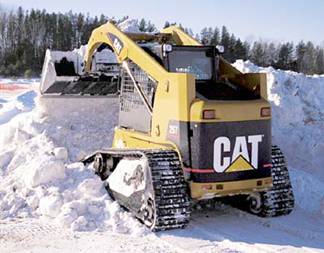
Crawler track types are generally preferred for digging and loading jobs where ground conditions are poor and low pressure characteristics are required, and are preferable for application involving rock and sharp stony ground as there is no possibility tire damage. These are best employed for short moves between loading and dumping points. These should be transported from one site to another after loading on the trailers.
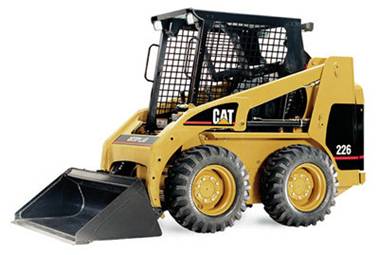
As a result of the development of more capable power trains (axles and tires), there was a steady trend towards wheel loaders at the expense of crawlers. Protective chains for tires, that considerably increases tire operating life, even in quarry applications, additionally favored the wheel loader against the rather more difficult to maneuver crawler.
Wheeled loaders are generally four wheel drive. However, for handling light jobs on good ground conditions two-wheel drive variants are also used. Four wheel drive loaders are generally used for construction jobs, whereas, two wheel drive loaders are used for bulk handling of coal, cement, fertilizer etc. into hoppers and trucks. From maneuverability point of view, wheel loaders are of following types:
(i) Articulated type (Pivot steer).
(ii) Rigid frame-two wheel steer or all wheel steer.
This type of loader is ringed in the middle of the front and rear axles, as shown in the Figure. Due to their operational characteristics and capability of working in limited space and short turning radius, resulting higher speed of work, these have become very popular. Because of the advantage of quick maneuvering and thereby easier spotting of loads, less rolling resistance on turns, better mobility on soft surface, these loaders give better performance and high productivity. The articulation permits the loader to pivot 30—45 degree either side of the centre.
In a skid steer loader and Multiterrain Loader, the power consists of a diesel engine and a set of hydraulic pumps.
Diesel engines are more efficient than gasoline engines. A skid steer loader or multiterrain Loader may operate eight or more hours every day. Over the course of a year, a 5 or 10 percent difference in efficiency can make a real difference in fuel costs.
Although the engine, cooling system and other accessories are tightly packed into the skid steer loader, the engine compartment is designed to make maintenance easy. A door on the back opens wide, and the radiator and fan tilt up to allow clear access to the engine and all of the maintenance items (such as filters).
The engines in the Caterpillar Skid Steer Loaders and Multi Terrain Loaders range from 49-horsepower (37-kilowatt), naturally aspirated diesel engine to a 74-hp (55-kW), turbocharged diesel engine. This power is transmitted to a set of hydraulic pumps bolted directly to the output of the engine.
| Are you interested in this topic.Then mail to us immediately to get the full report.
email :- contactv2@gmail.com |
