


Published on Jan 09, 2026
All of the expensive technology that goes into a fighter jet. Attack helicopter or bomber wouldn't be much use on the battlefield with out any ordnance.while there're not as expensive or complex as the military that carry them guns, missiles and bombs are pretty impressive aircraft in their own right. Smart weapons don't just sail through the air: they actually find their own way to the target.
One of the oldest and most successful smart weapons in the U.S arsenal, the legendry AIM-9 Sidewinder missile. The small and simple sidewinder is a highly effective combination of electronics and explosive power, brought together with incredible technical ingenuity.
The Sidewinder AIM-9 (air intercept missile 9) is classified as a short-range, air-to-air missile. Simply put, its job is to launch from an airborne aircraft and "kill" an enemy aircraft (damage it to the point that it goes down). Missiles like the Sidewinder are called smart weapons because they have built-in seeking systems that let them home in on a target.
The technology of smart weapons really got going in the decade following World War II. Most early guided weapon prototypes were built around radar technology, which proved to be expensive and problematic. These missiles had their own radar sensors, but obviously could not carry their own radar transmitters. For the guidance system to lock on an enemy plane, some remote radar system had to "illuminate" the target by bouncing radar beams off of it. In most cases, this meant the pilot had to keep the aircraft in a vulnerable position after firing in order to keep a radar lock on the enemy until the missile could find it. Additionally, the radar equipment in the missile was large and expensive, which made for a high-cost, bulky weapon. Most of these missiles had something around a 90 percent failure rate (nine shots out of 10 missed their targets).
In 1947, a Naval physicist named Bill McLean took it upon himself to build a better system -- a missile that would seek out the heat from an enemy aircraft's engine system. Since the missile would home in on the target's own emitted energy, rather than reflected radio energy, the pilot could "fire and forget" -- that is, he could launch the missile and get clear. In place of the bulky radar equipment, the missile would use a relatively small heat-sensing photovoltaic cell to "see" the target. This meant it could be built much smaller than the current radar prototypes, and at a much lower cost
Officially, the Navy had no interest in non-radar guidance systems, but at the China Lake, California, Naval Ordnance Test Station (NOTS) where McLean was employed, researchers had enough freedom to pursue unconventional projects. Under the guise of missile fuze development, McLean and his colleagues worked out the design of the first Sidewinder prototypes. Six years later, in September 1953, the missile had its first successful test run.
Since that time, the Sidewinder has taken a number of different forms, each model adding new technology and capabilities (check out F-16.net: AIM-9 Sidewinder for details on the specific models). While today's semiconductor guidance systems are a lot more advanced than the vacuum tubes on the original designs, the overall operation is pretty close. In the next couple of sections, we'll examine the current Sidewinder model, the AIM-9M, and also take a peek at its upcoming replacement, the AIM-9X.
As we saw in the last section, the central idea of the Sidewinder system is to home in on the heat, or infrared energy, from an enemy aircraft (from the engine exhaust or from the hot fuselage itself). Essentially, the missile's job is to keep flying toward the infrared energy until it reaches the target. Then the missile blows up, destroying the enemy aircraft.
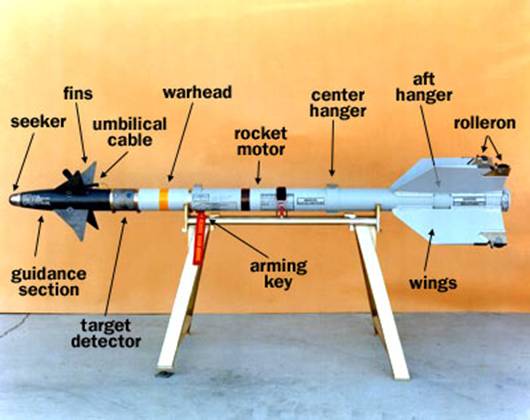
To do all of this, the Sidewinder needs nine major components:
• The rocket motor, which provides the thrust to propel the missile through the air
• The rear stabilizing wings, which provide the necessary lift to keep the missile aloft
• The seeker, which sees the infrared light from the target
• The guidance control electronics, which process the information from the seeker and calculate the proper course for the missile
• The control actuation section, which adjusts flight fins near the nose of the missile based on instructions from the guidance electronics
• The flight fins themselves, which steer the missiles through the air -- just like the flaps on an airplane wing, the moving flight fins generate drag (increase wind resistance) on one side of the missile, causing it to turn in that direction.
• The warhead, the explosive device that actually destroys the enemy aircraft
• A fuze system that sets the warhead off when the missile reaches the target
• A battery to provide power to the onboard electronics
• Length: 9 feet, 5 inches (~2.9 m)
• Diameter: 5 inches (~13 cm)
• Weight: 188 pounds (~85 kg)
• Finspan: 2 feet, 3/4 of an inch (~63 cm)
• Cost: $84,000
• Top Speed: Mach 2.5
• Range: 18 miles (~29 km)
To see how all these pieces work together, let's examine a typical attack sequence.
Before launching, the missile sits under one of the aircraft's wings, mounted to a launcher on the wing by several hangers. An "umbilical cable" near the nose of the missile connects the onboard electronic control system to the aircraft's computer system. When the pilot gets the plane in position -- ideally, behind the enemy -- he or she activates the fire control. The aircraft computer sends a command to the missile control system to activate the Mk 36 rocket motor and release the missile.
The rocket motor burns up solid propellant material to generate a high-pressure gas that streams out the back of the missile (the motor uses special low-smoke propellant material to help hide the missile from the enemy). This provides the initial thrust necessary to get the missile off the launcher and push it through the air at supersonic speeds (the current model flies at about Mach 2.5). Once the propellant has burned up, the missile glides the rest of the way to its target. Each of the four rear wings, which provide the necessary lift to keep the missile flying, is outfitted with a simple stabilizing device called a rolleron. Basically, a rolleron is a metal wheel with notches cut into it. As the missile speeds through the air, the air current spins the rolleron like a pinwheel.
The rollerons on the rear wings help stabilize the missile in flight.
If you've read How Gyroscopes Work, you know that a spinning wheel resists lateral forces acting on it. In this case, the gyroscopic motion counteracts the missile's tendency to roll -- to rotate about its central axis. The simple, cheap rollerons steady the missile as it zips through the air, which keeps the seeker assembly from spinning at top speed.
| Are you interested in this topic.Then mail to us immediately to get the full report.
email :- contactv2@gmail.com |
