

Published on Jan 09, 2026
Sensotronic Brake Control (SBC™) works electronically, and thus faster and more precisely, than a conventional hydraulic braking system. As soon as you press the brake pedal and the sensors identify the driving situation in hand, the computer makes an exact calculation of the brake force necessary and distributes it between the wheels as required.
This allows SBC™ to critically reduce stopping distances. SBC™ also helps to optimise safety functions such as ESP®, ASR, ABS and BAS.
With Sensotronic Brake Control, electric impulses are used to pass the driver's braking commands onto a microcomputer which processes various sensor signals simultaneously and, depending on the particular driving situation, calculates the optimum brake pressure for each wheel. As a result, SBC offers even greater active safety than conventional brake systems when braking in a corner or on a slippery surface.
A high-pressure reservoir and electronically controllable valves ensure that maximum brake pressure is available much sooner. Moreover, the system offers innovative additional functions to reduce the driver's workload. These include Traffic Jam Assist, which brakes the vehicle automatically in stop-and-go traffic once the driver takes his or her foot off the accelerator. The Soft-Stop function - another first - allows particularly soft and smooth stopping in town traffic
When drivers hit the brake pedal today, their foot moves a piston rod which is linked to the brake booster and the master brake cylinder. Depending on the pedal force, the master brake cylinder builds up the appropriate amount of pressure in the brake lines which - in a tried and tested interaction of mechanics and hydraulics - then presses the brake pads against the brake discs via the wheel cylinders.
By contrast, in the Mercedes-Benz Sensotronic Brake Control, a large number of mechanical components are simply replaced by electronics. The brake booster will not be needed in future either. Instead sensors gauge the pressure inside the master brake cylinder as well as the speed with which the brake pedal is operated, and pass these data to the SBC computer in the form of electric impulses. To provide the driver with the familiar brake feel, engineers have developed a special simulator which is linked to the tandem master cylinder and which moves the pedal using spring force and hydraulics.
In other words: during braking, the actuation unit is completely disconnected from the rest of the system and serves the sole purpose of recording any given brake command. Only in the event of a major fault or power failure does SBC automatically use the services of the tandem master cylinder and instantly establishes a direct hydraulic link between the brake pedal and the front wheel brakes in order to decelerate the car safely.
The central control unit under the bonnet is the centrepiece of the electrohydraulic brake. This is where the interdisciplinary interaction of mechanics and electronics provides its greatest benefits - the microcomputer, software, sensors, valves and electric pump work together and allow totally novel, highly dynamic brake management:
In addition to the data relating to the brake pedal actuation, the SBC computer also receives the sensor signals from the other electronic assistance systems.
For example, the anti-lock braking system (ABS) provides information about wheel speed, while Electronic Stability Program (ESP®) makes available the data from its steering angle, turning rate and transverse acceleration sensors. The transmission control unit finally uses the data highway to communicate the current driving range. The result of these highly complex calculations is rapid brake commands which ensure optimum deceleration and driving stability as appropriate to the particular driving scenario. What makes the system even more sophisticated is the fact that SBC calculates the brake force separately for each wheel.
Sensotronic Brake Control (SBC) is the name given to an innovative electronically controlled brake system which Mercedes-Benz will fit to future passenger car models. Following on from the Mercedes innovations ABS, ASR, ESP® and Brake Assist, this system is regarded as yet another important milestone to enhance driving safety. With Sensotronic Brake Control electric impulses are used to pass the driver’s braking commands onto a microcomputer which processes various sensor signals simultaneously and, depending on the particular driving situation, calculates the optimum brake pressure for each wheel.
As a result, SBC offers even greater active safety than conventional brake systems when braking in a corner or on a slippery surface. A high-pressure reservoir and electronically controllable valves ensure that maximum brake pressure is available much sooner. Moreover, the system offers innovative additional functions to reduce the driver’s workload. These include Traffic Jam Assist, which brakes the vehicle automatically in stop-and-go traffic once the driver takes his or her foot off the accelerator. The Soft-Stop function – another first – allows particularly soft and smooth stopping in town traffic.
Mechatronics – a new term is gaining popularity within the automotive industry and is rapidly developing into the catchword of a quiet technological revolution which in many fields stands century-old principles on their head. Mechatronics brings together two disciplines which in many cases were thought to be irreconcilable, namely mechanics and electronics.
Hence automobile functions which hitherto worked purely mechanically and partly with hydraulic assistance will in future be controlled by high-performance microcomputers and electronically controllable actuators. These either replace the conventional mechanical components or else enhance their function. The mechatronic interplay therefore opens up hitherto inconceivable possibilities to further raise the safety and comfort levels of modern passenger cars.
For example: it was only possible through mechatronics that an electronically controlled suspension system which instantly adapts to prevailing conditions when driving off, braking or cornering -- thus providing a totally new driving experience -- became a reality. In 1999 Mercedes-Benz launched this system under the name Active Body Control (ABC) in the flagship CL coupé, thereby signalling the advent of a new era of suspension technology.
This electronically controlled suspension system will quickly be followed by the electronic brake system: Mercedes-Benz and Bosch have teamed up on this benchmark development project which will shortly enter into series production at the Stuttgart automobile brand under the name Sensotronic Brake Control -- or SBC for short.
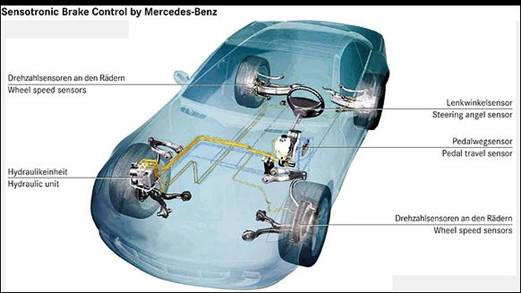
It turns the conventional hydraulic brake into an even more powerful mechatronic system. Its microcomputer is integrated into the car’s data network and processes information from various electronic control units. In this way, electric impulses and sensor signals can be instantly converted into braking commands, providing a marked safety and comfort gain for drivers.
To turn to the technical side: when drivers hit the brake pedal today, their foot moves a piston rod which is linked to the brake booster and the master brake cylinder. Depending on the pedal force, the master brake cylinder builds up the appropriate amount of pressure in the brake lines which – in a tried and tested interaction of mechanics and hydraulics - then presses the brake pads against the brake discs via the wheel cylinder.
In the Mercedes-Benz Sensotronic Brake Control, by contrast, a large number of mechanical components are simply replaced by electronics. The brake booster will not be needed in future either. Instead sensors gauge the pressure inside the master brake cylinder as well as the speed with which the brake pedal is operated, and pass these data to the SBC computer in the form of electric impulses.
To provide the driver with the familiar brake feel engineers have developed a special simulator which is linked to the tandem master cylinder and which moves the pedal using spring force and hydraulics. In other words: during braking the actuation unit is completely disconnected from the rest of the system and serves the sole purpose of recording any given brake command. Only in the event of a major fault or power failure inside the 12V vehicle battery does SBC automatically use the services of the tandem master cylinder and instantly establishes a direct hydraulic link between the brake pedal and the front wheel brakes in order to decelerate the car safely.
| Are you interested in this topic.Then mail to us immediately to get the full report.
email :- contactv2@gmail.com |
