

Published on Jan 09, 2026
Selective Laser Sintering is a new type of mechanism designed to transform progressive motion into rotary motion. The term "Selective Laser Sintering" is only a temporary name given to the mechanism and the mechanism has not yet been given iRapid Prototyping (RP) can be defined as a group of techniques used to quickly fabricate a scale model of a part or assembly using three-dimensional computer aided design (CAD) data.
What is commonly considered to be the first RP technique, selective laser sintering was patented by CARL DECKARD A UNIVERSITY OF TEXAS GRADUATE STUDENT.
The company was founded in 1989, and since then, a number of different RP techniques have become available. Rapid Prototyping has also been referred to as solid free-form manufacturing; computer automated manufacturing, and layered manufacturing. RP has obvious use as a vehicle for visualization. In addition, RP models can be used for testing, such as when an airfoil shape is put into a wind tunnel.
RP models can be used to create male models for tooling, such as silicone rubber molds and investment casts. In some cases, the RP part can be the final part, but typically the RP material is not strong or accurate enough. When the RP material is suitable, highly convoluted shapes (including parts nested within parts) can be produced because of the nature of RP.There is a multitude of experimental RP methodologies either in development or used by small groups of individuals.
The reasons of Rapid Prototyping are
" To increase effective communication.
" To decrease development time.
" To decrease costly mistakes
" To minimize sustaining engineering changes.
" To extend product lifetime by adding necessary features and eliminating redundant features early in the design.
Rapid Prototyping decreases development time by allowing corrections to a product to be made early in the process. By giving engineering, manufacturing, marketing, and purchasing a look at the product early in the design process, mistakes can be corrected and changes can be made while they are still inexpensive. The trends in manufacturing industries continue to emphasize the following
" Increasing number of variants of products.
" Increasing product complexity.
" Decreasing product lifetime before obsolescence.
" Decreasing delivery time.
Rapid Prototyping improves product development by enabling better communication in a concurrent engineering environment.
" It is patented in 1989.
" Considerably stronger than stereo lithography.
" Laser beam selectively fuses powder materials; nylon, elastomers and so on metals.
" Process is simple.
" There is no milling or masking steps required.
" Powdering, porous surface unless sealant is used. Sealant also strengthens the part.
" Uncured materials are easily removed after a build by brushing of.
The selective laser sintering is a free form fabrication method to create components by precise thermal fusing (sintering) of powdered materials. Parts of complex geometries can build in successive layers that define subsequent cross sections of the component.
The sinter powder is powder fed to the process chamber from two cartridges flanking the partly built product. This allows for bidirectional powder feeding to the roller that lays powder across the top of the product, thus improving building speed. Unsintered powder is returned to the powder feeding cartridges, to be recycled. The process is a CO2 type of 50watt power. The process chamber is filled with nitrogen to obtain safe materials sintering conditions.
The SLS technology uses a CO2 laser to sinter (fuse) a variety of thermoplastic and metal powders to "grow" 3D objects layer-by-layer from 3D electronic data (STL files). Because this is an additive process, highly complex geometries can be built without issue; and, because the powder holds the parts, no support structures have to be added and removed. The key advantage of SLS is its ability to rapidly produce durable, functional objects for a wide variety of applications.
Working parts and assemblies with good detail and surface finishing
• Variety of material: rigid and flexible plastics, fully dense metal, rubber-like elastomer, foundry friendly patterns
• Capable of living hinges, high-flex snaps, high stress and heat tolerance and service as short-run tooling
• Can be finished and painted for presentation, demonstration and video reproduction
• Dimensional tolerancing with thousandths of a inch
• Delivery of most parts and patterns in just a few working days
Selective Laser Sintering (SLS) parts are built with successive layers of powder selectively bound by a laser beam.
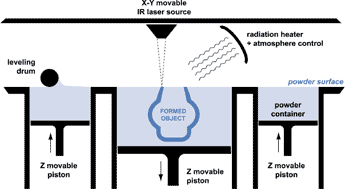
SLS is also a technique by which parts are built layer by layer. The basic material consists of powder with particle sizes in the order of magnitude of 50 µm. Successive powder layers are spread on top of each other. After deposition, a computer controlled CO2 laser beam scans the surface and selectively binds together the powder particles of the corresponding cross section of the product. During laser exposure, the powder temperature rises above the glass transition point after which adjacent particles flow together. This process is called sintering.
The parts are built in polyamide (PA). The powder being a solid material has an attractive feature of being self supporting for the generated product sections. This makes supports redundant. The polyamide material allows the production of fully functional prototypes with high mechanical and thermal resistance. The use of PA powder filled within glass particles (PA-GF) has a much higher thermal resistance and is typically used in functional test with high loads.
The polyamide SLS parts have excellent long term stability and are resistant against most chemicals. They can be made water tight by impregnation. The PA material is used as bio compatible, food safe and not harmful to health or environment.
| Are you interested in this topic.Then mail to us immediately to get the full report.
email :- contactv2@gmail.com |
