

Published on Jan 09, 2026
The successful exploration of space requires a system that will reliably transport payload such as personnel and instrumental etc. into space and return them back to earth without subjecting them an uncomfortable or hazardous environment. In other words, the spacecraft and its payloads have to be recovered safely into the earth. We have seen the re-entry capsules and winged space vehicles approach the earth followed by safe landing.
However, this could be accomplished only after considerable research in high speed aerodynamics and after many parametric studies to select the optimum design concept.
Re-entry systems were among the first technologies developed in 1960s for military photo-reconnaissance, life science and manned space flights. By 1970s, it led to the development of new refurbish able space shuttles. Today space technology has developed to space planes which intend to go and come back regularly from earth to space stations. USA's HERMS and Japan's HOPE is designed to land at conventional airports. Few significant advances in current proposed re-entry capsules are ballistic designs to reduce development and refurbishable cost, to simplify operations.
For entering into atmospheric and non-atmospheric planet the problem involves is reducing the spacecraft's speed . For an atmospheric planet the problem involves essentially deceleration, aerodynamic heating, control of time & location of landing. For non-atmospheric planets, the problem involves only deceleration and control of time & location of landing.
The vehicle selected to accomplish a re-entry mission incorporates a thick wing , subsonic ( Mach < 1 ) airfoil modified to meet hypersonic (Mach>> 1 ) thermodynamic requirements. The flight mechanics of this vehicle are unique in that rolling manoeuvres are employed during descent such that dynamic loading and aerodynamic heating are held to a minimum.
Therefore re-entry technology requires studies in the following areas:
1. Deceleration
2. Aerodynamic heating & air loads
3. Vehicle stability
4. Thermal Protection Systems (TPS)
5. Guidance and Landing.
Re-entry mission profile, constraints And vehicle requirements
The safe recovery of the spacecraft and its payloads is made possible by the re-entry mission. According to the different constraints the mission profile can be divided into three distinct flight segments:-
1. Deorbit and Descent to sensible atmosphere at an altitude of nearly 120kms.
2. Re-entry and hypersonic glide fight.
3. Transition flight phase, final approach and landing.
The unguided first flight segment (Keplarian trajectory) initiated by a rocket deboost maneuver at a specific orbital point determines the flight condition at re-entry. The second flight segment covers the atmospheric glide at an altitude of 120 km to 30 km during which the re-entry vehicle's high initial kinetic energy is dissipated by atmospheric breaking. The third flight segment does the final approach and landing.
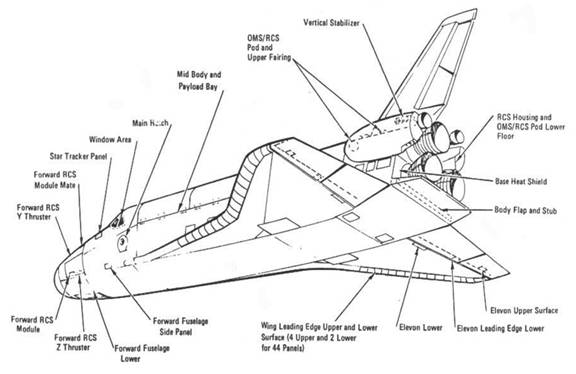
The various forces acting on the re-entry vehicle are:-
1. Gravitational force acting towards the centre of the planet.
2. Gas dynamic force opposite to the direction of motion of the vehicle.
3. Centrifugal and gas dynamic lift force acting normal to the direction of
4. motion of the vehicle.
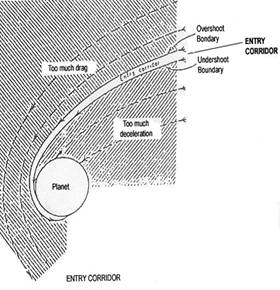
An entry corridor is a range of entry conditions within which an entry is possible. The ‘undershoot’ boundary and ‘overshoot’ boundary forms the upper and the lower limits of the entry corridor. Terrestrial flights are tolerant of guidance error accompanying a landing approach. An undershoot may cause destruction of vehicle during entry and an undershoot may result in a homeless exit to space.
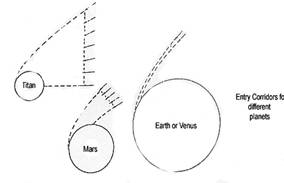
Figure shows the explanation of entry corridor and possible path for vehicle with lift to Venus, Mars, and Titan.
If the guidance error results in an excessive undershoot as shown by the two dashed trajectories, the vehicle will enter the atmosphere at an excessively steep angle, thereby experiencing too much deceleration. If the guidance error results in an excessive overshoot as shown by the two outer dashed trajectories, the vehicle will not slow down considerably in order to complete entry in a single pass. Hence the shaded portions representing excessively overshoot and undershoot are excluded as not representing the intended entry manoeuvre.
Although overshoot at hyperbolic velocity > (2gRo)1/2 may result in a homeless exit to space, overshoot at the outer corridor at parabolic speed = (2gRo)1/2 or at an elliptical speed < (2gRo)1/2 or at an elliptical speed , (2gRo)1/2 will result in a multipass entry.
Overshoot passage was considered a good way to came back from moon or more distant planets. Each pass through the atmosphere would slow down the vehicle a little , so that it would return in a series of successively shorter ellipses. In this way the heat problem would be solved, heat taken on each approach being radiated during the next outward journey.
When either truly circular entry is made inside entry corridor or final entry is made through multipass scheme, the descent trajectory through the atmosphere is similar to entry from a satellite orbit, namely ballistic path, glide path or slip path.
The width of entry corridor (rp) for non-lifting (L/D<0) and lifting (L/D>1) entry into various planetary atmosphere is given in the table below for entry at planetary velocity (2gro)1/2.
The major concern of re-entry is to find a way to survive the aerodynamic heating. This obstacle was named as the ‘Thermal Barrier’. A vehicle approaching the earth or a planetary atmosphere from space or from orbit possesses a large amount of kinetic energy due to its speed and potential energy by virtue of its position. These energies have to be dissipated and converted into heat to decelerate the vehicle to zero velocity and altitude. From speed of 8 Km/s to energy per mass of 31.4 MJ/Kg must be dissipated.
At high speed associated with re-entering from space, air cannot flow out of the way of the on rushing spacecraft fast enough. When the vehicle encounters the atmosphere a shock will from ahead of the nose of the vehicle heating the atmosphere in this region to a very high temperature. As the vehicle plunges into deeper and denser atmosphere the vehicle will increasingly be heated by the enveloping layer of incandescent atmosphere, while the speed of the vehicle will continuously be reduced by the braking force of the atmosphere. In this manner the vehicle’s K.E is converted into heat. If all the vehicle’s energy were converted to heat within the vehicle itself, it would be more than enough to vaporize the vehicle.
There are two ways in which the total energy is dissipated from the vehicle. They are:
i. By waves unloading major part of the heat on the atmosphere by the shock waves.
ii. To radiate heat away from hot surface of the vehicle.
Figure shows the shock wave formed fir blunt and streamlined configurations.
The diversion of heat by strong shock waves is the result of molecular interaction in the gas around the vehicle. When molecules strike the forward surface they bounce back. Many of the rebounding particles collide with the oncoming molecules diverting them from the surface and preventing them by heating it by direct impact. A blunt nose produces the strongest shock wave. Since the fraction of the total heat load that is transferred is directly proportional to the strength of the shock waves the stronger the shock wave, the smaller the frictional component introduced into the body. For the reason, the entry vehicle is given a blunt shape rather than a streamlined configuration that has been elastic solution to aerodynamic heating at lower speed.
| Are you interested in this topic.Then mail to us immediately to get the full report.
email :- contactv2@gmail.com |
