

Updated on May 29, 2026
In the past two decades it is estimated that disasters are responsible for about 3 million deaths worldwide, 800million people adversely affected, and property damage exceeding US$50 billion. The recent earthquake in Turkey in November of 1999 left 700 dead and 5000 injured. Many of these deaths were from structural collapse as buildings fell down onto people.
Urban Search and Rescue involves the location, rescue (extrication), and initial medical stabilization of victims trapped in confined spaces. Voids formed when a buildings collapse is one instance of a confined space.
Urban Search and Rescue may be needed for a variety of situations, including earthquakes, hurricanes, tornadoes floods, fires, terrorist activities, and hazardous materials (hazmat) accidents. Currently, a typical search and rescue team is composed of about ten people, including canine handlers and dogs, a paramedic, a structural engineer, and various specialists in handling special equipment to find and extract a victim. Current state of the art search equipment includes search cameras and listening devices. Search cameras are usually video cameras mounted on some device like a pole that can be inserted into gaps and holes to look for signs of people. Often a hole is bored into the obstructing walls if a void is suspected to exist on the other side.
Thermal imaging is also used. This is especially useful in finding warm bodies that have been coated with dust and debris effectively camouflaging the victim. The listening devices are highly sensitive microphones that can listen for a person who may be moving or attempting to respond to rescuers calls. This hole process can take many hours to search one building. If a person is found extrication can take even longer. This paper presents the developments of a modular robot system towards USAR applications as well as the issues that would need to be addressed in order to make such a system practical.
This section presents multisensor-based online path planning of a serpentine robot in the unstructured, changing environment of earthquake rubble during the search of living bodies. The robot presented in this section is composed of six identical segments joined together through a two-way, two degrees-of- freedom (DOF) joint enabling yaw and pitch rotation (Fig.), while our prototype mechanism (to be discussed later in this article) is made of ten joints with 1 DOF each.
The robot configuration of this section results in 12 controllable DOF. An ultrasound sensor, used for detecting the obstacles, and a thermal camera are located in the first segment (head). The camera is in a dust free, anti shock casting and operates intermittently when needed
The modified distance transform (MDT) is the original distance transform method modified for snake robot such that the goal cell is turned in to a valley of zero values within which the serpentine robot can nest. Other modifications are also made to render the method on line
" Distance transform is first computed for the line of sight directed towards the intermediate goal, without taking into account sensorial data about obstacles and free space. This is the goal-oriented planning.
" The obstacle cells are superimposed on the cellular workspace. This modification to the original distance transform integrates IR data that represent the obstacles are assigned high values
This section presents multisensor-based online path planning of a serpentine robot in the unstructured, changing environment of earthquake rubble during the search of living bodies. The robot presented in this section is composed of six identical segments joined together through a two-way, two degrees-of- freedom (DOF) joint enabling yaw and pitch rotation (Fig.), while our prototype mechanism (to be discussed later in this article) is made of ten joints with 1 DOF each.
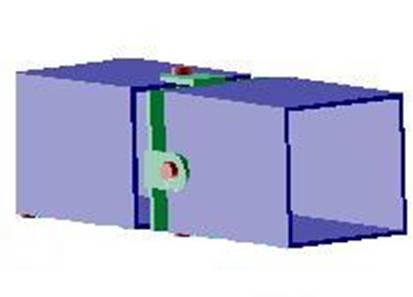
The robot configuration of this section results in 12 controllable DOF. An ultrasound sensor, used for detecting the obstacles, and a thermal camera are located in the first segment (head). The camera is in a dust free, anti shock casting and operates intermittently when needed. Twelve infrared (IR) sensors (Six pairs) are located on the left and right of the joints of the robot along its body
The modified distance transform (MDT) is the original distance transform method modified for snake robot such that the goal cell is turned in to a valley of zero values within which the serpentine robot can nest. Other modifications are also made to render the method on line
• Distance transform is first computed for the line of sight directed towards the intermediate goal, without taking into account sensorial data about obstacles and free space. This is the goal-oriented planning.
• The obstacle cells are superimposed on the cellular workspace. This modification to the original distance transform integrates IR data that represent the obstacles are assigned high values.
This modification of partitioning the distance transform (DT) application into goal oriented and range-data oriented speeds up the planning considerably, rendering it online. It is also observed that DT performed for an intermediate goal at an angular displacement from the line of sight different than zero angle displacement first. Then, the resultant workspace matrix is rotated by the required goal angle. Since the matrix resolution is finite (in our case 100*100), some cells remain unassigned. Therefore, we pass the matrix through a median filter that removes glitches in local map caused by un assigned cells.
The major aim of the serpentine search robot is to find and identify living beings under rubble and lock onto their signals until they are reached. Therefore, local map building is an essential component of our path planning approach. Since the objects in the rubble environment are expected to change position and orientation, the local map is used to find the next desired position of the robot on its way to a goal, the living being, placed in an initially unknown but detected location.
The ultrasound sensor scans to determine obstacles and free space and develops a local map. Thus, sensory data constructs a local map within this sensor range. After the local map is obtained, the next possible intermediate goals are found by considering points that are at the middle of the arcs representing free space. The intermediate goal is selected from the candidate next states by considering the directions of the candidate states relative to the robot’s head.
In real applications, the direction that gives the highest signal energy (thermal, sound) received from the goal (living being) is selected as an intermediate goal. The intermittent function of the camera is also used for choosing the most appropriate intermediate goal. However, in the simulation here, we represent, for illustrative purposes, the magnitude of the signals coming from the main goal as inversely proportional to the distance between sensor and goal.
| Are you interested in this topic.Then mail to us immediately to get the full report.
email :- contactv2@gmail.com |
