

Published on Nov 30, 2023
Shotcrete is the sprayed concrete, which was first used in Pennsylvania, USA in 1907 by Dr.Aneley. The technology is improving giving us enhanced comforts and the task is completed with a greater economy in terms of both time and investment. This innovative technology of shotcrete was introduced to make the work easier and immediate where any alterations are to be made or any architectural effects are to be enhanced.
Shortcreting has proved to be the best method for construction of curved surfaces. Domes are now much easier to construct with the advent of shotcrete technology. Tunnel linings are also becoming easy with this technology. Not only are these but there a wide range of applications where this technology has been a leading one. This technical paper includes the concept of shotcrete and how it differs from conventional concrete. It also enumerates the different types of process involved in shotcreting i.e. dry mix process and wet mix process. Advantages of shotcrete and its applications in various fields like tunneling, canals, buildings etc. are specified in detail. This paper presents an overview of shotcreteing technology along with its applications.
Unlike conventional concrete, which is first placed and then compacted in the second operation, shotcrete undergoes placement and compaction at the same time due to the force with which it is projected from the nozzle. Shotcrete is more dense, homogeneous, strong, and waterproof than is possible to obtain by any other process. For most bridges original concrete will require additional repair long before shotcrete needs repair and it suffers little detoriations. Shotcrete is not placed or contained by forms. It can be impacted onto any type or shape of surface, including vertical or overhead areas. It forms an excellent bond with the substrate and can be given a variety of surface finishes.
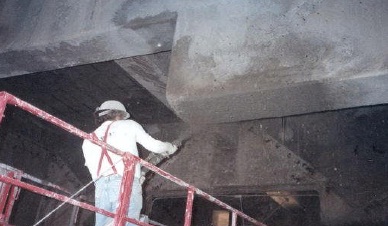
There are two classifications of shotcrete namely- 1. Dry process 2. Wet process They are discussed below.
Working of dry process proceeds as per the following steps:
Step1: Pre blended, dry or semi-dampened materials are placed into shotcrete equipment and metered into a hose.
Step2: Compressed air conveys materials at high velocity to the nozzle where the water is added.
Step3: Then the material is consolidated on receiving surface by high impact velocity.
The dry process can be used for any shotcreting applications from the smallest patching and sealing works to largest projects like tunnel linings, pools, canal linings or reservoirs. The maximum production achievable with dry process equipment ranges from 10-12 yards per hour of dry mix depending on the conditions. To achieve ultimate capacity it is necessary to use 2”-2.5” hose and larger compressors. Most applications have production rates of 2-6 cubic yards per hour of mix. Patching and sealing are done at even low rates by employing 1”-1.5” hoses. In dry process rebound and over spray should be considered.
Easy start up, shutdown and clean up.
Control of materials is on site.
Nozzle man can be up to 1000ft horizontally or 500ft vertically from the gun.
Working of wet process proceeds as per the following steps:
Step1: All ingredients, including water, are thoroughly mixed and introduced into the shotcrete equipment.
Step 2: Wet material is pumped to the nozzle where compressed air is introduced to provide high velocity for placement and consolidation of the material onto the receiving surface.
Step 3: Mostly wet-process shotcreting is done with premixed mortar or small aggregate concrete.
The mix design and consistency of supply are very important in order to provide a mix with the workability or plasticity to be pumped through a small-diameter hose. Sand gradation is the same as for the dry process and for coarse aggregate mixes; 20-30 percent of 3/8" aggregate is added. Cement content will vary according to the aggregate gradation and surface area. However, most mixes contain approximately 700 pounds or more of cement.
Little or no formwork is required.
Cost effective method for placing concrete.
Ideal for irregular surface applications
Allows for easier material handling in areas with difficult access
The use of Shotcrete to build new concrete structures as well as to restore and repair existing structures is well known and documented and it is perhaps the most diverse method available for concrete construction. The use of this innovative technology is increasing day by day and procedures for its proper performance are well developed and high quality work is regularly obtained.
| Are you interested in this topic.Then mail to us immediately to get the full report.
email :- contactv2@gmail.com |
