


Updated on May 29, 2026
A type of flat-panel display that works by sandwiching a neon/xenon gas mixture between two sealed glass plates with parallel electrodes deposited on their surfaces. The plates are sealed so that the electrodes form right angles, creating pixels. When a voltage pulse passes between two electrodes, the gas breaks down and produces weakly ionized plasma, which emits UV radiation. The UV radiation activates color phosphors and visible light is emitted from each pixel.
Also called "gas discharge display," a flat-screen technology that uses tiny cells lined with phosphor that are full of inert ionized gas (typically a mix of xenon and neon). Three cells make up one pixel (one cell has red phosphor, one green, one blue). The cells are sandwiched between x- and y-axis panels, and a cell is selected by charging the appropriate x and y electrodes. The charge causes the gas in the cell to emit ultraviolet light, which causes the phosphor to emit color. The amount of charge determines the intensity, and the combination of the different intensities of red, green and blue produce all the colors required.
Today, Plasma displays are becoming more and more popular. Compared to conventional CRT displays, plasma displays are about one-tenth the thickness--around 4'', and one-sixth the weight--less than 67 pounds for a 40" display. They use over 16 million colors and have a 160 degree-viewing angle. Companies such as Panasonic, Fujitsu, and Pioneer manufacture plasma displays.
Plasma displays were initially monochrome, typically orange, but color displays have become very popular and are used for home theater and computer monitors as well as digital signs.
The plasma technology is similar to the way neon signs work combined with the red, green and blue phosphor technology of a CRT. Plasma monitors consume significantly more current than LCD-based monitors.
The central element in a fluorescent light is a plasma, a gas made up of free-flowing ions (electrically charged atoms) and electrons (negatively charged particles). Under normal conditions, a gas is mainly made up of uncharged particles. That is, the individual gas atoms include equal numbers of protons (positively charged particles in the atom's nucleus) and electrons. The negatively charged electrons perfectly balance the positively charged protons, so the atom has a net charge of zero.
If you introduce many free electrons into the gas by establishing an electrical voltage across it, the situation changes very quickly. The free electrons collide with the atoms, knocking loose other electrons. With a missing electron, an atom loses its balance. It has a net positive charge, making it an ion.
In a plasma with an electrical current running through it, negatively charged particles are rushing toward the positively charged area of the plasma, and positively charged particles are rushing toward the negatively charged area.
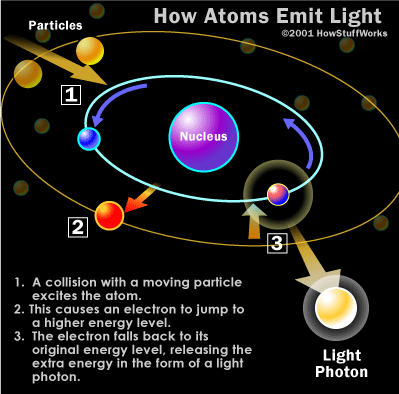
In this mad rush, particles are constantly bumping into each other. These collisions excite the gas atoms in the plasma, causing them to release photons of energy.
Xenon and neon atoms, the atoms used in plasma screens, release light photons when they are excited. Mostly, these atoms release ultraviolet light photons, which are invisible to the human eye. But ultraviolet photons can be used to excite visible light photons
The xenon and neon gas in a plasma television is contained in hundreds of thousands of tiny cells positioned between two plates of glass. Long electrodes are also sandwiched between the glass plates, on both sides of the cells. The address electrodes sit behind the cells, along the rear glass plate. The transparent display electrodes, which are surrounded by an insulating dielectric material and covered by a magnesium oxide protective layer, are mounted above the cell, along the front glass plate.
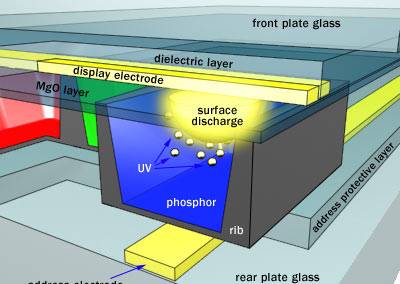
Both sets of electrodes extend across the entire screen. The display electrodes are arranged in horizontal rows along the screen and the address electrodes are arranged in vertical columns. As you can see in the diagram below, the vertical and horizontal electrodes form a basic grid.
Plasma display technology is a new "emmissive" flat panel display technology which gives you the rich, accurate color fidelity of conventional Cathode Ray Tube (CRT) monitors in a large display that is thin enough to hang on the wall. It's the best way to achieve flat panel displays with excellent image quality and large screen sizes viewable in any environment. This technology known as "plasmavision" is an array of cells, known as pixels, which are composed of 3 sub-pixels, corresponding to the colors red, green and blue.
Gas in a plasma state is used to react with phosphors in each sub-pixel to produce colored light (red, green or blue). These phosphors are the same types used in conventional cathode ray tube (CRT) devices such as televisions and standard computer monitors. You get the rich, dynamic colors you expect. Each subpixel is individually controlled by advanced electronics to produce over 16 million different colors. You get perfect images that are easily viewable in a display that is less than 4 inches thick.
Step 1: Address electrode causes gas to change to plasma state. Step 2: Gas in plasma state reacts with phosphors in discharge region. Step 3: Reaction causes each subpixel to produce red, green, and blue light.
Basic plasma display technology has been around since the 1960's, and works this way: a mixture of neon and xenon gas fills the space between two parallel sheets of glass, which contain millions of tiny cells filled with the gas mixture. This mixture is stimulated by electrical current and is changed into a plasma. As a result, ultraviolet (UV) light is emitted. Red, blue, and green fluorescent substances in the cells absorb this UV light, then re-radiate this energy as visible light to produce the colors and images you see on the screen.
This process creates a bright, vibrant picture. And since these individual cells are creating light and color, there's no need for the large cathode ray tubes (CRT's) used in conventional and projection TV's, and the display can be very thin and relatively lightweight. Plus, the flat screen eliminates the problem of images bending at the edge of the picture, as seen in conventional TV's.
| Are you interested in this topic.Then mail to us immediately to get the full report.
email :- contactv2@gmail.com |
