
Updated on May 29, 2026
The first use of Audio-Animatronics was for Walt Disney's Enchanted Tiki Room in Disneyland, which opened in June, 1963. The Tiki birds were operated using digital controls; that is, something that is either on or off. Tones were recorded onto tape, which on playback would cause a metal reed to vibrate. The vibrating reed would close a circuit and thus operate a relay.
The relay sent a pulse of energy (electricity) to the figure's mechanism which would cause a pneumatic valve to operate, which resulted in the action, like the opening of a bird's beak. Each action (e.g., opening of the mouth) had a neutral position, otherwise known as the "natural resting position" (e.g., in the case of the Tiki bird it would be for the mouth to be closed). When there was no pulse of energy forthcoming, the action would be in, or return to, the natural resting position.
This digital/tone-reed system used pneumatic valves exclusively--that is, everything was operated by air pressure. Audio-Animatronics' movements that were operated with this system had two limitations. First, the movement had to be simple--on or off. (e.g., The open and shut beak of a Tiki bird or the blink of an eye, as compared to the many different positions of raising and lowering an arm.)
Second, the movements couldn't require much force or power. (e.g., The energy needed to open a Tiki Bird's beak could easily be obtained by using air pressure, but in the case of lifting an arm, the pneumatic system didn't provide enough power to accomplish the lift.) Walt and WED knew that this this pneumatic system could not sufficiently handle the more complicated shows of the World's Fair. A new system was devised.
In addition to the digital programming of the Tiki show, the Fair shows required analog programming. This new "analog system" involved the use of voltage regulation. The tone would be on constantly throughout the show, and the voltage would be varied to create the movement of the figure. This "varied voltage" signal was sent to what was referred to as the "black box." The black boxes had the electronic equipment that would receive the signal and then activate the pneumatic and hydraulic valves that moved the performing figures.
The use of hydraulics allowed for a substantial increase in power, which was needed for the more unwieldy and demanding movements. (Hydraulics were used exclusively with the analog system, and pneumatics were used only with the tone-reed/digital system.)
There were two basic ways of programming a figure. The first used two different methods of controlling the voltage regulation. One was a joystick-like device called a transducer, and the other device was a potentiometer (an instrument for measuring an unknown voltage or potential difference by comparison to a standard voltage--like the volume control knob on a radio or television receiver).
If this method was used, when a figure was ready to be programmed, each individual action--one at a time-- would be refined, rehearsed, and then recorded. For instance, the programmer, through the use of the potentiometer or transducer, would repeatedly rehearse the gesture of lifting the arm, until it was ready for a "take."
Animatronics is a combination of animation and electronics. What exactly is an animatronic? Basically, an animatronic is a mechanized puppet. It may be preprogrammed or remotely controlled. The animatronic may only perform a limited range of movements or it may be incredibly versatile. The scare created by the Great White coming out of the water in "Jaws" and the tender otherworldliness of "E.T." are cinematic effects that will not be easily forgotten. Later animatronics was used together with digital effects. Through the precision, ingenuity and dedication of their creators, animatronic creatures often seem as real to us as their flesh-and-blood counterparts
During the design process, the client and the company developing the animatronics decide what the character will be,its appearance total number of moves, quality of moves, and what each specific move will be. Budgets ,time lines and check points are established. Many years have been spent to ensure that this critical step is as simple as possible. Once this critically important stage is solidified and a time line is agreed upon, the project moves to the sculpting department.
The sculpting department is responsible for converting two-dimensional ideas into three-dimensional forms. This team can work from photos, artwork, videos, models, statuettes and similar likenesses. Typically, the client is asked to approve the sculpting before it goes to the molding department.
The molding department takes the form created by the sculptor and creates the molds that will ultimately produce the character skins. Molds can be soft or hard, single or multiple pieces, and reusable or non-reusable. To get the sculptor’s exact interpretation, mold making is both an art form and an elaborate technical process. The process can be very time-consuming and complicated. It can be so unnerving that some animation mold makers even refer to it as “black magic.”
After the mold is finished and cured, it is ready for skin making. Fiberglass shells are simultaneously being laid up to form the body and limb shapes. Some of these shapes are reusable stock pieces, but the majority of shells are custom made for each character.
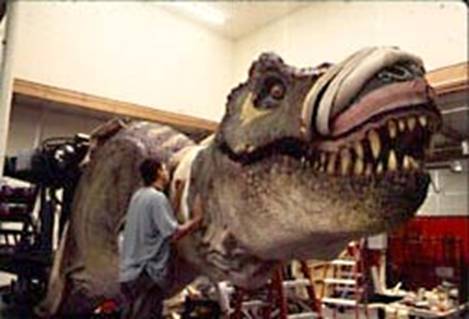
Meanwhile, various body armatures are being created and are assembled in the welding metal-fabricating areas. Each of the robot’s movements axis points must have an industrial-rated bearing to provide action and long life. Each individual part requires a custom design and fabrication. These artisans are combining both art and technology to achieve realistic, lifelike moves.
As the armature takes shape, the actuators, valves, flow controls and hoses are installed by the animation department. The technicians select those components carefully in order to ensure the durability and long life. As it’s assembled, each robotic move is individually tested and adjusted to get that perfect movement.
The costume, if there is one, is usually tailored to the character and its movements. Animation tailoring can be a very difficult tedious process considering the variables. The outfit has to allow for easy acces to the character’s operating mechanisms. It must also “look” normal after movement has taken place. The costume must be designed to provide hundreds of thousands of operations without wearing out and without causing the skin areas(i.e. around the necks or wrists) to breakdown as well.
Finally, if it is an animated character the electronic wizard move in to connect the control system into valve assembly in the preparation for programming. Programming is the final step, and for some animations it is the most rewarding. Programming can be done either at the manufacturing facility or at the final installation site. In programming, all the individual moves are coordinated into complex animated actions and nuances that bring the character to “life.”
| Are you interested in this topic.Then mail to us immediately to get the full report.
email :- contactv2@gmail.com |
