


Updated on May 29, 2026
Light emitting diodes (LEDs) have gained broad recognition as the ubiquitous little lights that tell us that our monitors are on, the phone is off the hook or the oven is hot semiconductor. The basic principle behind the emission of light is that: When charge carrier pairs recombine in a semiconductor with an appropriate energy band-gap generates light.
In a forward biased diode, little recombination occurs in the depletion layer. Most occurs in a few microns of either P- region or N -region, depending on which one is lightly doped. LEDs produce narrow band radiations, with wave length determined by energy band of the semiconductor.
Solid state electronics have replaced their vacuum tube predecessors for almost five decades. However in the next decade they will be brighter, more efficient and inexpensive enough to replace conventional lighting sources (i.e. incandescent bulbs, fluorescent tubes).
Recent development in AlGaP and AlInGaP blue and green semiconductor growth technology have enabled applications where several single to several millions of these indicator LEDs can be packed together to be used in full color signs, automotive tail lambs, traffic lights etc. still the preponderance of applications require that the viewer has to look directly into the LED. This is not "SOLID STATE LIGHTING"
Artificial lighting sources share three common characteristics:
-They are rarely viewed directly: light from sources are viewed as reflection off the illuminated object.
- The unit of measure is kilo lumen or higher not mille lumen or lumen as it is incase of LEDs
-Lighting sources are pre dominantly white with CIE color coordinates, producing excellent color rendering
Today there is no such commercially using "SOLID STATE LAMP" However high power LED sources are being developed, which will evolve into lighting sources
The first practical LED was developed in 1962 and was made of a compound semiconductor alloy, gallium arsenide phosphide, when emitted red light. From 1962, compound semiconductors would provide the foundation for the commercial expansion of LEDs. From 1962 when first LEDs were introduced at 0.001 lm/LED using GaAsP until the mid-1990s commercial LEDs were used exclusively as indicators. In terms of number of LEDs sold, indicators and other small signal applications in 2002 still consume the largest volume of LEDs, with annual global consumption exceeding several LEDs per person on the planet.
Analogous to famous Moore's law in silicon which predicts a doubling of number of transistors in a chip every 18-24 months, LED luminous output has been following Haitz's law, doubling every 18-24 months for past 34 years.
In 1999, the USA consumed 3 Trillion kWh of energy, 21% of which was used for lighting. Incandescent bulbs consumed 40% of the energy used for lighting (252 Billion kWh) to generate 15% of the total light produced. The more efficient fluorescent and discharge light sources consumed the remaining of the energy (378 Billion KWh) generating 85% of the light. At nearly $60 B/year, $12 B of which is for sources alone, the lighting market dwarfs the $3 B/year (2000) indicator LED market
With the convergence in the mid 1990s of major advances in AlInGaN and AlInGaP material technologies by the turn of the millennium LEDs were rapidly surpassing the efficiency of color filtered fluorescent light bulbs and white incandescent and halogen light bulbs. LEDs inherit other important advantages including lifetimes measured in tens of thousands of hours, ruggedness, environmental friendliness (no mercury), compact size, low operating voltages, and cool operation. Their small size allows design flexibility in the control and steering of the emitted light by utilizing sophisticated secondary optics. However, today’s lighting applications which require a light source to illuminate a desk, a screen, or a room demand not only high efficiency and long life, but also high flux, all at a low unit cost. The challenge is designing LED devices and packages that sustain two to three orders of magnitude higher input drive power than traditional (60 mW) indicator LEDs whilst retaining the same high efficiency and reliability.
The pioneering work on high-power LEDs began at Lumileds Lighting in 1998 with the introduction of the first commercial high power LED. At 1-W input power, Luxeon devices operate at power levels 20 times that of traditional 5-mm indicator LEDs with efficiencies that can be as much as 50% greater. Commercialization of high-power LEDs in 1998 has impacted the decades-old Haitz’s Law (Fig. 1), manifesting as a knee in the lm/LED versus time plot, defining the point in LED evolution when power LEDs diverged from indicator LEDs. Then came the brightest LED with output 150lm/LED, working with 5W input power. The diagram is shown below.
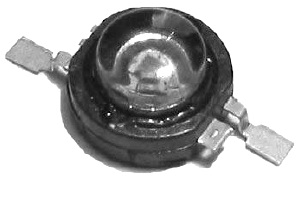
Fig: 3- 5W LED~15w incandescent Lamp
Fig-3 shows next-generation Luxeon LED, which is the world’s brightest white LED at 0.15 klm at 5-W drive, next to a 15-W incandescent bulb. This LED generates nearly 40% more light, occupies 1% of the package volume, and requires only 33% of the power of the incandescent light bulb. Twelve of these high-powered 0.15-klm devices are sufficient to make a blue-tinted high-intensity discharge (HID) equivalent 1.8-klm automotive headlamp. Single color green versions of the 5-W Luxeon devices offer luminous fluxes in excess of a 0.13 klm per package.
Two of these Luxeon sources can replace the 150-W light bulb in a typical or US traffic signal resulting in 90% energy savings. RGB combinations of Luxeon sources have efficiencies that even rival those of cold cathode fluorescent lamps. For example, applications such as backlighting for LCD televisions and monitors take advantage of the compact source size and narrow color bands, while providing extended color range, ruggedness, and eliminating high-voltage power supplies.
| Are you interested in this topic.Then mail to us immediately to get the full report.
email :- contactv2@gmail.com |
