


Updated on May 29, 2026
The demand for making air traveling more 'pleasant, secure and productive for passengers is one of the winning factors for airlines and aircraft industry. Current trends are towards high data rate communication services, in particular Internet applications. In an aeronautical scenario global coverage is essential for providing continuous service.
Therefore satellite communication becomes indispensable, and together with the ever increasing data rate requirements of applications, aeronautical satellite communication meets an expansive market.
Wireless Cabin (IST -2001-37466) is looking into those radio access technologies to be transported via satellite to terrestrial backbones . The project will provide UMTS services, W-LAN IEEE 802.11 b and Blue tooth to the cabin passengers. With the advent of new services a detailed investigation of the expected traffic is necessary in order to plan the needed capacities to fulfill the QoS demands. This paper will thus describe a methodology for the planning of such system.
In the future, airliners will provide a variety of entertainment and communications equipment to the passenger. Since people are becoming more and more used to their own communications equipment, such as mobile phones and laptops with Internet connection, either through a network interface card or dial-in access through modems, business travelers will soon be demanding wireless access to communication services.
So far, GSM telephony is prohibited in commercial aircraft due to the uncertain certification situation and the expected high interference levels of the TDMA technology. With the advent of spread spectrum systems such as UMTS and W-LAN, and low power pico-cell access such as Blue tooth this situation is likely to change, especially if new aircraft avionics technologies are considered, or if the communications technologies are in line with aircraft development as today .
When wireless access technologies in aircraft cabins are envisaged for passenger service, the most important standards for future use are considered to be: UMTS with UTRAN air interface, Blue tooth, and W-LAN IEEE 802.11 b. Of course, these access technologies will co-exist with each other, beside conventional IP fixed wired networks. The wireless access solution is compatible with other kinds of IFE, such as live TV on board or provision of Internet access with dedicated installed hardware in the cabin seats. Hence, it should not be seen as an alternative to wired architecture in an aircraft, but as a complementary service for the passengers.
Several wireless access segments in the aircraft cabin, namely a wireless LAN according to IEEE 802.11 b standard for IP services, an UMTS pico-cell for personal and data communications, and Bluetooth1.1, as well as a standard wired IP LAN.
A satellite segment for interconnection of the cabin with the terrestrial telecom networks. The different cabin services must be integrated and interconnected using a service integrator, that allows the separation and transportation of the services over a single or several satellite bearers. Peculiarities, such as limited bandwidth, asymmetric data rates on satellite up- and down-link, and dynamic traffic demand between the different services and handover between satellite bearers need to be addressed. In order to minimize the cost (satellite resources) for a given QoS efficient interworking between the service integrator and the satellite segment will be required.
An aircom service provider segment supporting the integrated cabin services. The aircom provider segment provides the interconnection to the terrestrial personal and data networks as well as the Internet backbone. For the UMTS cabin service, a subset of the UMTS core network must be available.
The provision of such a heterogeneous access network with collectively mobile users requires the development of new protocol concepts to support
· The integrated services with dynamic bandwidth sharing among the services and asymmetrical data rate;
· IP mobility and virtual private networks (VPN) for the individual passengers in the mobile network; authentication, admission and accounting (AAA) in the mobile network, especially taking into account the necessity to support different pricing concepts for each passenger in the mobile network and the interaction of airline, satellite provider, aircom service provider and terrestrial service providers.
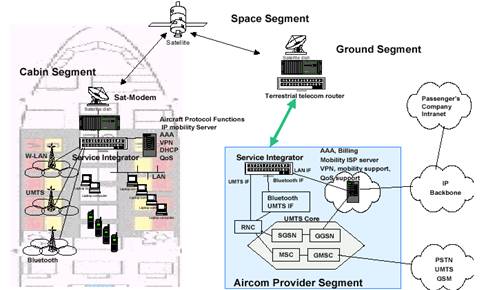
Several wireless access segments in the aircraft cabin, namely a wireless LAN according to IEEE 802.11 b standard for IP services, an UMTS pico-cell for personal and data communications, and Bluetooth1.1, as well as a standard wired IP LAN.
A satellite segment for interconnection of the cabin with the terrestrial telecom networks. The different cabin services must be integrated and interconnected using a service integrator, that allows the separation and transportation of the services over a single or several satellite bearers. Peculiarities, such as limited bandwidth, asymmetric data rates on satellite up- and down-link, and dynamic traffic demand between the different services and handover between satellite bearers need to be addressed. In order to minimize the cost (satellite resources) for a given QoS efficient interworking between the service integrator and the satellite segment will be required.
An aircom service provider segment supporting the integrated cabin services. The aircom provider segment provides the interconnection to the terrestrial personal and data networks as well as the Internet backbone. For the UMTS cabin service, a subset of the UMTS core network must be available.
The provision of such a heterogeneous access network with collectively mobile users requires the development of new protocol concepts to support
• The integrated services with dynamic bandwidth sharing among the services and asymmetrical data rate;
• IP mobility and virtual private networks (VPN) for the individual passengers in the mobile network; authentication, admission and accounting (AAA) in the mobile network, especially taking into account the necessity to support different pricing concepts for each passenger in the mobile network and the interaction of airline, satellite provider, aircom service provider and terrestrial service providers.
Connection to telecom networks is considered to be achieved by satellites with large coverage areas especially over oceanic regions during long-haul flights. The service concept needs to take into account today's peculiarities of satellite communications, thus it must cope with the available or in near future available satellite technology, and interworking must be performed at aircraft interface level with the satellite segment,
• Only restricted satellite data rates will be available in the near future; thus the bandwidth that is requested by standard interfaces of the wireless standards needs to be adapted to the available bandwidth (typically: 432 kb/s in down- link, 144 kb/s up-link (Inmarsat B- GANTM), or 5 Mb/s in down-link, 1.5 Mb/s in up-link (Connexion by Boeing)). Furthermore, dynamic bandwidth management is needed to allocate higher bit rates from temporarily unused services to other service-
• Currently, few geostationary satellites such as the Inmarsat fleet are available for two-way communications, that cover the land masses and the oceans. Ku-band may be used on a secondary allocation basis for aeronautical mobile satellite services (AMSS) but bandwidth is scarce and coverage is mostly provided over continents. K/Ka-band satellites will be launched in the near future, again here continental coverage is mainly intended. The scenario must thus consider
the use of different satellite systems, which will probably force the support of different service bearers, and
handover between satellite systems.
It is assumed that each satellite segment is connected via terrestrial wide area networks or via the IP backbone to the aircom service provider.
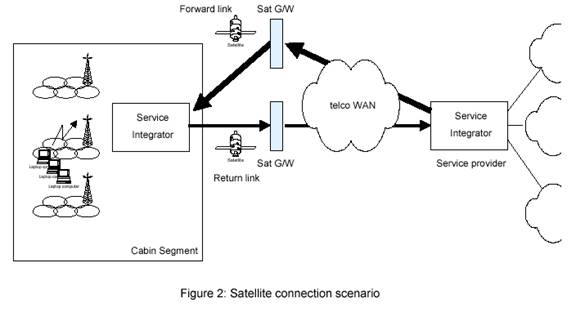
• Asymmetrical data rates in satellite up- and down-links, that may also be caused to operate in conjunction with different satellites systems for up- and down-link. The service portfolio in the cabin and the service integration needs to cope with this possibility.
The different wireless access services of UMTS, W-LAN and Bluetooth require an integration of the services over the satellite. The central part of the service portfolio provisioning is the service integrator (SI), cf. Figure 3. The service integrator will provide the interfaces for the wireless and wired service access points in the cabin, as well as the interface to the terrestrial networks at aircom provider site. All services will be bundled and transported between a pair of Service Integrators. It performs the encapsulation of the services and the adaptation of the protocols.
The SI multiplexer is envisaged to assign variable capacities to the streams, controlled by a bandwidth manager that monitors also the QoS requirements of the different service connections. Changes in capacity assignment must be signaled to the SI at the other communication end. The heterogeneous traffic stream is then sent to streaming splitter/combiner. This unit is envisaged to support several satellite segments and to perform handover between them. Asymmetrical data rates in inbound and outbound directions can be managed here. Adaptation to the supported satellite segments are done by medium access controllers (MAC) in a modular manner. Towards the terminal side, the interfaces of the wireless access standards need to interwork with the transport streaming of the SI by specific adaptation layers (AL). These ALs have to be designed according to the analysis of the impact of delay, jitter and restricted / variable bandwidth on the protocol stack. Buffering (to compensate delay jumps at handover) and jitter compensation for real-time services (e.g., voice) must be also provided here.
| Are you interested in this topic.Then mail to us immediately to get the full report.
email :- contactv2@gmail.com |
