


Updated on May 29, 2026
In the modern day theatre of combat, the need to be able to strike at targets that are on the opposite side of the globe has strongly presented itself. This had led to the development of various types of guided missiles. These guided missiles are self -guiding weapons intended to maximize damage to the target while minimizing collateral damage.
The buzzword in modern day combat is fire and forget. GPS guided missiles, using the exceptional navigational and surveying abilities of GPS, after being launched, could deliver a warhead to any part of the globe via the interface pof the onboard computer in the missile with the GPS satellite system. Under this principle many modern day laser weapons were designed.
Laser guided missiles use a laser of a certain frequency bandwidth to acquire their target. GPS/inertial weapons are oblivious to the effects of weather, allowing a target to be engaged at the time of the attacker's choosing. GPS allows accurate targeting of various military weapons including ICBMs, cruise missiles and precision-guided munitions. Artillery projectiles with embedded GPS receivers able to withstand accelerations of 12,000 G have been developed for use in 155 mm. GPS signals can also be affected by multipath issues, where the radio signals reflect off surrounding terrain; buildings, canyon walls, hard ground , etc. These delayed signals can cause inaccuracy.
A variety of techniques, most notably narrow correlator spacing, have been developed to mitigate multipath errors. Multipath effects are much less severe in moving vehicles. When the GPS antenna is moving, the false solutions using reflected signals quickly fail to converge and only the direct signals result in stable solutions. The multiple independently targeted re-entry vehicles (MIRVs) – ICBMs with many sub-missiles – were developed in the late 1960s. The cruise missile has wings like an airplane, making it ca pable of flying at low altitudes. In summary, GPS-INS guided weapons are not affected by harsh weather conditions or restricted by a wire, nor do they leave the gunner vulnerable for attack. GPS guided weapons, with their technological advances over previous, are the superior weapon of choice in modern day warfare.
Guided missile systems have evolved at a tremendous rate over the past four decades, and recent breakthroughs in technology ensure that smart warheads will have an increasing role in maintaining our military superiority. On ethical grounds, one prays that each warhead deployed during a sortie will strike only its intended target, and that innocent civilians will not be harmed by a misfire. From a tactical standpoint, our military desires weaponry that is reliable and effective, inflicting maximal damage on valid military targets and ensuring our capacity for light ingfast strikes with pinpoint accuracy. Guided missile systems help fulfill all of these demands.
Many of the early guidance systems used in missiles where based on gyroscope models. Many of these models used magnets in their gyroscope to increase the sensitivity of the navigational array. In modern day warfare, the inertial measurements of the missile are still controlled by a gyroscope in one form or another, but the method by which the missile approaches the target bears a technological edge. On the battlefield of today, guided missiles are guided to or acquire their targets by using:
· Radar signal
· Wires
· Lasers (or)
· Most recently GPS.
The central idea behind the design of DGPS/GPS/inertial guided weapons is that of using a 3- axis gyro/accelerometer package as an inertial reference for the weapon's autopilot, and correcting the accumulated drift error in the inertial package by using GPS PPS/P-code. Such weapons are designated as "accurate" munitions as they will offer CEPs (Circular Error Probable) of the order of the accuracy of GPS P -code signals, typically about 40ft.
The next incremental step is then to update the weapon before launch with a DGPS derived position estimate, which will allow it to correct its GPS error as it flies to the target, such weapons are designated "precise" and will offer accuracies greater than laser or TV guided weapons, potentially CEPs of several feet.For an aircraft to support such munitions, it will require a DGPS receiver, a GPS receiver and interfaces on its multiple ejector racks or pylons to download target and launch point coordinates to the weapons. The development of purely GPS/inertial guided munitions will produce substantial changes in how air warfare is conducted.
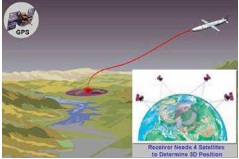
Unlike a laser-guided weapon, a GPS/inertial weapon does not require t hat the launch aircraft remain in the vicinity of the target to illuminate it for guidance - GPS/inertial weapons are true fire-and-forget weapons, which once released, are wholly autonomous, and all weather capable with no degradation in accuracy. Existing precision weapons require an unobscured line of sight between the weapon and the target for the optical guidance to work
The proliferation of GPS and INS guidance is a double-edged sword. On the one hand, this technology promise a revolution in air warfare not seen since the laser guided bomb, with single bombers being capable of doing the task of multiple aircraft packages. In summary, GPS-INS guided weapons are not affected by harsh weather conditions or restricted by a wire, nor do they leave the gunner vulnerable for attack. GPS guided weapons, with their technological advances over previous, are the superior weapon of choice in modern day warfare.
Many machines used in battle, such as tanks, planes, etc. and targets, such as buildings, hangers, launch pads, etc. have a specific signature when a radar wave is reflected off of it. Guided missiles that use radar signatures to acquire their targ ets are programmed with the specific signature to home in on. Once the missile is launched, it then uses its onboard navigational array to home in on the preprogrammed radar signature. Most radar guided missiles are very successful in acquiring their targets, however, these missiles need a source to pump out radar signals so that they can acquire their target. The major problem with these missiles in today’s battlefield is that the countermeasures used against these missiles work on the same principles that these missiles operate under. The countermeasures home in on the radar signal source and destroy the antenna array, which essential shuts down the radar source, and hence the radar guided missiles cannot acquire their targets
Wire guided missiles do not see the target. Once the missile is launched, the missile proceeds ina linear direction from the launch vehicle. Miles of small, fine wire are wound in the tail sectionof the missile and unwind as the missile travels to the target. Along this wire, the gunner sends navigational signals directing the missile to the target. If for some reason the wire breaks, the missile will never acquire the target. Wire guided missiles carry no instrument array that would allow them to acquire a target. One strong downside to wire guided missiles is the fact that the vehicle from which the missile is fired must stay out in the open to guide the missile to its target. This leaves the launch vehicle vulnerable to attack, which on the battle field one wants to avoid at all costs.
In modern day weaponry the buzzword is fire and forget.Under this principle many modern day laser weapons were designed. Laser guided missiles use alaser of a certain frequency bandwidth to acquire their target. The gunner sights the target using a laser; this is called painting the target. When the missile is launched it uses its onboard instrumentation to look for the heat signature created by the laser on the target. Once the missile locates the heat signature, the target is acquired, and the missile will home in on the target even if the target is moving. Despite the much publicized success of laser guided missiles, laser guided weapons are no good in the rain or in weather conditions where there is sufficient cloud cover. To overcome the shortcomings of laser guided missiles presented in unsuitable atmospheric conditions and radar guided missiles entered GPS as a method of navigating the missile to the target. So, before going to GPS guided missile we will have an introduction to GPS.
1.) Technique called differential correction can yield accuracies within 1 -5 meters, or even better, with advanced equipment.
2.) Differential correction requires a second GPS receiver, a base station, collecting data at a stationary position on a precisely known point (typically it is a surveyed benchmark).
3.) Because physical location of base station is known, a correction factor can be computed by comparing known location with GPS location determined by using satellites.
4.) Differential correction process takes this correction factor and applies it to GPS data collected by the GPS receiver in the field. -- Differential correction eliminates most of errors.
Inertial navigation relies on devices onboard the missile that senses its motion and acceleration in different directions. These devices are called gyroscopes and accelerometers.
The purpose of a gyroscope is to measure angular rotation, and a number of different Methods to do so have been devised. A classic mechanical gyroscope senses the stability of a mass rotating on gimbals. More recent ring laser gyros and fiber optic gyros are based on the interference between laser beams. Current advances in Micro-Electro-Mechanical Systems (MEMS) offer the potential to develop gyroscopes that are very small and inexpensive While gyroscopes measure angular motion, accelerometers measure linear motion. The accelerations from these devices are translated into electrical signals for processing by the missile computer autopilot. When a gyroscope and an accelerometer are combined into a single device along with a control mechanism, it is called an inertial measurement unit (IMU) or inertial navigation system (INS).
| Are you interested in this topic.Then mail to us immediately to get the full report.
email :- contactv2@gmail.com |
