

Updated on May 29, 2026
Adaptive optics is a new technology which is being used now a days in ground based telescopes to remove atmospheric tremor and thus provide a clearer and brighter view of stars seen through ground based telescopes.
Without using this system, the images obtained through telescopes on earth are seen to be blurred, which is caused by the turbulent mixing of air at different temperatures causing speed & direction of star light to vary as it continually passes through the atmosphere.
Adaptive optics in effect removes this atmospheric tremor. It brings together the latest in computers, material science, electronic detectors, and digital control in a system that warps and bends a mirror in a telescope to counteract, in real time the atmospheric distortion.
The advance promises to let ground based telescopes reach their fundamental limits of resolution and sensitivity, out performing space based telescopes and ushering in a new era in optical astronomy. Finally, with this technology, it will be possible to see gas-giant type planets in nearby solar systems in our Milky Way galaxy. Although about 100 such planets have been discovered in recent years, all were detected through indirect means, such as the gravitational effects on their parent stars, and none has actually been detected directly.
Adaptive optics refers to optical systems which adapt to compensate for optical effects introduced by the medium between the object and its image. In theory a telescope's resolving power is directly proportional to the diameter of its primary light gathering lens or mirror. But in practice , images from large telescopes are blurred to a resolution no better than would be seen through a 20 cm aperture with no atmospheric blurring. At scientifically important infrared wavelengths, atmospheric turbulence degrades resolution by at least a factor of 10.
Under ideal circumstances, the resolution of an optical system is limited by the diffraction of light waves. This so-called " diffraction limit " is generally described by the following angle (in radians) calculated using the light's wavelength and optical system's pupil diameter:
a = 1.22 ^
D
Where the angle is given in radians. Thus, the fully-dilated human eye should be able to separate objects as close as 0.3 arcmin in visible light, and the Keck Telescope (10-m) should be able to resolve objects as close as 0.013 arcsec.
In practice, these limits are never achieved. Due to imperfections in the cornea nd lens of the eye, the practical limit to resolution only about 1 arcmin. To turn the problem around, scientists wishing to study the retina of the eye can only see details bout 5 (?) microns in size. In astronomy, the turbulent atmosphere blurs images to a size of 0.5 to 1 arcsec even at the best sites.
Adaptive optics provides a means of compensating for these effects, leading to appreciably sharper images sometimes approaching the theoretical diffraction limit. With sharper images comes an additional gain in contrast - for astronomy, where light levels are often very low, this means fainter objects can be detected and studied
Adaptive optics compensates for atmospheric turbulence while the observations are in progress. In principle, very faint objects can be imaged in long exposures, provided there is a bright “ reference beacon ” nearby to allow the Adaptive Optics system to analyze the atmospheric effects. Further more, Adaptive Optics’ relative nature means that spectroscopy becomes possible on very small angular scales and it follows that fainter objects can be studied because less of the night. Sky back ground needs to be included in the light being analyzed. Vision science does not have any means of avoiding the imperfections in the cornea & lens in twine objects, so Adaptive Optics is the only option of studying living retinal tissue. Further more, a full Adaptive Optics system can compensate for micro-fluctuations in eye muscles, which means that the eye does not have to be temporarily paralyzed while under examination.
Space telescopes avoid problems with the atmosphere, but they are enormously expensive and the limit on aperture size of telescopes is quite restrictive. The Hubble Space telescope, the world’s largest telescope in orbit , has an aperture of only 2.4 meters, while terrestrial telescopes can have a diameter four times that size.
In order to avoid atmospheric aberration, one can turn to larger telescopes on the ground, which have been equipped with ADAPTIVE OPTICS system. With this setup, the image quality that can be recovered is close to that the telescope would deliver if it were in space. Images obtained from the adaptive optics system on the 6.5 m diameter telescope, called the MMT telescope illustrate the impact.
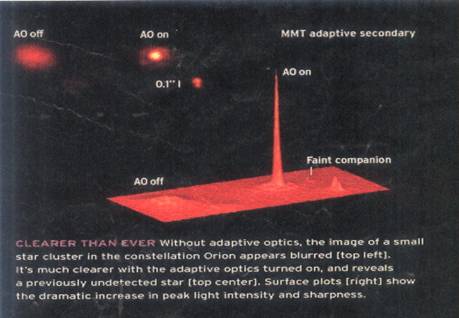
Two images of a small region in the vicinity of the middle star in Orion’s sword- a cluster of young stars were taken. The images show a close grouping of four stars. In the conventional blurred image, its not possible to make out more than two stars. With the adaptive optics on the other hand, sharpness improves by a factor of 13, making it clear that the fainter star is ,in fact a binary – two stars close together –and a fourth fainter member of the group appears that was previously undetected.
As light from a distant star reaches the earth, it is made up of plane waves that , in the last microseconds of their journey to the telescope, become badly distorted by atmospheric turbulence. An adaptive optics system reflattens the wave fronts by reflecting the light of a deformable mirror whose shape is changed in real time to introduce an equal but opposite distortion.
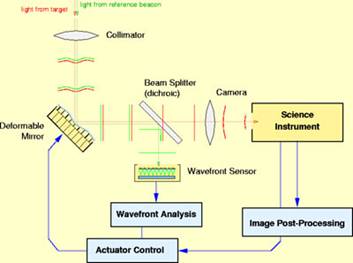
A beam splitter sends some of the reflected light to a wave front sensor. The information on how to distort the mirror comes from a wave front sensor, an instrument that measures optical aberration imposed by the atmosphere on light from a star. A fast computer converts the signals coming from the wave front sensor into drive signals for the deformable mirror. The whole cycle operates at a never ending cycle of measurement and correction, at typical speeds of 1000 updates per second.
After the light reflects of the deformable mirror, a beam splitter sends part of the light to a camera that will capture the high resolution image produced by the adaptive optics.
| Are you interested in this topic.Then mail to us immediately to get the full report.
email :- contactv2@gmail.com |
