

Updated on May 29, 2026
The most common computer authentication method is to use alphanumerical usernames and passwords. This method has been shown to have significant drawbacks. For example, users tend to pick passwords that can be easily guessed. On the other hand, if a password is hard to guess, then it is often hard to remember.
To address this problem, some researchers have developed authentication methods that use pictures as passwords.
Dhamija and Perrig proposed a graphical authentication scheme based on the HashVisualization technique . In their system, the user is asked to select a certain number of images from a set of random pictures generated by a program . Later, the user will be required to identify the pre selected images in order to be authenticated. The results showed that 90% of all participants succeeded in the authentication using this technique, while only 70% succeeded using text-based passwords and PINS. The average log-in time, however, is longer than the traditional approach. A weakness of this system is that the server needs to store the seeds of the portfolio images of each user in plain text. Also, the process of selecting a set of pictures from the picture database can be tedious and time consuming for the user.
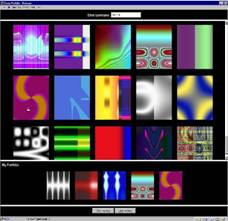
Random images used by Dhamija and Perrig
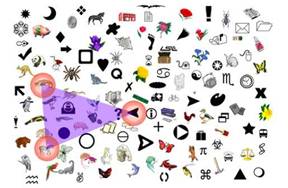
Sobrado and Birget developed a graphical password technique that deals with the shoulder-surfing problem. In the first scheme, the system will display a number of pass-objects (pre-selected by user) among many other objects. To be authenticated, a user needs to recognize pass-objects and click inside the convex hull formed by all the pass-objects.In order to make the password hard to guess, Sobrado and Birget suggested using 1000 objects, which makes the display very crowded and the objects almost indistinguishable, but using fewer objects may lead to a smaller password space, since the resulting convex hull can be large.
In their second algorithm, a user moves a frame (and the objects within it) until the pass object on the frame lines up with the other two pass-objects. The authors also suggest repeating the process a few more times to minimize the likelihood of logging in by randomly clicking or rotating. The main drawback of these algorithms is that the log in process can be slow.
During the authentication, the user must enter the registered images in the correct sequence. One drawback of this technique is that since the number of thumb nail images is limited to 30, the password space is small. Each thumbnail image is assigned a numerical value, and the sequence of selection will generate a numerical password. The result showed that the image sequence length was generally shorter than the textural password length. To address this problem, two pictures can be combined to compose a new alphabet element, thus expanding the image alphabet size.
| Are you interested in this topic.Then mail to us immediately to get the full report.
email :- contactv2@gmail.com |
