

Updated on May 29, 2026
Philips Research introduced Ambient Intelligence(AmI) in the year 1998. In 2001, AmI was taken up by The European Commission’s Information Society Technologies Advisory Group (ISTAG).
In computing, AmI refers to electronic environments that are sensitive and responsive to the presence of people. Ambient intelligence is a vision on the future of consumer electronics, telecommunications and computing for the time frame 2010–2020.
The development of ambient intelligence applications that effectively adapt to the needs of the users and environments requires the presence of planning mechanisms for goal-oriented behavior. A planning system for AmI applications is based on the hierarchical task network (HTN) approach and is called distributed hierarchical task network (D-HTN). D-HTN is able to find courses of actions to address given goals. The application areas of AmI include health-related applications, public transportation sector, education services etc. This seminar aims to give an insight into ambient intelligence technology and a planner for AmI applications
Ambient Intelligence (AmI) is a new paradigm in Information Technology that has potential for great impact in the future. The vision of AmI is that the people will be surrounded by intelligent objects that can sense the context and respond according to the desire of the people. AmI is a multidisciplinary topic, since it combines the features of many of the areas in Computer Science.
In the last five years, we have seen significant advances in three promising technology areas: virtual environments, in which 3D displays and interaction devices immerse the user in a synthesized world, mobile communication and sensors, in which increasingly small and inexpensive terminals and wireless networking llow users to roam the real world without being limited to stationary machines. The merging of these areas allows the emergence of a new vision: the Ambient Intelligence (AmI).
AmI refers to a digital environment that proactively, but sensibly, supports people in their everyday lives. It will make the feeling that the people live with technology. It is aligned with the concept of ‘disappearing computer’, since the AmI environment make the technology invisible. As the devices grow smaller, more connected and more integrated into our environment, the technology disappears into our surroundings.“The most profound technologies are those that disappear. They weave themselves into the fabric of everyday life until they are indistinguishable from it.” M. Weiser The basic idea behind AmI is that by enriching an environment with technology (mainly sensors and devices interconnected through a network), a system can be built to take decisions to benefit the users of that environment based on real-time information gathered and historical data accumulated.
An important aspect of AmI has to do with interaction. On one side there is a motivation to reduce the human-computer interaction as the system is supposed to use its intelligence to infer situations and user needs from the recorded activities, as if a passive human assistant was observing activities unfold with the expectation to help when (and only if) required. On the other side, a diversity of users may need or voluntarily seek direct interaction with the system to indicate preferences and needs. The entire environment around us, homes and offices, cars and cities, will collectively develop a pervasive network of intelligent devices that will cooperatively gather, process and transport information
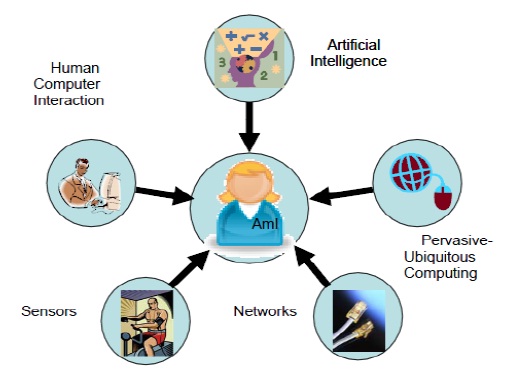
The benefit of an AmI system is measured by how much can give to people while minimizing explicit interaction. The aim is to enrich specific places (a room, a building, a car, a street) with computing facilities which can react to people’s needs and provide assistance. In order for AmI to become a reality a number of key technologies are required:
Unobtrusive hardware (Miniaturisation, Nanotechnology, smart devices, sensors etc.)
Seamless mobile/fixed communication and computing infrastructure (interoperability, wired and wireless networks, service-oriented architecture, semantic web etc.)
Dynamic and massively distributed device networks, which are easy to control and program (e.g. service discovery, auto-configuration, end-user programmable devices and systems etc.).
Human-centric computer interfaces (intelligent agents, multimodal interaction, context awareness etc.)
Dependable and secure systems and devices (self-testing and self repairing software, privacy ensuring technology etc.)
| Are you interested in this topic.Then mail to us immediately to get the full report.
email :- contactv2@gmail.com |
