


Published on Feb 21, 2020
Soft Computing differs from conventional (hard) computing in that, unlike hard computing, it is tolerant of imprecision, uncertainty, partial truth, and approximation. In effect, the role model for soft computing is the human mind. Principal constituents of Soft Computing are Neural Networks, Fuzzy Logic, Evolutionary Computation, Swarm Intelligence and Bayesian Networks.
The successful applications of soft computing suggest that the impact of soft computing will be felt increasingly in coming years. Soft computing is likely to play an important role in science and engineering, but eventually its influence may extend much farther
Soft Computing became a formal Computer Science area of study in the early 1990's.Earlier computational approaches could model and precisely analyze only relatively simple systems. More complex systems arising in biology, medicine, the humanities, management sciences, and similar fields often remained intractable to conventional
mathematical and analytical methods. That said, it should be pointed out that simplicity and complexity of systems are relative, and many conventional mathematical models have been both challenging and very productive. Soft computing deals with imprecision, uncertainty, partial truth, and approximation to achieve tractability, robustness and low solution cost
Unlike hard computing schemes, which strive for exactness and full truth, soft computing techniques exploit the given tolerance of imprecision, partial truth, and uncertainty for a particular problem. Another common contrast comes from the observation that inductive reasoning plays a larger role in soft computing than in hard computing. Components of soft computing include: Neural Network, Perceptron, Fuzzy Systems, Baysian Network, Swarm Intelligence and Evolutionary Computation.
The highly parallel processing and layered neuronal morphology with learning abilities of the human cognitive faculty ~the brain~ provides us with a new tool for designing a cognitive machine that can learn and recognize complicated patterns like human faces and Japanese characters. The theory of fuzzy logic, the basis for soft computing, provides mathematical power for the emulation of the higher-order cognitive functions ~the thought and perception processes. A marriage between these evolving disciplines, such as neural computing, genetic algorithms and fuzzy logic, may provide a new class of computing systems ~neural-fuzzy systems ~ for the emulation of higher-order cognitive power
Neural Networks, which are simplified models of the biological neuron system, is a massively parallel distributed processing system made up of highly interconnected neural computing elements that have the ability to learn and thereby acquire knowledge and making it available for use. It resembles the brain in two respects:
- Knowledge is acquired by the network through a learning process.
-Interconnection strengths known as synaptic weights are used to store the knowledge
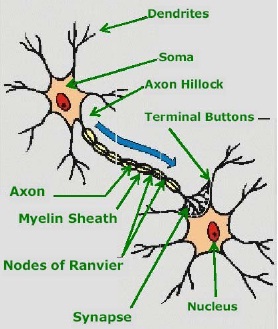
A neuron is composed of nucleus- a cell body known as soma. Attached to the soma are long irregularly shaped filaments called dendrites. The dendrites behave as input channels, all inputs from other neurons arrive through dendrites.
Another link to soma called Axon is electrically active and serves as an output channel. If the cumulative inputs received by the soma raise internal electric potential of the cell known as membrane potential, then the neuron fires by propagating the action potential down the axon to excite or inhibit other neurons. The axon terminates in a specialized contact called synapse that connects the axon with the dendrite links of another neuron
An artificial neuron model bears direct analogy to the actual constituents of biological neuron. This model forms basis of Artificial Neural Networks
| Are you interested in this topic.Then mail to us immediately to get the full report.
email :- contactv2@gmail.com |
