
Published on Jan 09, 2026
Robot is a system with a mechanical body, using computer as its brain. Integrating the sensors and actuators built into the mechanical body, the motions are realised with the computer software to execute the desired task. Robots are more flexible in terms of ability to perform new tasks or to carry out complex sequence of motion than other categories of automated manufacturing equipment.
Today there is lot of interest in this field and a separate branch of technology 'robotics' has emerged. It is concerned with all problems of robot design, development and applications.
The technology to substitute or subsidise the manned activities in space is called space robotics. Various applications of space robots are the inspection of a defective satellite, its repair, or the construction of a space station and supply goods to this station and its retrieval etc. With the over lap of knowledge of kinematics, dynamics and control and progress in fundamental technologies it is about to become possible to design and develop the advanced robotics systems. And this will throw open the doors to explore and experience the universe and bring countless changes for the better in the ways we live.
The space robot applications can be classified into the following four categories
1 In-orbit positioning and assembly: For deployment of satellite and for assembly of modules to satellite/space station.
2 Operation: For conducting experiments in space lab.
3 Maintenance: For removal and replacement of faulty modules/packages.
4 Resupply: For supply of equipment, materials for experimentation in space lab and for the resupply of fuel.
The following examples give specific applications under the above categories
" Metallurgical experiments which may be hazardous.
" Astronomical observations.
" Biological experiments.
" Assist in deployment and assembly out side the station.
" Assist crew inside the space station: Routine crew functions inside the space station and maintaining life support system.
" Refueling.
" Replacement of faulty modules.
" Assist jammed mechanism say a solar panel, antenna etc.
" Replace payloads by an upgraded module.
" Attach extra modules in space.
" Grab a satellite and effect orbital transfer.
" Efficient transfer of satellites from low earth orbit to geostationary orbit.
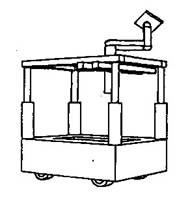
Tessellator
Tessellator is a mobile manipulator system to service the space shuttle.The method of rewaterproofing for space shuttle orbiters involves repetitively injecting the extremely hazardous dimethyloxysilane (DMES) into approximately 15000 bottom tile after each space flight. The field robotic center at Carneige Mellon University has developed a mobile manipulating robot, Tessellator for autonomous tile rewaterproofing. Its automatic process yields tremendous benefit through increased productivity and safety.
In this project, a 2D-vehicle workspace covering and vehicle routing problem has been formulated as the Travelling Workstation Problem (TWP). In the TWP, a workstation is defined as a vehicle which occupies or serves a certain area and it can travel; a workspace is referred to as a 2D actuation envelop of manipulator systems or sensory systems which are carried on the workstation; a work area refers to a whole 2D working zone for a workstation.
The objective of the TWP is
1 To determine the minimum number of workspaces and their layout, in which, we should minimize the overlapping among the workspaces and avoid conflict with obstacles.
2 To determine the optimal route of the workstation movement, in which the workstation travels over all workspaces within a lowest cost (i.e. routing time).
The constraints of the problem are
1) The workstation should serve or cover all workareas.
2) The patterns or dimensions of each workspace are the same and
3) There some geographical obstacles or restricted areas.
In the study, heuristic solutions for the TWP, and a case study of Tessellator has been conducted. It is concluded that the covering strategies, e.g. decomposition and other layout strategies yield satisfactory solution for workspace covering, and the cost-saving heuristics can near-optimally solve the routing problem. The following figure shows a sample solution of TWP for Tessellator.
The US department of defense is developing an orbital-refueling robot that could expand the life span of American spy satellites many times over, new scientists reported. The robotic refueler called an Autonomous Space Transporter and Robotic Orbiter (ASTRO) could shuttle between orbiting fuel dumps and satellites according to the Defense Advance Research Projects Agency.
Therefore, life of a satellite would no longer be limited to the amount of fuel with which it is launched. Spy satellites carry a small amount of fuel, called hydrazine, which enable them to change position to scan different parts of the globe or to go into a higher orbit. Such maneuvering makes a satellites position difficult for an enemy to predict. But, under the current system, when the fuel runs out, the satellite gradually falls out of orbit and goes crashing to the earth. In the future the refueler could also carry out repair works on faulty satellites, provided the have modular electronic systems that can be fixed by slot in replacements.
| Are you interested in this topic.Then mail to us immediately to get the full report.
email :- contactv2@gmail.com |
