

Published on Jan 09, 2026
Riding on the light from the sun, Solar Sails are large, elegant structures that can deliver payloads to unique locations in our solar system. Just as the sailing ships of past centuries opened up new frontiers for affordable transport and exploration, solar sails offer revolutionary capabilities for in-space propulsion, transport, and exploration of the earth, the sun, the planets, and even interstellar travel.
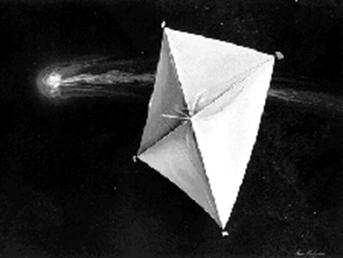
Nearly 400 years ago, as much of Europe was still involved in naval exploration of the world, Johannes Kepler proposed the idea of exploring the galaxy using sails. Through his observation that comet tails were blown around by some kind of solar breeze, he believed sails could capture that wind to propel spacecraft the way winds moved ships on the oceans. What Kepler observed was the pressure of solar photons on dust particles that are released by the comet as it is orbiting. While Kepler's idea of a solar wind has been disproving, scientists have since discovered that sunlight does exert enough force to move objects.
Photonic pressure is a very gentle force which is not observable on earth because the frictional forces in the atmosphere are so much larger. To take advantage of this force, NASA has been experimenting with giant solar sails that could be pushed through the cosmos by light. Solar sails were seriously studied by NASA in the 1960s as possible manned transportation around the solar system. In those days of optimism serious plans were formed for lunar bases by 1975 nuclear launchers and interplanetary engines, and unmanned interstellar probes. None of these ever received serious funding, and they all died on the drawing boards and test beds by the early 1970s.
A solar sail is a very large mirror that reflects sunlight. As the photons of sunlight strike the sail and bounce off, they gently push the sail along by transferring momentum to the sail. Because there are so many photons from sunlight, and because they are constantly hitting the sail, there is a constant pressure (force per unit area) exerted on the sail that produces a constant acceleration of the spacecraft. Although the force on a solar-sail spacecraft is less than conventional chemical rockets, such as the space shuttle, the solar-sail spacecraft constantly accelerates over time and achieves a greater velocity.
It's like comparing the effects of a gust of wind versus a steady, gentle breeze on a dandelion seed floating in the air. Although the gust of wind (rocket engine) initially pushes the seed with greater force, it dies quickly and the seed coasts only so far. In contrast, the breeze weakly pushes the seed during a longer period of time, and the seed travel farther. Solar sails enable spacecraft to move within the solar system and between stars without bulky rocket engines and enormous amounts of fuel.
There are three components to a solar sail-powered spacecraft:
" Continuous force exerted by sunlight
" A large, ultra thin mirror
" A separate launch vehicle
A number of choices exist for solar sail materials. For an Earth-launched near-term sail craft, one approach is to create the sail using a sandwich of three materials. A metallic, highly reflective (front) layer faces the Sun, followed by a layer of flexible, temperature-resistant plastic. The back layer is composed of a highly emissive material such as chromium. The function of the layer facing the Sun is to reflect as much of the sunlight as possible (up to about 90%). The plastic layer’s function is to improve sail flexibility during the sail unfurlment process. Sunlight absorbed by the front layer is reemitted as infrared electromagnetic radiation from the back emissive layer. The sail thickness is typically of the order of a few microns.
Additional sail strength can be achieved by including strips of metallic ribbing within the sail structure. These might minimize the effects of micrometeoroid impacts. Some researchers have examined the possibility of using plastics that would rapidly degrade when exposed to solar ultraviolet radiation. In a sail constructed of this material, the “sandwich” layers would be reflective, emissive, and finally UV-sensitive plastic. This approach could greatly reduce sail area mass thickness such a sail could be less than 1 gram per square meter. A sail craft constructed using this material could operate well within 0.1 AU.
If the perforations are substantially smaller than the wavelength of incident light, low mass and high reflectance might combine to greatly increase sail performance.
A solar sail-powered spacecraft wouldn't need traditional propellant for power, because its propellant would be sunlight and the sun would be its engine. Light is composed of electromagnetic radiation that exerts force on objects it comes in contact with. NASA researchers have found that at 1 astronomical unit (AU),which is the distance from the sun to Earth, equal to 93 million miles (150 million km), sunlight can produce about 1.4 kilowatts (kw) of power. If you take 1.4 kW and divide it by the speed of light, you would find that the force exerted by the sun is about 9 Newton (N)/square mile (i.e., 2 lb/km2 or .78 lb/mi2).
In comparison, a space shuttle main engine can produce 1.67 million N of force during liftoff and 2.1 million N of thrust in a vacuum. Eventually, however, the continuous force of the sunlight on a solar sail could propel a spacecraft to speeds five times faster than traditional rockets.Using the following equations and values, you can calculate the force of sunlight on solar sail and acceleration of the spacecraft:
• Force (F) = 2(P x A)/c
• Acceleration (a) = F/M
At 1 astronomical unit, the power of sunlight is about 1,400 watts/meter2.
Our spacecraft weighs 2.2-lb (1-kg) and has a sail area of 1 km2 or 1-million m2,
So:
* P (power) = 1,400 watts/m2
* A (area) = 1-million m2
* c (speed of light) = 3x10⁸ m/s
* M (mass) = 1 kg
This works out to a force (F) of about 2 lb or 9 Newton’s (N). This force leads to an acceleration (a) of about 29 ft/s 2 (9 m/s2), slightly less than the acceleration due to Earth's gravity. In comparison, a space-shuttle main engine can produce 367,000 lb (1.67-million N) of force during liftoff and 462,000 lb (2.1-million N) of thrust in a vacuum.
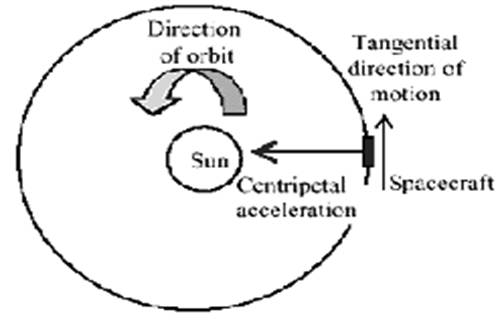
As every sailor knows, to tack a sailboat is to sail the boat at an angle into the wind. Before we can explore the motion of a spacecraft with a light sail attached to it, we must first understand its natural motion in the presence of the sun's gravitational field. If one places a spacecraft in orbit around the sun, it moves on a trajectory that is defined by the sum of all the forces acting on it. The dominant force acting on an orbiting space craft is the centripetal force due to the gravitational pull of the sun as described in figure and table below. This force is balanced by the outward centrifugal force, mv2/r, of the spacecraft's motion.
Maneuvering a solar-sail spacecraft requires balancing two factors: the direction of the solar sail relative to the sun and the orbital speed of the spacecraft. By changing the angle of the sail with respect to the sun, you change the direction of the force exerted by sunlight.
When the spacecraft is in orbit around the Earth or sun, it is traveling in a circular or elliptical path at a given speed and distance. To go to a higher orbit (travel farther away from the object), you angle the solar sail with respect to the sun so that the pressure generated by sunlight is in the direction of your orbital motion. The force accelerates the spacecraft, increases the speed of its orbit and the spacecraft moves into a higher orbit. In contrast, if you want to go to a lower orbit (closer to the object), you angle the sail with respect to the sun so that the pressure generated by the sunlight is opposite the direction of your orbital motion. The force then decelerates the spacecraft, decreases the speed of its orbit and the spacecraft drops into a lower orbit.
The pressure of sunlight decreases with the square of the distance from the sun. Therefore, sunlight exerts greater pressure closer to the sun than farther away. Future solar-sail spacecraft may take advantage of this fact by first dropping to an orbit close to the sun -- a solar fly-by -- and using the greater sunlight pressure to get a bigger boost of acceleration at the start of the mission. This is called a powered perihelion maneuver.
| Are you interested in this topic.Then mail to us immediately to get the full report.
email :- contactv2@gmail.com |
