

Published on Jan 09, 2026
Success is all about being in the right place at the right time ….. and the axiom is a guiding principle for designers of motorsport circuits. To avoid problems you need know where and when things are likely to go wrong before cars turn a wheel -and anticipating accidents is a science.
Take barriers, for example .there is little point erecting them in the wrong place -but predicting the right place is a black art. The FIA has developed bespoke software, the Circuit and Safety Analysis System (CSAS), to predict problemareas on F1 circuits.
Where and when cars leave circuits is due to the complex interaction between their design, the driver's reaction and the specific configuration of the track, and the CSAS allows the input of many variables-lap speeds ,engine power curves, car weight changes, aerodynamic characteristics etc -to predict how cars may leave the circuit at particular places. The variables are complex. The impact point of a car continuing in a straight line at a corner is easy to predict, but if the driver has any remaining control and alters the car's trajectory, or if a mechanical fault introduces fresh variables, its final destination is tricky to model.
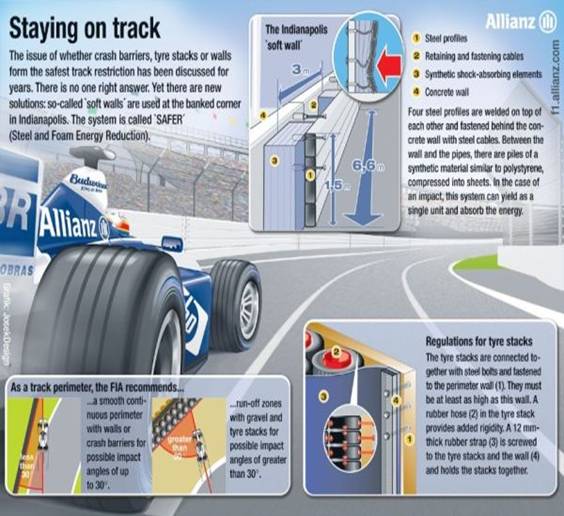
Modern tyre barriers are built of road tyres with plastic tubes sandwiched between them. The side facing the track is covered with conveyor belting to prevent wheels becoming snagged and distorting the barrier. The whole provides a deformable 'cushion' a principle that has found its way to civilian roads. Barriers made of air filled cells, currently under investigation may be the final answer. Another important safety factor is the road surface. Racing circuits are at the cutting edge of surface technology, experimenting with new materials for optimum performance.
Predicting the trajectory and velocity of a racing car when it is driven at the limit within the confines of a racing track, is now the subject of a great deal of analytical work by almost all teams involved in racing at all levels. However, predicting the trajectory and velocity of a car once the driver has lost control of it has not been something the teams have devoted a great deal of time to. This can now also be analyzed though in the same sort of detail, to assess the safety features of the circuits on which it is raced. The two tasks are very different, and the FIA had to start almost from scratch when it set out to develop software for its Circuit and Safety Analysis System (CSAS).
The last two decades have seen a steady build up of the R&D effort going into vehicle dynamics modeling, particularly by those teams that design and develop cars as well as race them. The pace of development has been set by the availability of powerful PC's, the generation of vehicle and component data, and the supply of suitably qualified graduates to carry out the work. Their task is to be able to model and predict the effects of every nuance of aerodynamic, tire, engine, damper etc., characteristic on the speed of their car at every point on a given circuit. The detail in the model will only be limited by available dynamic characteristics and track data, and will require a driver model to complete the picture. However, they are only interested in the performance of the car while the tires are in contact with the tarmac, and the driver is operating them at or below their peaks.
The ideal crash barrier is no barrier at all. However, the only applications of this in motor sport are at Bonneville and the Black Rock desert, used for Land Speed Record attempts. At these sites there are several miles in every direction between the track and the mountains and, even through a telephoto lens the vehicles seem a very long way away from the spectators and viewers. Barriers are necessary on race circuits to enable spectators and TV cameras to get close enough to the action, without being exposed to the danger of being hit by an out of control car.
The problem is little different from stopping a train ploughing into the platform and injuring potential passengers when the driver has left the braking too late. The buffer is equipped with energy absorbing devices (large spring/dampers), which engage with similar devices on the front of the train. The energy is absorbed and dissipated and the train brought to a halt without damage or too great a shock to the passengers. Provided the capacity of the joint energy absorbing system is adequate. Road and racing car barrier systems work in a similar fashion: both cars and barriers have energy absorbing devices, which engage and dissipate the kinetic energy of the car.
However, while trains are perfectly aligned, buffer to buffer, by the rails, cars can hit a barrier pointing in any direction, at any height, and either spinning, rolling, tumbling end over end, or some complex combination of all of them. The energy must be dissipated without either subjecting the car to loads that cause the driver protection structure (safety cell) to fail and injure the driver by intrusion, or subject the driver to decelerations that cause internal injuries or result in him striking the safety cell, especially with his head. The magnitude of the energy to be absorbed and dissipated increases as the square of the speed: at 100kph it is the equivalent of dropping the car from a height of 78 meters; at 200kph - 314 meters; at 300kph - 707 meters. Loss of control of a racing car at the end of a straight is the equivalent of falling from an aircraft flying at a height of nearly one kilometer.
The mechanisms used by the car and barrier energy absorbing systems vary. The Formula 1 Technical Regulations stipulate a series of tests on frontal, rear and side impact structures that results in short, stiff, sacrificial structures that dissipate energy by material failure. The highest performance of these tests - the frontal impact test - generates peak loads of 460KN (60g), 300KN (40g) average, and dissipates the energy equivalent to a fully loaded car travelling at 50kph in little over 0.5 meters. Barriers tend to be more like train buffer systems, behaving like spring/dampers.
They absorb energy by deflection, dissipating some of it via the damper part, and storing and releasing again the remainder, via the spring. This latter causes rebound, Some barriers also slow the car by momentum transfer: the car collects heavy parts of the barrier, and by the principle of conservation of momentum, its speed is reduced proportional to the increase in the mass of the car plus the barrier. Fig.1 shows a car hitting a two-row tire barrier, spaced in front of a three-row barrier. When it hits the first rows it collects an ever-increasing mass of tires, which combines with the mass of the car to reduce its velocity by momentum transfer, prior to impacting the second set of tires. In fact, most barriers combine momentum transfer, material failure, spring and damper in a complex interaction.
Pure material failure (crushable) barriers such as Armco and foam blocks, have not found the favor one might expect as they are one-shot systems, and there is a racing requirement to replace barriers as soon as they are damaged. Spring/damper barriers usually recover, to be capable of absorbing further impacts.
| Are you interested in this topic.Then mail to us immediately to get the full report.
email :- contactv2@gmail.com |
