


Published on Jan 09, 2026
The term "Cryogenics" originates from Greek word which means creation or production by means of cold. As prices for energy and raw materials rise and concern for the environment makes safe waste disposal difficult and Costly, resource recovery becomes a vital matter for today's business. Cryogenic grinding technology can efficiently grind most tough materials and can also facilitate Cryogenic recycling of tough composite materials and multi component scrap.
The heart of this technology is the CRYO-GRIND SYSTEM. It employs a cryogenic process to embrittle and grind materials to achieve consistent particle size for a wide range of products. The cryogenic process also has a unique capability for recycling difficult to separate composite materials.
Cryogenic grinding is a method of powdering herbs at sub-zero temperatures ranging from 0 to minus 70°F. The herbs are frozen with liquid nitrogen as they are being ground. This process does not damage or alter the chemical composition of the plant in any way. Normal grinding processes which do not use a cooling system can reach up to 200°F. These high temperatures can reduce volatile components and heat-sensitive constituents in herbs. The cryogenic grinding process starts with air-dried herbs, rather than freeze-dried herbs.
Solid materials are ground or pulverized by way of hammer mills, attrition mills, granulators or other equipment. A smaller particle size is usually needed to enhance the further processing of the solid, as in mixing with other materials. A finer particle also helps in melting of rubber and plastics for molding. However, many materials are either very soft or very tough at room temperatures. By cooling to cryogenic temperatures with liquid nitrogen, these may be embrittled and easily fractured into small particles.
A scientifically controlled study using four herbs was conducted at Frontier Herbs in the Fall of 1996, comparing cryogenic grinding methods with normal grinding methods. The herbs tested included feverfew, goldenseal, valerian and echinacea. In all cases the cryogenically ground herb contained greater amounts of the constituents tested. Feverfew herb showed the greatest difference, with the cryogenically ground herb containing 21.8% higher levels of parthenolide, the primary active constituent. Valerian root showed an 18.7% increase in valerenic acid when cryogenically ground. Goldenseal root showed a 16.4% increase in berberine and 10.7% increase in hydrastine. Lastly, Echinacea purpurea root showed a 12.1% increase in total phenolic content in the cryogenically ground root. Test results were obtained by HPLC (high performance liquid chromatography) methods.
Cryogenic grinding was shown to significantly affect active constituent levels in herbs. Test results showed an average increase of 15.6% in constituents tested in four medicinal herbs when they were ground cryogenically. The range was 10.7% to 21.8%, indicating that some herbs are affected more than others by the temperatures at which they're ground.
Since almost all materials embrittle when exposed to cold temperatures, cryogenic size reduction utilizes the cold energy available from liquid nitrogen to cool, embrittle and inert materials prior to and or during the grinding process. All materials which due to their specific properties at ambient temperatures are elastic, have low melting points, contain volatile or oily substances, have low combustion temperatures and are sensitive to oxygen, are ideal candidates for cryogenic size reduction.
Physical properties of liquid nitrogen is produced by the separation of air into its components in an air separation plant and is distributed in vacuum insulated transport vessels to the end user where it is stored in a vacuum insulated storage vessel till it is used. At atmospheric pressure liquid nitrogen is at a temperature of -320 deg F and possesses a latent energy content of 94 BTU/LB resulting in a total cooling energy content of 179.6 BTU/LB. Nitrogen is anon-flammable, non toxic and inert gas which makes up 78.09% of the air we breathe.
When using the system, measurable and repeatable results are obtained for lab or productions calculations. Mills range in size from 7-1/2 HP to 200 HP. With our cryogenic grinding unit an understanding develops with interaction of equipment components and operating parameters. Factors such as consistent feed rate, precise temperature measurement, mill operating parameters and pressure control are critical to the evaluation of cryogenic grinding and cryogenic grinding systems.
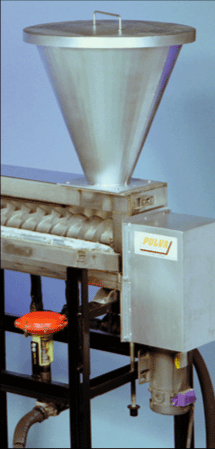
For pulverizing many materials, cryogenic grinding technology increases productivity and lowers power costs. Many elastic or "soft" materials are very difficult to pulverize, requiring long cycle times and high energy consumption. This combination decreased productivity and increased costs unnecessarily. Cryogenic grinding involves cooling a material below its embrittlement temperature with a cryogenic fluid, typically liquid nitrogen or, in certain applications, carbon dioxide. After cooling, the material is fed into an impact mill where it is reduced in size primarily by brittle fracture. This process has several benefits:
• Ability to process relatively "soft" or elastic materials that cannot otherwise be ground
• Increased throughput
• Reduced power consumption
• Smaller size particles
• Minimal loss of volatile components
• Lower capital investment
Probably the greatest benefit provided by cryogenic grinding is the ability to grind "soft" or elastic materials that otherwise could not be ground, or could be ground only with long cycle times and high energy use. By embrittling the material, fine powder or crumb can be obtained easily and with a minimum expenditure of energy. Because embrittled material grinds easily, the throughput for a given mill is substantially increased and less power is used per pound of material ground.
Cryogenic grinding also reduces the material to particle sizes difficult or impossible to attain with ambient temperature grinding. The dry, cold, inert atmosphere in which the grinding occurs minimizes reaction with the material and reduces the loss of volatile components. When processing composite materials, cryogenic grinding usually makes it easy to separate the various materials.
Cryogenic grinding is used for grinding spices, thermoplastics, elastomers, color concentrates, and similar materials. It is also used to recover a variety of scrap materials, such as factory scrap rubber and scrap tires, and to separate the components in composite materials.
1. Higher production rate
2. Lower energy consumption
3. Finer particle size
4. More uniform particle distribution
5. Lower grinding cost
6. No heat generation which is good while grinding spices, pharmaceuticals and scrap plastics
7. Provides an inert atmosphere thus eliminating the possibility of oxidation
| Are you interested in this topic.Then mail to us immediately to get the full report.
email :- contactv2@gmail.com |
