
Published on Jan 09, 2026
As the whole world is aligning itself to new standards, the industry has to meet the challenges and realign itself to satisfy the customer's demands. Thus arise various production techniques and competitive management standards. A concept which arose in U.S.A in1990 called AGILITY is the subject of this seminar.
This seminar aims to throw light into the concept and philosophy of agility and how it can be used in manufacturing. It also helps to learn the pillars on which it is built. Some case studies are also included to show the effect of various pillars.
The world as a whole is now adjusting itself to the competitive realities of a new set of competitive standards. In the old economy competitive success was based almost exclusively on the ability to improve productivity .In the new economy, organization and nations compete in quality, variety, customization, timely response etc. So manufactures must be able to develop and produce customized products rapidly to meet ever changing customer needs to be ahead of others.
Methods to meet these requirements are the basics of agile engineering. Agile Engineering or Manufacturing is a new concept of management originating from USA aimed at carving a new path for business enterprises. The emphasis is to make the organization quick shift in style of working to adopt the changes in market environment in order to remain the business leader ahead of competitors. Thus the ability to use and exploit a fundamental resource-knowledge and imagination is the impetus behind agile organizations.
The industrial revolution led to mass production practices and the scientific definition of cost accounting system. That period represented seller's market, where demand was greater than capacity. Price was based on the cost of production and expected profit. The fixed of capital was amortized for a long period of time, but variable costs were high and needed to be managed. The solution was simple -treat manufacturing as a cost driver by focusing on local optimization, breaking down to tasks into small simple steps and producing high volumes of standard products at the lowest possible cost. Consequently labor was de-skilled.
The computer revolution dramatically changed the market characteristic. Today it's the buyer's market where capacity is higher than demand. Price is dictated by the market and is not based on producer's expected profit. Manufactures must develop a balance between the external and internal measures. Their focus is changing to global optimization from local optimization by determining what customers want and delivering the right product.g
The Japanese who dominated the market at the middle of the 20th century had developed their own paradigm called "LEAN MANUFACTURING" .As the customers were shifting towards the Japanese the US introduced "AGILE ENGINEERING" IN 1991 so as to compete with them.
With the Indian automobile industry now open to global players, competition has set in and the customer has a wide choice now. The mechatronics application in automotives has revolutionized the automobile industries. Computers are the electronic devices that stores data, manipulate them through arithmetic and logical operations and an output according to the instructions already given to it.
A mid-sized engineering consulting firm uses a web based optimization solution to give employees more options for self-service and increase the productivity of its human resource staff.
Agile Engineering a mid-sized consulting a mid size consulting firm faced a large backlog of opportunities for new projects but was struggling to build an adequate work force to handle the work load. From bringing new hires on broad, to keep company needed to enhance its workforce management tools and processes.
Agile Engineering launched a work force optimization solution using the internet to advantage to give employees quick access to the information they needed to their jobs and to simplify and enhance a wide range of human resource activities. Employees themselves now can complete processes that are required a phone call or letter to human resources –with a turn around of several days in minutes.
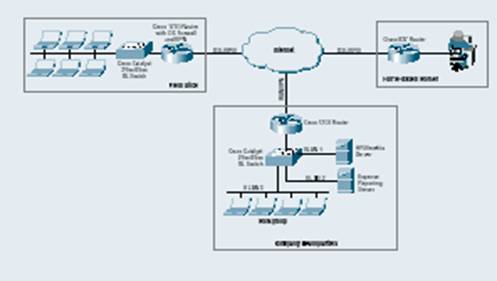
Fig .3(B)
The work force optimization strategy for Agile centered on
Through a new company wide intranet, Agile Engineering gave employees a single, web based window into their company policies, directories etc.Making training available on line enabled employees to improve their skills at their convenience, without costly travel to the headquarters and without disrupting normal work schedules. This helped to respond more quickly to problems and opportunities.
Agile’s engineers work in three remote sites and frequently from their homes or customer sites. The workforce optimization solution eliminates the isolation of these remote employees by allowing them to use any web connection to update their benefits choices, report expenses and complete performance reviews at their convenience.
The work force optimization solution provided human resources with new tools to finding and hiring skilled employees. Using internet agile was able to reach candidates all over the world
A single microprocessor in an automobile may do the following
1. Carburetor/Fuel injection control
2. Spark timings
3. Idle speed of the engine
4. Cruise control
5. Air management
6. Exhaust control
7. Transmission control
8. Instrumental panel display
9. Self-diagnosis of the system
10. Passenger safety aspects.
The brain behind all these functions is a small digital computer which contains the logic for the entire system.
1. The first is the change from standardization to post standardization .Industrial society was characterized by high volume production of small variety of items. An information society however is capable of small production runs of multiple items which match individual needs.
2. The second is the shift from specialization to collaboration, with many aspects of society becoming increasingly composite and multidisciplinary.
3. The third is the shift from constraints of time and place.
4. The fourth is the trend away from concentration and diversification.
5. From centralization to decentralization
6. Finally leading to sustainability in manufacturing
The new economy requires management technologies, work force that are flexible and roboust, agile engineering. The new markets standards would not have been possible without an equally new role for technology. Thus agile manufacturing techniques has fully exploited the flexible new technology, by using it in conjunction with equally flexible workforce and organizational formats, have raised the level of competition and increased the range of competitive standards.
| Are you interested in this topic.Then mail to us immediately to get the full report.
email :- contactv2@gmail.com |
