


Updated on May 29, 2026
The Synchronous optical network, commonly known as SONET, is a standard for communicating digital information using lasers or light emitting diodes (LEDs) over optical fiber as defined by GR-253-CORE from Telcordia. It was developed to replace the PDH system for transporting large amounts of telephone and data traffic and to allow for interoperability between equipment from different vendors.
The more recent Synchronous Digital Hierarchy (SDH) standard developed by ITU (G.707 and its extension G.708) is built on experience in the development of SONET. Both SDH and SONET are widely used today; SONET in the U.S. and Canada, SDH in the rest of the world. SDH is growing in popularity and is currently the main concern with SONET now being considered as the variation.
SONET differs from PDH in that the exact rates that are used to transport the data are tightly synchronized to network based clocks. Thus an entire network can operate synchronously, though the presence of different timing sources allow for different circuits within a SONET signal to be timed off of different clocks (through the use of pointers and buffers.) SDH was made possible by the existence of atomic clocks.
Both SONET and SDH can be used to encapsulate earlier digital transmission standards, such as the PDH standard, or used directly to support either ATM or so-called Packet over SONET networking. As such, it is inaccurate to think of SONET as a communications protocol in and of itself, but rather as a generic and all-purpose transport container for moving both voice and data.
Both optical and electrical physical interfaces are defined for SONET. There are three basic line inter¬face types for short, intermediate, and long reach, as defined in the appendices. Fundamentally, a SONET signal can be transmitted up to approximately 40 Km, without requiring a signal regeneration or amplification.
The actual optical signal used in fiber optics trans¬mission is a serial digital stream consisting of a light source being turned on and off very quickly to match the incoming electrical signal from the input source. The electronic binary 'on-off' becomes an optical binary 'on-off'. The fiber material consists of an inner cylindrical glass core surrounded by an outer glass sheath called a cladding The cladding is reflective, while the inner core is highly transparent. The light transmitted into the end of the fiber goes through the transparent core and stays within the core by bouncing off the reflective cladding (figure 2). The cladding is like a cylindrical mirror surrounding the core, so that light stays in the fiber core as if it were a 'light pipe' in the same way water stays in a metal clad pipe.
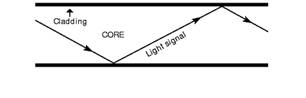
"It is interesting to note just how transparent the glass is in the core of an optical fiber. It is composed of pure silicon dioxide (SIO2). Consider the picture window you have at home in your living room; it is V plate glass. You could replace it with a window made of fiber optic core glass that was three miles thick, and you could get the same bright image coming through the three mile thick window that you currently do with the V8"plate glass window."
The use of single mode vs. multi-mode is a function of the core diameter of the fiber. In multi-mode, the core is from 50 to 100 microns (II 500th to II 250th of an inch). In single mode, the diameter is 7 to 9 microns (about II 3000th of an inch). With a wider core, different rays of light bounce off the fiber cladding at different angles and they actually travel different total distances as they go through a long cable from one end to the other. Since some light rays travel longer distances and some shorter, while the speed of light is constant (186,000 mps), some of the rays will arrive at the distant end later than others.
Therefore, a square pulse of light power may exhibit pulse spreading or dispersion over long distances. In single mode, the transmission is with a single ray of light, usually with a laser. However, an LED can be used. In single mode systems, a square wave pulse maintains its integrity throughout the pipe. R>r very high rates and long distances, single mode provides the best method of transmission.
As the serial digital signal is transmitted over the fiber cable, information is overlaid according to a predefined organizational structure called the STS-1 Frame. This STS-1 Frame overlays data on the optical signal at 51.84 Mbps. The signal layout is usually depicted as a two dimensional array (figure 3) consisting of nine rows by 90 columns, representing 810 8-bit bytes, or 6,480 bits per frame. The frame repetition rate is 8,000 frames per second. The duration of each frame is 125 microseconds. At 6,480 bits per frame x 8,000 frames a second equals 51,840,000 bps
| Are you interested in this topic.Then mail to us immediately to get the full report.
email :- contactv2@gmail.com |
