


Updated on May 29, 2026
The new millennium has introduced increased pressure for finding new renewable energy sources. The exponential increase in population has led to the global crisis such as global warming, environmental pollution and change and rapid decrease of fossil reservoirs.
Also the demand of electric power increases at a much higher pace than other energy demands as the world is industrialized and computerized. Under these circumstances, research has been carried out to look into the possibility of building a power station in space to transmit electricity to Earth by way of radio waves-the Solar Power Satellites. Solar Power Satellites(SPS) converts solar energy in to micro waves and sends that microwaves in to a beam to a receiving antenna on the Earth for conversion to ordinary electricity.
SPS is a clean, large-scale, stable electric power source. Solar Power Satellites is known by a variety of other names such as Satellite Power System, Space Power Station, Space Power System, Solar Power Station, Space Solar Power Station etc. One of the key technologies needed to enable the future feasibility of SPS is that of Microwave Wireless Power Transmission.WPT is based on the energy transfer capacity of microwave beam i.e, energy can be transmitted by a well focused microwave beam. Advances in Phased array antennas and rectennas have provided the building blocks for a realizable WPT system.
Increasing global energy demand is likely to continue for many decades. Renewable energy is a compelling approach - both philosophically and in engineering terms. However, many renewable energy sources are limited in their ability to affordably provide the base load power required for global industrial development and prosperity, because of inherent land and water requirements. The burning of fossil fuels resulted in an abrupt decrease in their .it also led to the green house effect and many other environmental problems. Nuclear power seems to be an answer for global warming, but concerns about terrorist attacks on Earth bound nuclear power plants have intensified environmentalist opposition to nuclear power.
Moreover, switching on to the natural fission reactor, the sun, yields energy with no waste products. Earth based solar panels receives only a part of the solar energy. It will be affected by the day & night effect and other factors such as clouds. So it is desirable to place the solar panel in the space itself, where, the solar energy is collected and converted in to electricity which is then converted to a highly directed microwave beam for transmission. This microwave beam, which can be directed to any desired location on Earth surface, can be collected and then converted back to electricity. This concept is more advantageous than conventional methods. Also the microwave energy, chosen for transmission, can pass unimpeded through clouds and precipitations.
The concept of a large SPS that would be placed in geostationary orbit was invented by Peter Glaser in 1968. The SPS concept was examined extensively during the late 1970s by the U.S Department of Energy (DOE) and the National Aeronautics and Space Administration (NASA). The DOE-NASA put forward the SPS Reference System Concept in 1979.
The central feature of this concept was the creation of a large scale power infrastructure in space, consisting of about 60 SPS, delivering a total of about 300GW.But, as a result of the huge price tag, lack of evolutionary concept and the subsiding energy crisis in 1980-1981, all U.S SPS efforts were terminated with a view to re-asses the concept after about ten years. During this time international interest in SPS emerged which led to WPT experiments in Japan.
Solar Power Satellites would be located in the geosynchronous orbit. The difference between existing satellites and SPS is that an SPS would generate more power-much more power than it requires for its own operation.
The solar energy collected by an SPS would be converted into electricity, then into microwaves. The microwaves would be beamed to the Earth’s surface, where they would be received and converted back into electricity by a large array of devices known as rectifying antenna or rectenna.(Rectification is the process by which alternating electrical current ,such as that induced by a microwave beam , is converted to direct current). This direct current can then be converted to 50 or 60 Hz alternating current.
Each SPS would have been massive; measuring 10.5 km long and 5.3 km wide or with an average area of 56 sq.km.The surface of each satellite would have been covered with 400 million solar cells.
The transmitting antenna on the satellite would have been about 1 km in diameter and the receiving antenna on the Earth’s surface would have been about 10 km in diameter. The SPS would weigh more than 50,000 tons.
The reason that the SPS must be so large has to do with the physics of power beaming. The smaller the transmitter array, the larger the angle of divergence of the transmitted beam. A highly divergent beam will spread out over a large area, and may be too weak to activate the rectenna.In order to obtain a sufficiently concentrated beam; a great deal of power must be collected and fed into a large transmitter array.
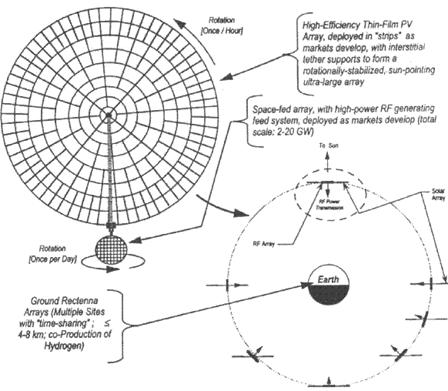
Figure 1 Configuration of SPS is space.
The day-night cycle ,cloud coverage , atmospheric attenuation etc.reduces the amount of solar energy received on Earth’s surface.SPS being placed in the space overcomes this .Another important feature of the SPS is its continuous operation i.e,24 hours a day,365 days a year basis. Only for ma total of 22 in a year would the SPS would be eclipsed for a period of time to a maximum of 72 min.If the SPS and the ground antenna are located at the same longitude, the eclipse period will center around midnight.
The power would be beamed to the Earth in the form of microwaves at a frequency of 2.45 GHz. Microwaves can pass unimpeded through clouds and rain .Microwaves have other features such as larger band width , smaller antenna size, sharp radiated beams and they propagate along straight lines. Because of competing factors such as increasing atmospheric attenuation but reducing size for the transmitting antenna and the other components at higher frequency , microwave frequency in the range of 2-3 GHz are considered optimal for the transmission of power from SPS to the ground rectenna site. A microwave frequency of 2.45 GHz is considered particularly desirable because of its present uses for ISM band and consequently probable lack of interference with current radar and communication systems. The rectenna arrays would be designed to let light through, so that crops or even solar panels could be placed underneath it. Here microwaves are practically nil.
The amount of power available to the consumers from one SPS is 5 GW.the peak intensity of microwave beam would be 23 mW/cm². So far, no non thermal health effects of low level microwave exposure have been proved, although the issue remains controversial. SPS has all the advantage of ground solar, plus an additional advantage; it generates power during cloudy weather and at night. In other words SPS receiver operates just like a solar array. Like a solar array, it receives power from space and converts it into electricity. If the satellite position is selected such that the Earth and the Sun are in the same location in the sky, when viewed from the satellite, same dish could be used both as solar power collector and the microwave antenna. This reduces the size and complexity of satellite.
However, the main barrier to the development of SPS is social, not technological. The initial development cost for SPS is enormous and the construction time required is very long. Possible risks for such a large project are very large, pay-off is uncertain. Lower cost technology may be developed during the time required to construct the system. So such a large program requires a step by step path with immediate pay-off at each step and the experience gained at each step refine and improve the risk in evolutionary steps.
| Are you interested in this topic.Then mail to us immediately to get the full report.
email :- contactv2@gmail.com |
