

Updated on May 29, 2026
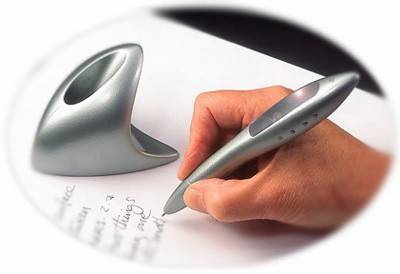
Lyndsay Williams of Microsoft Research's Cambridge UK lab is the inventor of the Smartquill,a pen that can remember the words that it is used to write, and then transform them into computer text . The idea that "it would be neat to put all of a handheld-PDA type computer in a pen," came to the inventor in her sleep . "It's the pen for the new millennium," she says.
Encouraged by Nigel Ballard, a leading consultant to the mobile computer industry, Williams took her prototype to the British Telecommunications Research Lab, where she was promptly hired and given money and institutional support for her project.
The prototype, called SmartQuil, has been developed by world-leading research laboratories run by BT (formerly British Telecom) at Martlesham, eastern England. It is claimed to be the biggest revolution in handwriting since the invention of the pen.
The sleek and stylish prototype pen is different from other electronic pens on the market today in that users don't have to write on a special pad in order to record what they write. User could use any surface for writing such as paper, tablet, screen or even air. The SmartQuill isn't all space-age, though -- it contains an ink cartridge so that users can see what they write down on paper. SmartQuill contains sensors that record movement by using the earth's gravity system, irrespective of the platform used. The pen records the information inserted by the user. Your words of wisdom can also be uploaded to your PC through the "digital inkwell", while the files that you might want to view on the pen are downloaded to SmartQuill as well.
It is an interesting idea, and it even comes with one attribute that makes entire history of pens pale by comparison-if someone else picks your SmartQuill and tries to write with it- it won't. Because user can train the pen to recognize a particular handwriting. Hence SmartQuill recognizes only the owner's handwriting. SmartQuill is a computer housed within a pen which allows you to do what a normal personal organizer does .
It's really mobile because of it's smaller size and one handed use. People could use the pen in the office to replace a keyboard, but the main attraction will be for users who usually take notes by hand on the road and type them up when returning to the office. SmartQuill will let them skip the step of typing up their notes.
SmartQuill is slightly larger than an ordinary fountain pen. Users can enter information into these applications by pushing a button on the pen and writing down what they would like to enter .The SmartQuill does not need a screen to work. The really clever bit of the technology is its ability to read handwriting not only on paper but on any flat surface - horizontal or vertical.
There is also a small three-line screen to read the information stored in the pen; users can scroll down the screen by tilting the pen slightly. The user trains the pen to recognize a particular handwriting style - no matter how messy it is, as long as it is consistent, the pen can recognize it. The handwritten notes are stored on hard disk of the pen.
The pen is then plugged into an electronic "inkwell" ,text data is transmitted to a desktop computer, printer, or modem or to a mobile telephone to send files electronically. Up to 10 pages of notes can be stored locally on the pen . A tiny light at the tip allows writing in the dark. When the pen is kept idle for some time ,power gets automatically off.
" Display technology used in SmartQuill
" Handwriting recognition and signature verification
" Display scrolls using tilt sensors
" Communication with other devices
" Memory and power
Display technology used in SmartQuill
Handwriting recognition and signature verification
Display scrolls using tilt sensors
Communication with other devices
Memory and power
Technology used in SmartQuill for display is Kopin Corp’s Cyber Display technology. Cyber Display is a ¼ inch diagonal LCD that uses circuitry built on a silicon wafer, then removed and mounted to glass. The displays are integrated to miniature monitors using its own backlighting,
optics, ICS and packaging.
Accelerometers measure hand movement in 2 or 3 planes
• On board DSP converts to ASCII characters for pen applications
• Write on paper, flat surface, vertical wall or in air
• Single character recognition on pen
• Record cursive letters and download to PC for decoding
• Password by signature recognition
SmartQuill works by measuring the pen's movements and matching them to the movements that produce letters and words programmed into its memory. It's similar to the way a microphone detects sound. Consistency of handwriting, rather than neatness, is the only condition for accuracy.
There are 2 techniques used for this purpose :-
1. Accelerometer technology
2. Handwriting recognition software
This technology uses a device called Accelerometer which is used for measuring motion. A tiny accelerometer in a pen could be used to detect the stops and starts, arcs and loops of handwriting, and transmit this information to a small microprocessor that would make sense of it as text. There's also the possibility of viewing a full page of text through a special monocular magnified "virtual" screen that could be built into the end of the pen.
Invisible writing in air is achieved through this unique technology called accelerometer that monitors hand movements and can also be used as a ‘virtual hinge’ to scroll around the small screen on the pen and detect left or right-handed use. It records movement by using the earth's gravity system, whether you write on paper or in the air. Hence it is independent of surface used. Movements are stored within the SmartQuill. This information is transmitted on to a small microprocessor that would make sense of it as a text displayed on the sleek built in screen
| Are you interested in this topic.Then mail to us immediately to get the full report.
email :- contactv2@gmail.com |
