


Updated on May 29, 2026
With in today's Internet data is transported using wavelength division multiplexed (WDM) optical fiber transmission system that carry 32-80 wavelengths modulated at 2.5gb/s and 10gb/s per wavelength.
Today's largest routers and electronic switching systems need to handle close to 1tb/s to redirect incoming data from deployed WDM links. Mean while next generation commercial systems will be capable of single fiber transmission supporting hundreds of wavelength at 10Gb/s and world experiments have demonstrated 10Tb/shutdown transmission.
The ability to direct packets through the network when single fiber transmission capacities approach this magnitude may require electronics to run at rates that outstrip Moor's law. The bandwidth mismatch between fiber transmission systems and electronics router will becomes more complex when we consider that future routers and switches will potentially terminate hundreds of wavelength, and increase in bit rate per wavelength will head out of beyond 40gb/s to 160gb/s. even with significance advances in electronic processor speed, electronics memory access time only improve at the rate of approximately 5% per year, an important data point since memory plays a key role in how packets are buffered and directed through a router.
Additionally opto-electronic interfaces dominate the power dissipations, footprint and cost of these systems, and do not scale well as the port count and bit rate increase. Hence it is not difficult to see that the process of moving a massive number of packets through the multiple layers of electronics in a router can lead to congestion and exceed the performance of electronics and the ability to efficiently handle the dissipated power.
In this article we review the state of art in optical packet switching and more specifically the role optical signal processing plays in performing key functions. It describe how all-optical wavelength converters can be implemented as optical signal processors for packet switching, in terms of their processing functions, wavelength agile steering capabilities, and signal regeneration capabilities.
Examples of how wavelength converters based processors can be used to implement asynchronous packet switching functions are reviewed. Two classes of wavelength converters will be touched on: monolithically integrated semiconductor optical amplifiers (SOA) based and nonlinear fiber based.
Routing and transmission are the basic functions required to move packets through a networks In today’s internet protocol (IP) networks, the packet routing and transmission problems are designed to handle separately. A core packet network will typically interface to smaller networks and/or other high capacity networks.
A router moves randomly arriving packets through a network by directing them from its multiple inputs to outputs and transmitting them on a link to next router. The router uses information carried with arriving packets (e.g. IP headers, packet type and priority) to forward them from its input to output ports as efficiently as possible with minimal packet loss and disruption to packet flow.
This processing of merging multiple random input packet streams onto common output is called statistical multiplexing. In smaller networks, the links between routers can be made directly using Ethernet; however in high capacity metropolitan enterprise transmission systems between routers employ synchronous framing techniques like synchronous optical network (SONET), packet over SONET (pos), or Gigabit Ethernet (Gig E). This added layer of framing is designed to simplify transmission between routers and decouple it from packet routing and forwarding process. Figure 1 illustrate that the transport that connects routers can designed to handle the packets asynchronously or synchronously.
The most commonly used approaches (SONET, pos, Gig.E) maintain the random nature of packet flow by only loosely aligning them with in synchronous transmission frames. Although not widely used in today’s networks, packets may also be transmitted using a fixed time slotted approach, similar to older token ring and fiber distributed data interface (FDDI) networks, where they are placed with in an assigned time slot is frame, as illustrated in lower portion of Fig. 1
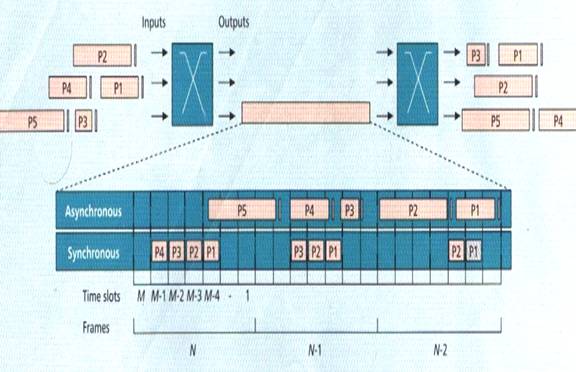
Fig.1. The function of a router is to take randomly arriving packets on its input and statistically multiplex onto its outputs. Packets may be transmitted between routers using a variety of asynchronous or synchronous network access and transmission techniques.
In all optical packet switching network the data is maintained in optical format throughout the routing and transmission processes. One approach that has been widely used is all-optical label swapping (AOLS). AOLS is intended to solve potential mismatch between dense WDM (DWDM) fiber capacity and router packet forwarding capacity, especially as packet data rate increase beyond that easily handled by electronics (>40gb/s). Packets can be routed independent of the payload bit rate, coding format or length. In this approach a lower bit rate label is attached to front end of the packet.
The packet bit rate is then independent of the label bit rate, coding format or length. AOLS is not limited to handle only IP packets but can also handle asynchronous transfers mode ATM) cells, optical bursts, data file transfer, and other data structures without SONET framing. Migrating from POS to packet routed networks can improve efficiency but reduce latency.
In this approach a lower bit rate label is attached to the front end of the packet. The packet bit rate is then independent of the label bit rate and the label can be detected and processed using lower-cost electronics in order to make routing decisions. However, actual removal and replacement of label with respect to packet is done with optics. While the packet contains original electronic IP network data and routing information specifically used in the optical routing layer. The label may also contain bits for error checking and correction as well as source and destination information and framing and timing information
| Are you interested in this topic.Then mail to us immediately to get the full report.
email :- contactv2@gmail.com |
