


Updated on May 29, 2026
With the rapid growth of Internet and networks technique, multimedia data transforming and sharing is common to many people. Multimedia data is easily copied and modified, so necessity for copyright protection is increasing. It is the imperceptible marking of multimedia data to "brand" ownership. Digital watermarking has been proposed as technique for copyright protection of multimedia data.
Digital watermarking invisibly embeds copyright information into multimedia data. Thus, digital watermarking has been used for copyright protection, finger printing, copy protection and broadcast monitoring. Indeed, a watermarking algorithm requires both invisibility and robustness, which exist in a trade-off relation. Thus good watermarking algorithm must be satisfied the requirements.
The process of digital watermarking involves the modification of the original multimedia data to embed a watermark containing key information such as authentication or copyright codes. The embedding method must leave the original data perceptually un-changed, yet should impose modifications which can be detected by using an appropriate extraction algorithm.
Common types of signals to watermark are images, music clips and digital video. The application of digital watermarking to still images is concentrated here. The major technical challenge is to design a highly robust digital watermarking technique, which discourages copyright infringement by making the process of watermarking removal tedious and costly.
Digital watermarking is a technology for embedding various types of information in digital content. In general, information for protecting copyrights and proving the validity of data is embedded as a watermark.
A digital watermark is a digital signal or pattern inserted into digital content. The digital content could be a still image, an audio clip, a video clip, a text document, or some form of digital data that the creator or owner would like to protect. The main purpose of the watermark is to identify who the owner of the digital data is, but it can also identify the intended recipient.
Why do we need to embed such information in digital content using digital watermark technology? The Internet boom is one of the reasons. It has become easy to connect to the Internet from home computers and obtain or provide various information using the World Wide Web (WWW).
All the information handled on the Internet is provided as digital content. Such digital content can be easily copied in a way that makes the new file indistinguishable from the original. Then the content can be reproduced in large quantities.
For example, if paper bank notes or stock certificates could be easily copied and used, trust in their authenticity would greatly be reduced, resulting in a big loss. To prevent this, currencies and stock certificates contain watermarks. These watermarks are one of the methods for preventing counterfeit and illegal use.
Digital watermarks apply a similar method to digital content. Watermarked content can prove its origin, thereby protecting copyright. A watermark also discourages piracy by silently and psychologically deterring criminals from making illegal copies.
A watermark on a bank note has a different transparency than the rest of the note when a light is shined on it. However, this method is useless in the digital world.
Currently there are various techniques for embedding digital watermarks. Basically, they all digitally write desired information directly onto images or audio data in such a manner that the images or audio data are not damaged. Embedding a watermark should not result in a significant increase or reduction in the original data.
Digital watermarks are added to images or audio data in such a way that they are invisible or inaudible Ñ unidentifiable by human eye or ear. Furthermore, they can be embedded in content with a variety of file formats. Digital watermarking is the content protection method for the multimedia era.
Digital watermarking is applicable to any type of digital content, including still images, animation, and audio data. It is easy to embed watermarks in material that has a comparatively high redundancy level ("wasted"), such as color still images, animation, and audio data; however, it is difficult to embed watermarks in material with a low redundancy level, such as black-and-white still images.
To solve this problem, we developed a technique for embedding digital watermarks in black-and-white still images and a software application that can effectively embed and detect digital watermarks.
Structure of a digital watermark
The structure of a digital watermark is shown in the following figures.

The material that contains a digital watermark is called a carrier. A digital watermark is not provided as a separate file or a link. It is information that is directly embedded in the carrier file. Therefore, simply viewing the carrier image containing it cannot identify the digital watermark. Special software is needed to embed and detect such digital watermarks. Kowa 's SteganoSign is one of these software packages.
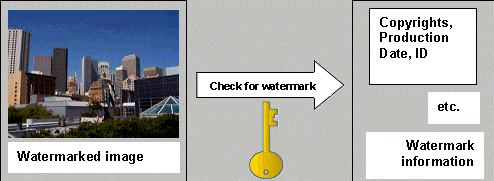
Both images and audio data can carry watermarks. A digital watermark can be detected as shown in the following illustration.
The Internet has provided worldwide publishing opportunities to creators of various works, including writers, photographers, musicians and artists. However, these same opportunities provide ease of access to these works, which has resulted in pirating. It is easy to duplicate audio and visual files, and is therefore probable that duplication on the Internet occurs without the rightful owners' permission.
An example of an area where copyright protection needs to be enforced is in the on-line music industry. The Recording Industry Association of America (RIAA) says that the value of illegal copies of music that are distributed over the Internet could reach $2 billion a year.
Digital watermarking is being recognized as a way for improving this situation. RIAA reports that "record labels see watermarking as a crucial piece of the copy protection system, whether their music is released over the Internet or on DVD-Audio". They are of the opinion that any encryption system can be broken, sooner or later, and that digital watermarking is needed to indicate who the culprit is.
Another scenario in which the enforcement of copyright is needed is in newsgathering. When digital cameras are used to snapshoot an event, the images must be watermarked as they are captured. This is so that later, image's origin and content can be verified. This suggests that there are many applications that could require image watermarking, including Internet imaging, digital libraries, digital cameras, medical imaging, image and video databases, surveillance imaging, video-on-demand systems, and satellite-delivered video.
| Are you interested in this topic.Then mail to us immediately to get the full report.
email :- contactv2@gmail.com |
