


Updated on May 29, 2026
In digital communication , CellonicsTM offers a fundamental change to the way modem solutions have traditionally been designed and built. CellonicsTM technology introduces a simple and swift Carrier - Rate DecodingTM solution to the receiving and decoding of a modulated signal.
It encodes and decodes signals at one symbol per cycle-a feature not found elsewhere. Its simplicity will obsolete the super heterodyne receiver design that has been in use since its invention by Major Edward Armstrong in 1918.In fact, according to one estimate,98 % of the worlds radio systems are still based on this superhet design.
Cellonics Inc. has invented and patented a number of circuits that mimic the above biological cell behavior. The CellonicsTM circuits are incredibly simple with advantages of low-cost, low power consumption and smallness of size. When applied in communication, the CellonicsTM technology is a fundamental modulation and demodulation technique. The CellonicsTM receivers are used as devices that generate pulses from the received analog signal and perform demodulation based on pulse counting
For the last 60 years, the way radio receivers are designed and built has undergone amazingly little change. Much of the current approach could be attributed to EH Armstrong, the oft -credited Father of FM, who invented the super heterodyne method in 1918.He further developed it into a complete FM commercial system in 1933 for use in public-radio broadcasting. Today, more than 98% of receivers in radios, television and mobile phones use this method.
The subsystem used in the superhet design consists of radio-frequency (RF)amplifiers mixers ,phase-lock loops ,filters, oscillators and other components ,which are all complex ,noisy ,and power hungry. Capturing a communications element from the air to retrieve its modulated signal is not easy ,and a system often needs to spend thousands of carrier cycles to recover just one bit of information .This process of demodulation is inefficient ,and newly emerging schemes result in complex chips difficult and expensive to manufacture.
So it was necessary to invent a new demodulation circuit ,which do the job of conventional superheterodyne receiver but at afar lesser component count, faster and lower in power consumption and possessing greater signal robustness These requirements were met by designing a circuit which models the biological cell behavior as explained earlier. The technology for this, named CELLONICS ,was invented by scientists from CWC(Center for Wireless communication) and Computational Science Department in Singapore.
The Cellonics technology is a revolutionary and unconventional approach based on the theory of nonlinear dynamical systems and modeled after biological cell behavior. When used in the field of communication, the technology has the ability to encode, transmit and decode digital information powerfully over a variety of physical channels, be they cables or wirelessly through air.
Cellonics Inc. has developed and patented families of Cellonics™ circuits that are useful for various applications. One of these Cellonics™ circuits is an extremely simple circuit that exhibits the “S curve” transfer characteristic. The circuit contains a negative impedance converter.
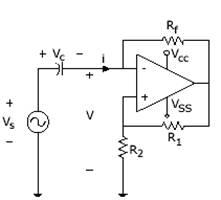
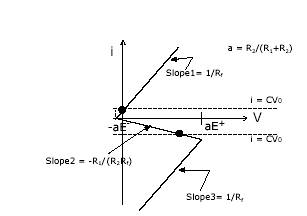
The transfer characteristic consists of three different regions . The two lines at the top and bottom have positive slope, 1/RF and they represent the regions in which the Op-Amp is operating in the saturated (nonlinear) mode. In Fig 2b, the middle segment has a negative slope (negative resistance) and represents the region in which the Op-Amp is operating linearly. It is this negative resistance region that allows the Op-Amp to oscillate and produce pulses bounded by the positive and negative saturation voltages.
For ease of explanation, we assume that the input signal is a triangular waveform. Here we have dVs/dt the negative slope, the number of pulses to be produced at the output = (V0 depending on the slope of the triangular input waveform. Whenever the slope is positive, the Op-Amp is stable and outputs a constant saturation voltage. Thus a silent period is observed i.e. no spike is being produced. On the other hand, with properly selected circuit parameters whenever the slope of the triangular waveform is negative, the Op-Amp is unstable. In this region, the output is oscillating.
The duration of each pulse is similar and the number of pulses generated depends on the length of time the slope remains negative. Thus by controlling the duration of negative slope , the number of pulses to be produced at the output of the Op-Amp can be controlled. The Cellonics™ circuit is robust against noise perturbations – as long as the effective negative slope keeps the Op-Amp unstable, the noise will not have an effect on the pulse generation. The level of tolerance against the noise perturbations is carried out by proper selection of circuit parameters in the design
| Are you interested in this topic.Then mail to us immediately to get the full report.
email :- contactv2@gmail.com |
