


Updated on May 29, 2026
Over the past 15 years, optical current sensors have received significant attention by a number or search groups around the world as next generation high voltage measurement devises, with a view to replacing iron-core current transformers in the electric power industry.
Optical current sensors bring the significant advantages that they are non-conductive and lightweight, which can allow for much simpler insulation and mounting the designs. In addition, optical sensors do not exhibit hysteresis and provide a much larger dynamic range and frequency response than iron-core CT's.
A common theme of many of the optical current sensors is that they work on the principle of the Faraday effect. Current measurement plays an important role in protection and control of electric power systems. With the development of the conventional CT, the accuracy of the CT is up to 0.2% in the steady state power system. However many disadvantages of the conventional CT appear with the short circuit capacities of electric power systems getting larger and the voltage levels going higher for example, saturation under fault current conditions, ferroresonance effects, potential for catastrophic failure etc. Today there is number of interest in using optical current transformer (OCT) to measure the electric current by means of Faraday effect.
The benefits of an OCT are the inverse of the conventional CT's problems. That is, no saturation under fault current conditions, with out iron core and there fore no ferroresonance effects, with out oil and there fore cannot explode, light weight, small size, etc.
A common theme of many of the optical current sensors is that they work on the principle of the Faraday effect. Current flowing in a conductor induces a magnetic field, which, through the Faraday effect, rotates the plane of polarization of the light traveling in a sensing path encircling the conductor. Ampere's law guarantees that if the light is uniformly sensitive to magnetic field all along the sensing path, and the sensing path defines a closed loop, then the accumulated rotation of the plane of polarization of the light is directly proportional to the current flowing in the enclosed wire.
The sensor is insensitive to all externally generated magnetic fields such as those created by currents flowing in near by wires. A measurement of the polarization state rotation thus yields a measurement of the desired current. The technology originated 8 years ago to measure currents in Series Capacitor installations. Since then, it has been introduced not only to Series Capacitor and Thyristor Controlled Series Capacitor installations (FACTS), but also into High Voltage Direct Current Systems (HVDC).
These FACTS & HVDC systems gain their very high availability and reliability using the optically powered CT technology. Further integration of the optically powered technology has led to an economical and solid metering and protection current transformer without any of the known environmental problems associated with the oil or SF6-gas filled technology.
Researchers have perfected the OPCT to measure currents and transmit the data from high voltage system to ground potential using state of the art Laser technology. The fundamental of this technology includes the idea of using fiber optic cables to isolate the current transformers from ground potentials. The advantages of the optically powered scheme compared to the conventional, high voltage, free standing magnetic CT include an environmentally friendly, light weight, non seismic critical composite signal column together with proven, conventional, low voltage rated 'dry type' CT technology.
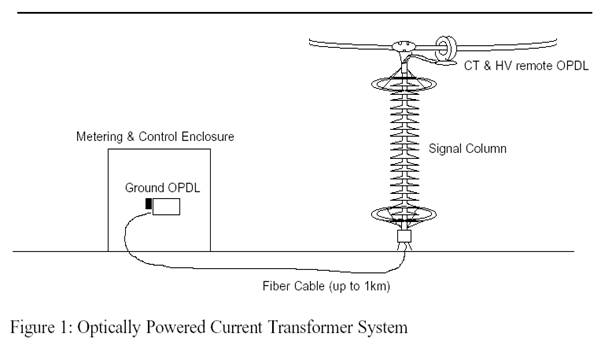
The OPDL system can be divided in to a remote unit at high voltage potential and a local unit, which is based in the sub station control room or an existing control enclosure. This unit houses the laser with its associated laser driver and the data recovery circuitry. The laser system used for this application can couple a maximum optical power of 1.5 Watt in to the power link fiber. These lasers are not to be very reliable with a long life time (MTBF: >100,000 h). A self-check Function supervises all vital functions of the OPCT. An alarm will be initiated long before the laser reaches the end of its life time indicating necessary maintenance. A trip signal will be set if the system has identified a misoperation.
Depending on the metering or relay scheme, this unit can provide a digital serial output, +/- 10Volts (full scale) or a current loop of 1 amp (nominal) @ maximum 20 or 40 VA. The power to operate this unit can conveniently be supplied by any station power supply. The OPDL local ground unit is connected by two optical fibers, a power fiber and a data link, to the remote electronic board at the high voltage system. The remote unit is shielded against any EMI or RFI noise and converts the voltage drop across the CT burden resistor in to digital signals. The electrical power to operate this unit provided by the photovoltaic power converter that is connected to the laser over one of the fiber optical links with a conversion efficiency of up to 40 %.
The remote system provides two A/D channels with a sampling rate of 40 kHz each corresponding to a bandwidth of 15kHz (250 Harmonics@60Hz system!). The performance of this board is below 1% error for protection purposes at nominal value and a range of 30p u and exceeds Class 0.2 for metering accuracy. The output of the A/D converter together with some data control and supervisory signals make up a serial data stream, which is converted in to light pulses and coupled in to the data fiber. In addition to the data stream, the voltage of the remote board is monitored for safety reasons and for control of the laser output.
To ensure the capability for a remote calibration of the electronic circuitry, a very precise voltage source is incorporated into the design, which can be connected in to the data path from the local unit while being in a calibration in a test mode.
The current transformer used for the OPCT can either be a CT designed for metering or protection class accuracy or a resistive shunt. These transformers are dry type, out door rated systems. Since a signal column provides the high voltage isolation, these CT s can be of a low voltage 600V(720V Europe) type.
A high precision, low drift burden resistor together with the CT provides the voltage input for the OPDL system. The burden resistor and an input protection filter are housed together with the remote circuitry in a shielded enclosure to provide immunity against EMI and RFI disturbance. This combined unit is lightweight (about 15 pounds), which allows easy installation hence limiting the system outage time to a minimum. The unit is mechanically protected fiber link connects the unit to the signal column.
The CT and burden resistors are available in all common current ratings. The output voltage of the burden resistor is adjusted to the full range of interest (i.e. 30 p. u. for protection).
| Are you interested in this topic.Then mail to us immediately to get the full report.
email :- contactv2@gmail.com |
