


Updated on May 29, 2026
Micro electro mechanical systems (MEMS) comprise a rapidly expanding research field with potential applications varying from sensors in air bags, wrist-warn GPS receivers, and matchbox size digital cameras to more recent optical applications.
Depending on the application, these devices often require an on board power source for remote operation, especially in cases requiring for an extended period of time. In the quest to boost micro scale power generation several groups have turn their efforts to well known enable sources, namely hydrogen and hydrocarbon fuels such as propane, methane, gasoline and diesel.
Some groups are develo ping micro fuel cells than, like their micro scale counter parts, consume hydrogen to produce electricity. Others are developing on-chip combustion engines, which actually burn a fuel like gasoline to drive a minuscule electric generator. But all these approaches have some difficulties regarding low energy densities, elimination of by products, down scaling and recharging. All these difficulties can be overcome up to a large extend by the use of nuclear micro batteries.
Radioisotope thermo electric generators (RTGs) exploited the extraordinary potential of radioactive materials for
generating electricity. RTGs are particularly used for generating electricity in space missions. It uses a process known as See-beck effect. The problem with RTGs is that RTGs don't scale down well. So the scientists had to find some other ways of converting nuclear energy into electric energy. They have succeeded by developing nuclear batteries.
Nuclear batteries use the incredible amount of energy released naturally by tiny bits of radio active material without any fission or fusion taking place inside the battery. These devices use thin radioactive films that pack in energy at densities thousands of times greater than those of lithium-ion batteries. Because of the high energy density nuclear batteries are extremely small in size. Considering the small size and shape of the battery the scientists who developed that battery fancifully call it as "DAINTIEST DYNAMO". The word 'dainty' means pretty.
Scientists have developed two types of micro nuclear batteries. One is junction type battery and the other is self-reciprocating cantilever. The operations of both are explained below one by one.
The kind of nuclear batteries directly converts the high-energy particles emitted by a radioactive source into an electric current. The device consists of a small quantity of Ni-63 placed near an ordinary silicon p-n junction - a diode, basically.
As the Ni-63 decays it emits beta particles, which are high-energy electrons that spontaneously fly out of the radioisotope's unstable nucleus. The emitted beta particles ionized the diode's atoms, exciting unpaired electrons and holes that are separated at the vicinity of the p-n interface. These separated electrons and holes streamed away form the junction, producing current.
It has been found that beta particles with energies below 250KeV do not cause substantial damage in Si [4] [5]. The maximum and average energies (66.9KeV and 17.4KeV respectively) of the beta particles emitted by Ni-63 are well below the threshold energy, where damage is observing silicon. The long half-life period (100 years) makes Ni-63 very attractive for remote long life applications such as power of spacecraft instrumentation. In addition, the emitted beta particles of Ni-63 travel a maximum of 21 micrometer in silicon before disintegrating; if the particles were more energetic they would travel longer distances, thus escaping. These entire things make Ni-63 ideally suitable in nuclear batteries.
Since it is not easy to micro fabricate solid radioactive materials, a liquid source is used instead for the micro machined p-n junction battery. The diagram of a micro machined p-n junction is shown below
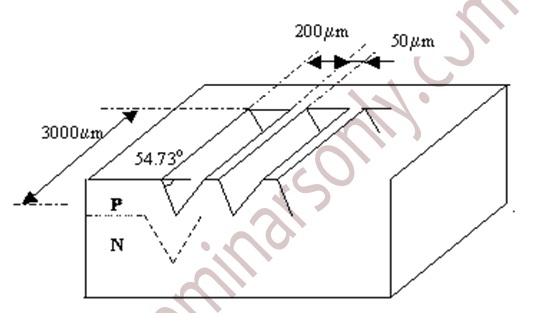
As shown in figure a number of bulk-etched channels have been Micro machined in this p-n junction. Compared with planar p-n Junctions, the three dimensional structure of our device allows for a substantial increase of the junction area and the macro machined channels can be used to store the liquid source. The concerned p-n junction has 13 micro machine channels and the total junction area is 15.894 sq.mm (about 55.82% more than the planar p-n junction). This is very important since the current generated by the powered p-n junction is proportional to the junction area.
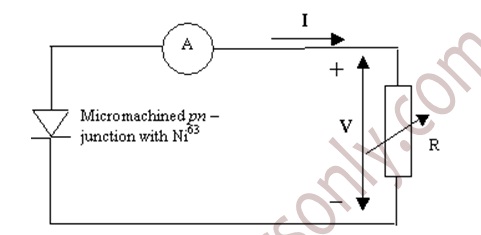
In order to measure the performance of the 3-dimensional p-n junction in the presence of a radioactive source, a pipette is used to place 8 l of liquid Ni-63 inside the channels micro machined on top of the p-n junction. It is then covered with a black box to shield it from the light. The electric circuit used for these experiments is shown below.
This concept involves a more direct use of the charged particles produced by the decay of the radio active source: the creation of a resonator by inducing movement due to attraction or repulsion resulting from the collection of charged particles. As the charge is collected, the deflection of a cantilever beam increases until it contacts a grounded element, thus discharging the beam and causing it to return to its original position. This process will repeat as long as the source is active. This has been tested experimentally. The following figure shows the experimental setup.
The self-reciprocating cantilever consists of a radioactive source of thickness very small and of area 4square mm. above this thin film there is a cantilever beam. It is made of a rectangular piece of silicon. Its free end is able to move up and down. On this cantilever beam there is a copper sheet attached to it. Also above this cantilever there is a piezoelectric plate. So the self-reciprocating cantilever type nuclear batteries are also called as radioactive piezoelectric generator.
First the beta particles, which are high-energy electrons, fly spontaneously from the radioactive source. These electrons get collected on the copper sheet. Copper sheet becomes negatively charged. Thus an electrostatic force of attraction is established between the silicon cantilever and radioactive source. Due to this force the cantilever bends down.
The piece of piezoelectric material bonded to the top of the silicon cantilever bends along with it. The mechanical stresses of the bend unbalances the charge distribution inside the piezoelectric crystal structure, producing a voltage in electrodes attached to the top and bottom of the crystal.
After a brief period – whose length depends on the shape and material of the cantilever and the initial size of the gap- the cantilever come close enough to the source to discharge the accumulated electrons by direct contact. The discharge can also take place through tunneling or gas breakdown. At that moment, electrons flow back to the source, and the electrostatic attractive force vanishes. The cantilever then springs back and oscillates like a diving board after a diver jumps, and the recurring mechanical deformation of the piezoelectric plate produces a series of electric pulses.
| Are you interested in this topic.Then mail to us immediately to get the full report.
email :- contactv2@gmail.com |
