


Updated on May 29, 2026
The most important development in the computer communications industry in the 1990s is the evolution of the integrated services digital network (ISDN) and broadband ISDN (B-ISDN). The ISDN and B-ISDN have had a dramatic impact on the planning and deployment of intelligent digital networks providing integrated services for voice, data and video.
Further, the work on the ISDN and B-ISDN standards has led to the development of two major new networking technologies; frame relay and asynchronous transfer mode (ATM). Frame relay and ATM have become the essential ingredients in developing high-speed networks for local, metropolitan and wider area applications.
The ISDN is intended to be a worldwide public telecommunications network to replace existing public telecommunication networks and deliver a wide variety of services. The ISDN is defined by the standardization of user interfaces and implemented as a set of digital switches and paths supporting a broad range of traffic types and providing value added processing services. In practice, there are multiple networks, implemented within national boundaries but from the user's point of view, the eventual widespread deployment of ISDN will lead to a single, uniformly accessible, worldwide network.
The narrowband ISDN is based on the use of a 64 kbps channel as the basic unit of switching and has a circuit switching orientation. The major technical contribution of the narrowband ISDN effort has been frame relay. The B-ISDN supports very high data rates (100s of Mbps) and has a packet switching orientation. The major technical contribution of the B-ISDN effort has been asynchronous transfer mode, also known as cell relay.
The circuit switching is the dominant technology for both voice and data communications. Communication via circuit switching implies that there is a dedicated communication path between two stations. That path is a connected sequence of links between network nodes. On each physical link, a channel is dedicated to the connection. The three phases involved in a communication via circuit switching are circuit establishment, information transfer and circuit disconnect.
In a typical data connection much of the time the line is idle. Thus circuit switched approach is inefficient. In packet switching data are transmitted in short packets. Each packet contains a portion of the user's data plus some control information. The control information, at a minimum, includes the information that the network requires to be able to route the packet through the network and deliver it to the intended destination. At each node enroute, the packet is received, stored briefly, and passed on the next node. The advantages of packet switching are line efficiency is greater, data rate conversion is possible and priorities can be used.
With modern, high-speed telecommunication systems, the overhead in error control is unnecessary and counter productive. To take advantages of the high data rates and low error rates of contemporary networking facilities, frame relay was developed. Whereas the original packet switching networks were designed with a data rate to the end user of about 64 kbps, Frame relay networks are designed to operate at user data rates of up to 2 Mbps. The key to achieving these high data rates are to strip out most of the overhead involved with error control.
It was integrated digital networks, which set the stage for the development of the ISDN.The integrated digital networks are based on digital switching as well as on digital transmission.
1. Support of voice and nonvoice applications using a limited set of standardized facilities. The ISDN will support a variety of services related to voice communications (telephone calls) and non-voice communications (digital data exchange). These services acre to be provided in conformance with ITU-T standards.
2. Support for switched and non-switched applications---ISDN will support both circuit switching and packet switching. ISDN supports non-switched services in the form of leased lines.
3. Reliance on 64kbps connections---ISDN is intended to provide circuit switched and packet switched connections at 64kbps. This is the fundamental building block of ISDN.
4. Intelligence in the network---Sophisticated services are provided by the use of signaling system 7 and by the use of intelligent switching nodes in the network.
5. Layered protocol architecture ---The protocols being developed for user access to ISDN exhibits a layered architecture and can be mapped into the OSI model.
6. Variety of configuration---More than one physical configuration is possible for implementing ISDN.This allows for differences in national policy, in the state of technology.
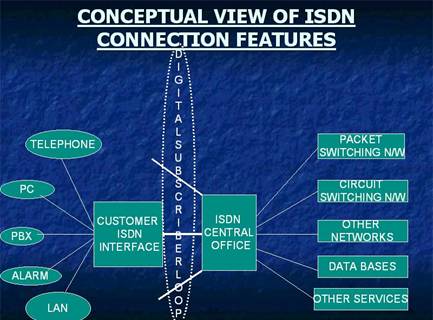
1. Evolution from telephone IDNs. --- The intent is that the ISDN evolve from the existing telephone networks.
2. Transition of one or more decades. ----The evolution to ISDN will be slow process. The introduction of ISDN services will be done in the context of existing digital facilities and existing services.
3. Use of existing networks. ---ISDN will also provide a packet switched Services.
4. Interim user –network arrangements. ---The lack of digital subscriber lines might delay introduction of digital services, particularly in developing countries. With the modems and other equipment, existing analog facilities can support at least some ISDN functions.
5. Connections at other than 64kbps---The 64kbps data rate was chosen as the basic channel for circuit switching. This rate is too low for many digital data applications.
The digital pipe between the central office and the ISDN subscriber will be used to carry a number of communication channels. The capacity of the channel may vary from user to user. The transmission structure of any access link will be constructed from the following types of channels:
B Channel: 64kbps
D Channel: 16 or 64kbps
H Channel: 384 (H0), 1536(H11), or 1920(H12) kbps.
The B Channel is a user channel that can be used to carry digital data, PCM encoded digital voice, or a mixture of lower rate traffic, including digital data and digitized voice encoded at a fraction of 64 kbps. Three connections can be set up over a B Channel.
1. Circuit-switched: The user places a call and a circuit switch is established with another network user. The call establishment does not take place over the B channel but is done using common channel signaling
2. Packet switched: The user is connected to a packet switching node, and data are exchanged with other users.
3. Semi-permanent: This is a connection to another user setup by the prior arrangement and not requiring establishment protocol. This is equivalent to a leased line.
The D channel serves two main purposes. First, it carries common channel signaling information to control circuit switched calls on associated B channels at the user interface. In addition, the D channel may be used for packet switching or low speed telemetry at times when no signaling information is waiting.
H channels are provided for user information at higher bit rates. The user may use such a channel as a high-speed trunk or subdivide the channel according to the users own TDM scheme.
Basic access consists of two full duplex 64 Kbps B channels and a full duplex 16 Kbps D channel. In some cases one or both of the B- channels remain unused. This results in a B + D or D interface, rather than the 2B + D interface.
There are two basic types of ISDN service: Basic Rate Interface (BRI) and Primary Rate Interface (PRI). BRI consists of two 64 kb/s B channels and one 16 kb/s D channel for a total of 144 kb/s. This basic service is intended to meet the needs of most individual users.
| Are you interested in this topic.Then mail to us immediately to get the full report.
email :- contactv2@gmail.com |
