

Updated on May 29, 2026
Tether is a word, which is not heard often. The word meaning of tether is 'a rope or chain to fasten an animal so that it can graze within a certain limited area'. We can see animals like cows and goats 'tethered' to trees and posts.
In space also tethers have an application similar to their word meaning. But instead of animals, there are spacecrafts and satellites in space. A tether if connected between two spacecrafts (one having smaller orbital altitude and the other at a larger orbital altitude) momentum exchange can take place between them. Then the tether is called momentum exchange space tether. A tether is deployed by pushing one object up or down from the other. The gravitational and centrifugal forces balance each other at the center of mass. Then what happens is that the lower satellite, which orbits faster, tows its companion along like an orbital water skier. The outer satellite thereby gains momentum at the expense of the lower one, causing its orbit to expand and that of the lower to contract. This was the original use of tethers.
But now tethers are being made of electrically conducting materials like aluminium or copper and they provide additional advantages. Electrodynamic tethers, as they are called, can convert orbital energy into electrical energy. It works on the principle of electromagnetic induction. This can be used for power generation. Also when the conductor moves through a magnetic field, charged particles experience an electromagnetic force perpendicular to both the direction of motion and field. This can be used for orbit raising and lowering and debris removal. Another application of tethers discussed here is artificial gravity inside spacecrafts.
Space tethers have been studied theoretically since early in the 20th century, it wasn't until 1974 that Guiseppe Colombo came up with the idea of using a long tether to support satellite from an orbiting platform. But that was simple momentum exchange space tether. Now lets see what made scientists think of electrodynamic tethers.
Every spacecraft on every mission has to carry all the energy sources required to get its job done, typically in the form of chemical propellants, photovoltaic arrays or nuclear reactors. The sole alternative - delivery service - can be very expensive. For example, a spacecraft orbiting in the International space Station (ISS) will need an estimated 77 metric tons of booster propellant over its anticipated 10 year life span just to keep itself from gradually falling out of orbit. Assuming a minimal price of $7000 a pound (dirt cheap by current standards) to get fuel up to the station's 360 km altitude, i.e. $1.2 billion simply to maintain the orbital status quo.
So scientists have are taking a new look at space tether, making it electrically conductive. In 1996, NASA launched a shuttle to deploy a satellite on a tether to study the electrodynamic effects of a conducting tether as it passes through the earth's magnetic fields. As predicted by the laws of electromagnetism, a current was produced in the tether as it passed through the earth's magnetic field, acting as an electrical generator. This was the origin of electrodynamic tethers
A tether in space is a long, flexible cable connecting two masses. When the cable is electrically conductive, the ensemble becomes an electrodynamic tether.
There can be three main types of electrodynamic tether employed systems providing different advantages:
1. Electrodynamic tether systems - in which two masses are separated by a long flexible cable electrically conductive cable - can perform many of the same functions as conventional spacecrafts but without the use of chemical or nuclear fuel sources.
2. In low earth orbit (LEO) tether systems could provide electrical power and positioning capability for satellites and manned spacecraft, as well as help get rid the region of dangerous debris.
3. On long term missions, such as exploration of Jupiter and its moons, tethers could drastically reduce the amount of fuel needed to maneuver while also providing a dependable source of electricity.
Electrodynamic tethers systems have the potential to accomplish many of the same tasks as conventional spacecrafts but without the need for large quantities of onboard fuel. They take advantage of two basic principles of electromagnetism: current is produced when conductor moves through magnetic fields, and the field exerts a force on the current.
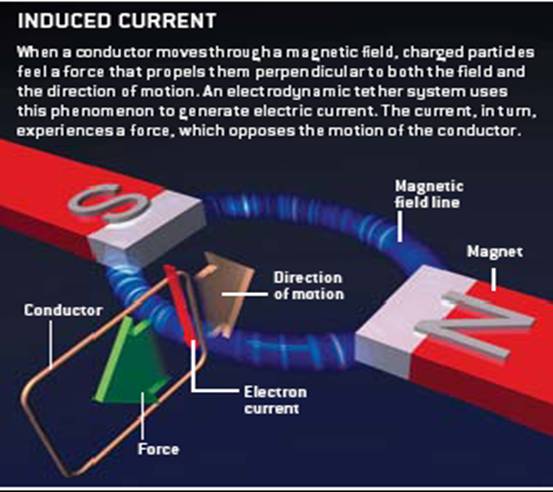
Consider the figure-1 shown below. There are two poles - North and South and they produce a magnetic field. A conductor, when it moves through this field, it cuts the magnetic lines of force. Then the charged particles feel a force that propels them perpendicular to both the field and the direction of motion. An electrodynamic tether system uses this phenomenon to generate electric current. The current in turn, experiences a force that opposes the motion of the conductor
Now consider the figure-2 shown. Here a battery is added to the circuit. It can over come the induced current by reversing the current direction. Consequently the force also reverses direction. An electrodynamic tether exploits this effect to produce thrust.
The main applications of electrodynamic tethers being discussed in this paper are:
- Orbit raising and lowering
- Power generation
- Debris removal
- Artificial gravity
The spacecrafts orbiting the earth will experience a constant drag force, which pulls them towards the earth. If we do not provide any energy to counteract this drag force, the spacecraft would gradually be thrown out of its orbit. An electrodynamic tether can be used to reposition the satellites – i.e. lower or raise the orbit by using the two above-mentioned principles of electromagnetism.
Earth can be considered as a magnet with North and South poles as shown here. Now consider the tether system shown on the left side of the figure. There are no externally induced currents. So when the tether passes through the earth’s magnetic field, an electron current is induced to flow towards the earth. This current in turn experiences a force from the earth’s magnetic field that is opposite to the tether’s direction of motion. That produces drag, thus decreasing the tether’s energy and lowering its orbit.
Next consider the tether system shown on the right. In this tether an external current is driven in a direction opposite to that of naturally induced current. This would reverse the direction of force that the tether experiences. In this case force would be in the same direction as the tether’s motion increasing its energy and raising its orbital altitude.The major advantage of this technique compared to other space propulsion systems is that it does not require any propellant. It uses Earth’s magnetic field as it’s “reaction mass”. By eliminating the need to launch large amounts of propellant into orbit,EDT can greatly reduce the cost of in-space propulsion.
| Are you interested in this topic.Then mail to us immediately to get the full report.
email :- contactv2@gmail.com |
