


Updated on May 29, 2026
An optical mouse is an advanced computer pointing device that uses a light-emitting diode (LED), an optical sensor, and digital signal processing (DSP) in place of the traditional mouse ball and electromechanical transducer. Movement is detected by sensing changes in reflected light, rather than by interpreting the motion of a rolling sphere.
The optical mouse takes microscopic snapshots of the working surface at a rate of more than 1,000 images per second. If the mouse is moved, the image changes. The tiniest irregularities in the surface can produce images good enough for the sensor and DSP to generate usable movement data. The best surfaces reflect but scatter light; an example is a blank sheet of white drawing paper. Some surfaces do not allow the sensor and DSP to function properly because the irregularities are too small to be detected. An example of a poor optical-mousing surface is unfrosted glass.
In practice, an optical mouse does not need cleaning, because it has no moving parts. This all-electronic feature also eliminates mechanical fatigue and failure. If the device is used with the proper surface, sensing is more precise than is possible with any pointing device using the old electromechanical design. This is an asset in graphics applications, and it makes computer operation easier in general.
Open up a mouse and inside it we will find two wheels, each one similar to the first drawing. The wheel is usually made of black plastic with rectangular slots punched in it. I have shown only 6 slots at 60° spacing but they are a lot closer and many more. Shining through the slots are two LEDs (light Emitting Diodes) shown by the black dots. Each LED shines on to a light sensitive transistor.
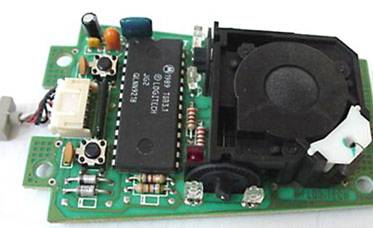
The two emitters are spaced so that, when one transistor can 'see' its LED through the centre of its window, the other LED is looking at an edge and is therefore switching on or off. In my illustration the LEDs are spaced at 105° (60° x 1.75).
The output voltage from the transistor is processed to switch rapidly from high to low as the LED's light is transmitted or occluded so that the voltage is low when the transistor is lit and high when it is in darkness. In the diagram LED A is fully illuminated and LED B is switching. Note that LED B may be switching from light to dark or from dark to light - this depends on the rotation direction.
The main goal of any mouse is to translate the motion of our hand into signals that the computer can use. Almost all mice today do the translation using five components.
| Are you interested in this topic.Then mail to us immediately to get the full report.
email :- contactv2@gmail.com |
