


Updated on May 29, 2026
Cellular Neural Network is a revolutionary concept and an experimentally proven new computing paradigm for analog computers. Looking at the technological advancement in the last 50 years ; we see the first revolution which led to pc industry in 1980's, second revolution led to internet industry in 1990's cheap sensors & mems arrays in desired forms of artificial eyes, nose, ears etc.
this third revolution owes due to C.N.N.This technology is implemented using CNN-UM and is also used in imageprocessing.It can also implement any Boolean functions.
A standard CNN architecture consists of an m*n rectangular array of cells c(i,j) with Cartesian coordinates (i,j) i=1,2…..M, j=12…...N.
A class -1 m*n standard CNN is defined by a m*n rectangular array of cells cij located at site (i,j) i= 1,2 …….m ,j=1,2,….n is defined mathematically by
(dXij/dt )= -Xij + A(I,j,k,l) Ykl + B(i,j,k,l) + Zij
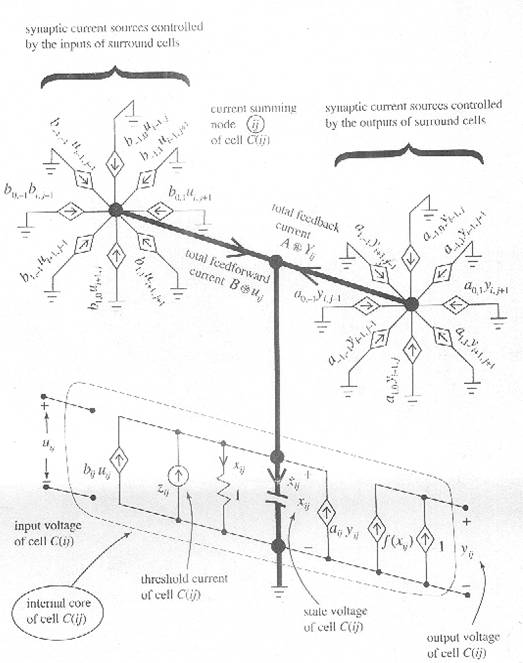
Voltage controlled current sources impliment various coupling terms. These transconductances can be easily constructed on "CMOS" integrated circuits
Recently a novel structure has been introduced to implement any Boolean / gray level function of any number of variables .The output is no longer restricted to be binary so that CNNs with gray scale outputs are obtained. Simplical CNNs are implemented using RTDs (resonant tunneling diodes)
RTDs are nano electric quantum device is featuring high speed regims and small integration sizes and they can be designed to operate in nano /femto sizes leading to extreme low power designs. In addition they exhibit an intrinsic non linear behaviour which can be exploited in many diverse applications, for instance in frequency multiplier and parity generators the threshold logic gates multi gigahertz a-d converters, and multivalued logic applications including multivalued memory design among others.
A simplical partition is used to subdivide the domain in to convex regions called simplices which are the natural extension 2-d triangle into an n-d space the corners of these simplices are called vertices & for the particular chosen domain are the points of the form ( +1,-1,+1,-1) it was proven that the set of all PWL function f is a linear vector space. Every PWL function can be expressed as a linear combination
F= € CiAi (u)
Ai(v-j)=1, if i=j
| Are you interested in this topic.Then mail to us immediately to get the full report.
email :- contactv2@gmail.com |
