


Published on Apr 02, 2024
Have you pulled your car up to the gas pump lately and been shocked by the high price of gasoline? As the pump clicked past $20 or $30, maybe you thought about trading in that SUV for something that gets better mileage. Or maybe you are worried that your car is contributing to the greenhouse effect. Or maybe you just want to have the coolest car on the block.
Currently, there is a solution for all this problems; it's the hybrid electric vehicle. The vehicle is lighter and roomier than a purely electric vehicle, because there is less need to carry as many heavy batteries. The internal combustion engine in hybrid-electric is much smaller and lighter and more efficient than the engine in a conventional vehicle. In fact, most automobile manufacturers have announced plans to manufacture their own hybrid versions.
How does a hybrid car work? What goes on under the hood to give you 20 or 30 more miles per gallon than the standard automobile? And does it pollute less just because it gets better gas mileage. In this seminar we will study how this amazing technology works and also discuss about TOYOTA & HONDA hybrid cars.
Any vehicle is hybrid when it combines two or more sources of power. In fact, many people have probably owned a hybrid vehicle at some point. For example, a mo-ped (a motorized pedal bike) is a type of hybrid because it combines the power of a gasoline engine with the pedal power of its rider.
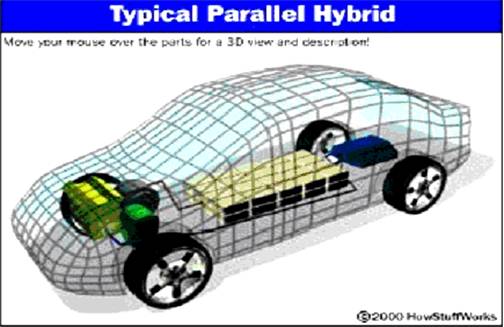
Hybrid electric vehicles are all around us. Most of the locomotives we see pulling trains are diesel-electric hybrids. Cities like Seattle have diesel-electric buses -- these can draw electric power from overhead wires or run on diesel when they are away from the wires. Giant mining trucks are often diesel-electric hybrids. Submarines are also hybrid vehicles -- some are nuclear-electric and some are diesel-electric. Any vehicle that combines two or more sources of power that can directly or indirectly provide propulsion power is a hybrid.
The most commonly used hybrid is gasoline-electric hybrid car which is just a cross between a gasoline-powered car and an electric car. A 'gasoline-electric hybrid car' or 'hybrid electric vehicle' is a vehicle which relies not only on batteries but also on an internal combustion engine which drives a generator to provide the electricity and may also drive a wheel. In hybrid electric vehicle the engine is the final source of the energy used to power the car. All electric cars use batteries charged by an external source, leading to the problem of range which is being solved in hybrid electric vehicle.
You can combine the two power sources found in a hybrid car in different ways. One way, known as a parallel hybrid, has a fuel tank, which supplies gasoline to the engine. But it also has a set of batteries that supplies power to an electric motor. Both the engine and the electric motor can turn the transmission at the same time, and the transmission then turns the wheels.
An electric motor is all about magnets and magnetism: A motor uses magnets to create motion. We know the fundamental law of all magnets: Opposites attract and likes repel. So if you have two bar magnets with their ends marked "north" and "south," then the north end of one magnet will attract the south end of the other. On the other hand, the north end of one magnet will repel the north end of the other (and similarly, south will repel south). Inside an electric motor, these attracting and repelling forces create rotational motion .
DC series motor used in hybrid electric vehicle is a versatile and flexible machine. It can satisfy the demands of load recurring high starting, accelerating and retarding torques. A DC machine is also easily adaptable for drives with a wide range of speed control and fast reversals. In the diagram shown below we can see two magnets in the motor: The armature (or rotor) is an electromagnet, while the field magnet is a permanent magnet
Using the concept of Hybridization of cars results in better efficiency and also saves a lot of fuel in today's fuel deficit world. Though at present the concept has been put in to maximum utilization by Honda & Toyota, it is indeed an important research avenue for other car manufacturing units as well. A hybrid gives a solution to all the problems to some extent. If proper research and development is done in this field, hybrid vehicle promises a practical, efficient, low pollution vehicle for the coming era. One can surely conclude that this concept and the similar ones to follow with even better efficiency & conservation rate are very much on the anvil in today's energy deficit world.
Components used in hybrid electric vehicles are given below:
The hybrid car has a gasoline engine much like the one you will find on most cars. However, the engine on a hybrid will be smaller and lighter, and is more efficient than the engine in a conventional vehicle, because the engine runs at a relatively constant speed, and does not need to provide direct power for acceleration, which is the biggest reason for large engines. Use advanced technologies to reduce emissions.
The fuel tank in a hybrid is the energy storage device for the gasoline engine. Gasoline has a much higher energy density than batteries do. For example, it takes about 1,000 pounds of batteries to store as much energy as 1 gallon (7 pounds) of gasoline.
The electric motor on a hybrid car is very sophisticated. Electric motor used in hybrid cars are usually dc series motor since it’s versatile and ease with which a variety of speed-torque characteristics can be obtained, and wide range of speed control is also possible in this. Advanced electronics allow it to act as a motor as well as a generator. For example, when it needs to, it can draw energy from the batteries to accelerate the car. But acting as a generator, it can slow the car down and return energy to the batteries.
The generator is similar to an electric motor, but it acts only to produce electrical power. It is used mostly on series hybrids. Generator used in hybrid electric vehicle is alternator since cooling is easy and hence maximum output and also the output/weight ratio is higher than that of the DC generator.
The power split device is a clever gearbox that hooks the internal combustion engine and D.C.motor together. The power split device helps the vehicle to accelerate to a speed of about 15km/hr before switching on the gasoline engine. The engine starts only after the vehicle attains a certain speed. Once the engine starts it operates on a narrow speed band. The power split device allows the engine to stay in its most efficient load and speed range most of the time.
The batteries in a hybrid car are the energy storage device for the electric motor. Unlike the gasoline in the fuel tank, which can only power the gasoline engine, the electric motor on a hybrid car can put energy into the batteries as well as draw energy from them. The batteries used in HEV is Ni-Cd cells since its lighter than the lead acid cells and its also mechanically strong and can stand very rough use.
The transmission on a hybrid car performs the same basic function as the transmission on a conventional car. Some hybrids, like the Honda Insight, have conventional transmissions. Others, like the Toyota Prius, have radically different ones, which we’ll talk about later.
An electric motor is all about magnets and magnetism: A motor uses magnets to create motion. We know the fundamental law of all magnets: Opposites attract and likes repel. So if you have two bar magnets with their ends marked "north" and "south," then the north end of one magnet will attract the south end of the other. On the other hand, the north end of one magnet will repel the north end of the other (and similarly, south will repel south). Inside an electric motor, these attracting and repelling forces create rotational motion.
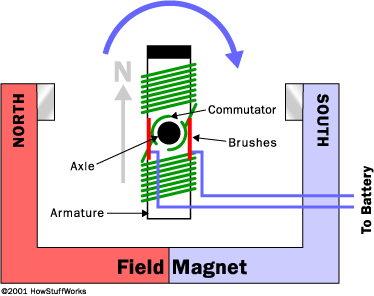
DC series motor used in hybrid electric vehicle is a versatile and flexible machine. It can satisfy the demands of load recurring high starting, accelerating and retarding torques. A DC machine is also easily adaptable for drives with a wide range of speed control and fast reversals. In the diagram shown below we can see two magnets in the motor: The armature (or rotor) is an electromagnet, while the field magnet is a permanent magnet (the field magnet could be an electromagnet as well, but in most small motors it isn't in order to save power). Different parts used in a simple DC motor are as shown in the diagram above:
• Armature or rotor
• Stator
• Commutator
• Brushes
• Field magnet
The magnetic circuit of a DC consists of the armature magnetic material (core), the air-gap, field poles and yoke. The yoke of a DC machine is a annular ring to the middle of which is bolted field poles and the interlopes. The interlopes or commutation poles are narrow poles fixed to the yoke, midway between the main field poles. The use of an electric field winding, which supplies electric energy to establish a magnetic field in the magnetic circuit , result in the great diversity and a variety of performance characteristics. The armature winding is connected to the external power source through a commutator brush system, which is a mechanical rectifying (switching) device for converting the alternating currents and induced emf of the armature to the DC form.
The cylindrical-rotor or armature of a machine is mounted on a shaft, which is supported on the bearing. One or both ends of the shaft act as input or output terminal of the machine and would be coupled mechanically to a load (motoring machine) or to a prime-mover (generating machine).Usually parallel-sided axial slots (evenly spaced normally) are used on the rotor (armature winding) surface. The magnetic material between the slots is the teeth. The slot cross-section influences significantly the performance characteristics of the machines and parameters such as armature coil inductance, magnetic saturation in the teeth, eddy-current loss in the stator poles and the cost and complexity of laying armature winding.
Besides a smaller, more efficient engine, today's hybrids use many other tricks to increase fuel efficiency. Some of those tricks will help any type of car get better mileage, and some only apply to a hybrid. To squeeze every last mile out of a gallon of gasoline, a hybrid car can:
Whenever you step on the brake pedal in your car, you are removing energy from the car. The faster a car is going, the more kinetic energy it has. The brakes of a car remove this energy and dissipate it in the form of heat. A hybrid car can capture some of this energy and store it in the battery to use later. It does this by using "regenerative braking." That is, instead of just using the brakes to stop the car, the electric motor that drives the hybrid can also slow the car. In this mode, the electric motor acts as a generator and charges the batteries while the car is slowing down.
A hybrid car does not need to rely on the gasoline engine all of the time because it has an alternate power source -- the electric motor and batteries. So the hybrid car can sometimes turn off the gasoline engine, for example when the vehicle is stopped at a red light.
The tires on most cars are optimized to give a smooth ride, minimize noise, and provide good traction in a variety of weather conditions. But they are rarely optimized for efficiency. In fact, the tires cause a surprising amount of drag while you are driving. Hybrid cars use special tires that are both stiffer and inflated to a higher pressure than conventional tires. The result is that they cause about half the drag of regular tires.
Using the concept of Hybridization of cars results in better efficiency and also saves a lot of fuel in today’s fuel deficit world. Though at present the concept has been put in to maximum utilization by Honda & Toyota, it is indeed an important research avenue for other car manufacturing units as well. A hybrid gives a solution to all the problems to some extent. If proper research and development is done in this field, hybrid vehicle promises a practical, efficient, low pollution vehicle for the coming era. One can surely conclude that this concept and the similar ones to follow with even better efficiency & conservation rate are very much on the anvil in today’s energy deficit world.
| Are you interested in this topic.Then mail to us immediately to get the full report.
email :- contactv2@gmail.com |
