

Published on Apr 02, 2024
4G Wireless Systems or Fourth generation wireless system is a packet switched wireless system with wide area coverage and high throughput. It is designed to be cost effective and to provide high spectral efficiency . The 4g wireless uses Orthogonal Frequency Division Multiplexing (OFDM), Ultra Wide Radio Band (UWB),and Millimeter wireless. Data rate of 20mbps is employed.
Mobile speed will be up to 200km/hr.The high performance is achieved by the use of long term channel prediction, in both time and frequency, scheduling among users and smart antennas combined with adaptive modulation and power control.
Frequency band is 2-8 GHz. it gives the ability for world wide roaming to access cell anywhere. Wireless mobile communications systems are uniquely identified by "generation designations. Introduced in the early 1980s, first generation (1G) systems were marked by analog frequency modulation and used primarily for voice communications. Second generation (2G) wireless communications systems, which made their appearance in the late 1980s, were also used mainly for voice transmission and reception The wireless system in widespread use today goes by the name of 2.5G-an "in between " service that serves as a stepping stone to 3G. Whereby 2G communications is generally associated with Global System for Mobile (GSM) service, 2.5G is usually identified as being "fueled " by General Packet Radio Services (GPRS) along with GSM. In 3G systems, making their appearance in late 2002 and in 2003, are designed for voice and paging services, as well as interactive media use such as teleconferencing, Internet access, and other services.
The problem with 3G wireless systems is bandwidth-these systems provide only WAN coverage ranging from 144 kbps (for vehicle mobility applications) to 2 Mbps (for indoor static applications). Segue to 4G, the "next dimension " of wireless communication. The 4g wireless uses Orthogonal Frequency Division Multiplexing (OFDM), Ultra Wide Radio Band (UWB), and Millimeter wireless and smart antenna. Data rate of 20mbps is employed. Mobile speed will be up to 200km/hr.Frequency band is 2 ]8 GHz. it gives the ability for world wide roaming to access cell anywhere.
o Support for interactive multimedia, voice, streaming video, Internet, and other broadband services
o IP based mobile system
o High speed, high capacity, and low cost per bit
o Global access, service portability, and scalable mobile services
o Seamless switching, and a variety of Quality of Service driven services
o Better scheduling and call admission control techniques
o Ad hoc and multi hop networks (the strict delay requirements of voice make multi hop network service a difficult problem)
o Better spectral efficiency
o Seamless network of multiple protocols and air interfaces (since 4G will be all ]IP, look for 4G systems to be compatible with all common network technologies, including802.11, WCDMA, Blue tooth, and Hyper LAN).
o An infrastructure to handle pre existing 3G systems along with other wireless technologies, some of which are currently under development.
4G technologies are significant because users joining the network add mobile routers to the network infrastructure. Because users carry much of the network with them, network capacity and coverage is dynamically shifted to accommodate changing user patterns. As people congregate and create pockets of high demand, they also create additional routes for each other, thus enabling additional access to network capacity. Users will automatically hop away from congested routes to less congested routes. This permits the network to dynamically and automatically self-balance capacity, and increase network utilization. What may not be obvious is that when user devices act as routers, these devices are actually part of the network infrastructure.
So instead of carriers subsidizing the cost of user devices (e.g., handsets, PDAs, of laptop computers), consumers actually subsidize and help deploy the network for the carrier. With a cellular infrastructure, users contribute nothing to the network. They are just consumers competing for resources. But in wireless ad hoc peer-to-peer networks, users cooperate - rather than compete - for network resources. Thus, as the service gains popularity and the number of users increases, service likewise improves for all users. And there is also the 80/20 rules.
With traditional wireless networks, about 80% of the cost is for site acquisition and installation, and just 20% is for the technology. Rising land and labor costs means installation costs tend to rise over time, subjecting the service providers 7 business models to some challenging issues in the out years. With wireless peer-to-peer networking, however, about 80% of the cost is the technology and only 20% is the installation. Because technology costs tend to decline over time, a current viable business model should only become more profitable over time. The devices will get cheaper, and service providers will reach economies of scale sooner because they will be able to pass on the infrastructure savings to consumers, which will further increase the rate of penetration.
The goal of 4G is to replace the current proliferation of core mobile networks with a single worldwide core network standard, based on IP for control, video, packet data, and voice. This will provide uniform video, voice, and data services to the mobile host, based entirely on IP.
The objective is to offer seamless multimedia services to users accessing an all IP-based infrastructure through heterogeneous access technologies. IP is assumed to act as an adhesive for providing global connectivity and mobility among networks.
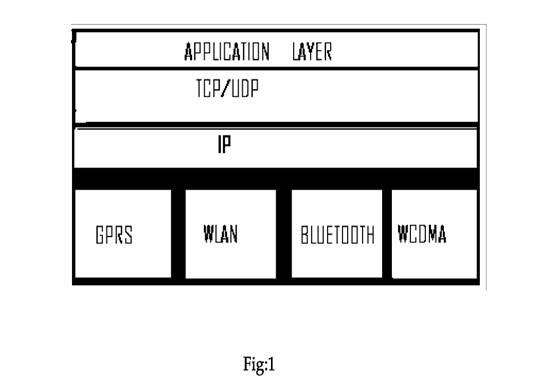
An all IP-based 4G wireless network has inherent advantages over its predecessors. It is compatible with, and independent of the underlying radio access technology. An IP wireless network replaces the old Signaling System 7 (SS7) telecommunications protocol, which is considered massively redundant. This is because SS7 signal transmission consumes a larger part of network bandwidth even when there is no signaling traffic for the simple reason that it uses a call setup mechanism to reserve bandwidth, rather time/frequency slots in the radio waves.
IP networks, on the other hand, are connectionless and use the slots only when they have data to send. Hence there is optimum usage the available bandwidth. Today, wireless communications are heavily biased toward voice, even though studies indicate that growth in wireless data traffic is rising exponentially relative to demand for voice traffic. Because an all IP core layer is easily scalable, it is ideally suited to meet this challenge. The goal is a merged data/voice/multimedia network the available bandwidth. Today, wireless communications are heavily biased toward voice, even though studies indicate that growth in wireless data traffic is rising exponentially relative to demand for voice traffic. Because an all IP core layer is easily scalable, it is ideally suited to meet this challenge. The goal is a merged data/voice/multimedia network.
1. OFDM
2. UWB
3. MILLIMETER WIRELESS
4. SMART ANTENNAS
5. LONG TERM POWER PREDICTION
6. SHEDULING AMONG USERS
7. ADAPTIVE MODULATION AND POWER CONTROL
The first issue deals with optimal choice of access technology, or how to be best connected. Given that a user may be offered connectivity from more than one technology at any one time, one has to consider how the terminal and an overlay network choose the radio access technology suitable for services the user is accessing.
There are several network technologies available today, which can be viewed as complementary. For example, WLAN is best suited for high data rate indoor coverage. GPRS or UMTS, on the other hand, are best suited for nation wide coverage and can be regarded as wide area networks, providing a higher degree of mobility. Thus a user of the mobile terminal or the network needs to make the optimal choice of radio access technology among all those available. A handover algorithm should both determine which network to connect to as well as when to perform a handover between the different networks. Ideally, the handover algorithm would assure that the best overall wireless link is chosen. The network selection strategy should take into consideration the type of application being run by the user at the time of handover. This ensures stability as well as optimal bandwidth for interactive and background services.
The second issue regards the design of a mobility enabled IP networking architecture, which contains the functionality to deal with mobility between access technologies. This includes fast, seamless vertical (between heterogeneous technologies) handovers (IP micro-mobility), quality of service (QoS), security and accounting. Real-time applications in the future will require fast/seamless handovers for smooth operation.
Mobility in IPv6 is not optimized to take advantage of specific mechanisms that may be deployed in different administrative domains. Instead, IPv6 provides mobility in a manner that resembles only simple portability. To enhance Mobility in IPv6, 'micro-mobility7 protocols (such as Hawaii[5], Cellular IP[6] and Hierarchical Mobile IPv6[7]) have been developed for seamless handovers i.e. handovers that result in minimal handover delay, minimal packet loss, and minimal loss of communication state. The third issue concerns the adaptation of multimedia transmission across 4G networks. Indeed multimedia will be a main service feature of 4G networks, and changing radio access networks may in particular result in drastic changes in the network condition. Thus the framework for multimedia transmission must be adaptive. In cellular networks such as UMTS, users compete for scarce and expensive bandwidth.
To Download Full Report Click Here
| Are you interested in this topic.Then mail to us immediately to get the full report.
email :- contactv2@gmail.com |
