


Published on Feb 21, 2020
Many people think the Internet and the Web are the same thing. They're not. The Internet is a piece of wire that goes from me to you and from me to 300 million other people in the world. The Web is software that I put on my end of the wire, and you put on your end -- allowing us to exchange information.
While the Internet (the wire) evolves gradually, the software on the wire can change quickly. Before the Web, other software was clamped onto the Internet. WAIS, Gopher, and Usenet were the dominant systems, and there were companies that were doing commerce using those software models. I call this the "executable Internet," or X Internet, for short. X Internet offers several important advantages over the Web: 1) It rides Moore's Law -- the wide availability of cheap, powerful, low real-estate processing; 2) it leverages ever dear bandwidth -- once the connection is made, a small number of bits will be exchanged, unlike the Web where lots of pages are shuttled out to the client; and 3) X Internet will be far more peer-to-peer -- unlike the server-centric Web.
This scenario could be marred by two threats: viruses and lack of standards. Once executables start to move fluidly through the Net, viruses will have perfect conditions to propagate. Standards, or rather the lack thereof, will block the quick arrival of X Internet. I can't see Microsoft, Sun, IBM, or other traditionalists setting the standards. The Web-killer's design will emerge from pure research, academe, or open source -- as did the Web.
What It Means -- No. 1: Web-centric companies get stuck holding the bag. They will wake up one day with hundreds of millions of dollars of legacy code on their hands. Yes, their brands will remain intact, but their technology will suddenly be very outmoded. Yahoo!, eBay, and AOL will find themselves competing with a new wave of commerce players that market, deliver, and service using the superior technology of X Internet. One of the upstarts will Amazon Amazon.
What It Means -- No. 2: Investors get happy. The new wave of startups will race to market with X Internet, blasting old Web infrastructure and commerce companies out of their path. Internet creative destruction, round two.
What It Means -- No. 3: Peer-to-peer (P2P) networking rockets. The X Internet's "smarts everywhere" design will enable an epidemic of Napstering. Courts, legislators, governments, companies, and other rule makers will have to contend with an empowered and ever more liberated, unruly populace -- armed with technology that allows them to bypass economic toll roads and bridges.
• Smart parking systems can bill users for parking time automatically, ensuring compliance, reducing enforcement and maximizing revenues.
• Retail, shipping and warehousing companies are moving to rFiD to track inventory and trigger billing systems. rFiD eliminates the manual labor of scanning UpC codes, and adds new capabilities such as automatic reordering of stock based on what’s actually on the shelves.
• When hospitals bill insurers for the use of infusion pumps and other medical equipment, they must provide insurance companies with documentation of patient information and length of time the equipment was used. active rFiD tags on the equipment can be used to track where equipment is being used throughout the hospital, automatically providing the required records.
• The U.S. Military is using active rFiD to manage shipments in transit, allocate material where it’s needed and ultimately to manage battlefeld logistics and save lives.
• Automotive manufacturers are exploring ways to better control just-in-time delivery of parts by having the parts monitor and report on their own status. wiring harnesses, for instance, get brittle when they’re cold and can’t be installed until they have warmed up. intelligent two-way sensors on the harnesses can report their own temperature and location, enabling supply chains to automatically adjust for optimum delivery times.
• Mining companies and transportation agencies are beginning to use intelligent sensors to monitor conditions and alert authorities to hazardous conditions and needed maintenance. Sensors can be used to monitor for poisonous gases, the structural integrity of bridges and tunnels, the location of workers and so on
The whole point of the X-internet is to make every aspect of life easier, giving people and businesses full control over things and the way they interact with people, the environment and each other. Insofar as possible, that control should happen automatically — in accordance with user needs and preferences, but without requiring explicit commands. From the end-user point of view, the X-internet simplifies everything. But that means all the complexity is transferred from the user to the underlying technology.
The X-internet will connect all kinds of things in all kinds of spaces. Mobility will be the norm. that means, frst and foremost, that the X-internet will depend on pervasive wireless connectivity. at the same time, different X-internet applications will have different requirements for radio frequency, range, data rate and cost — so cooperative wireless technologies will be required to allow systems based on multiple standards to work together seamlessly.
In an X-internet enabled home, for example, low data-rate systems such as home security, monitoring, and environmental control will share the same network that streams high-bandwidth music, video, and games to entertainment devices throughout the house. enabling technologies for the X-internet must automatically resolve the differences between various radio technologies and communications protocols to allow seamless interaction.
True seamlessness depends on the ability of devices and even inanimate objects to sense their environment, and to communicate their own presence and context to other relevant devices and objects. Depending on the application, context-aware nodes may sense:
• The technical environment, including what networks and devices are within range, what rF standards are in use, what applications and content are available and so on. this mode of awareness enables X-internet nodes to automatically join available networks and exchange data as required by the application.
• The physical environment, including aspects such as temperature, moisture, lighting, vibration and equipment parameters. Many of these capabilities are already in use today by manufacturing, distribution and other vertical enterprises. the X-internet will require similar capabilities to be distributed horizontally across all kinds of objects — exponentially expanding the types of data and relationships available for processing to enable new kinds of business and personal applications.
• Human behavior, and other new categories of complex, highly integrated awareness. Devices of the future will observe user behavior and monitor the environment to seamlessly deliver the appropriate content and services. For example, the security systems of the future might be able to automatically recognize the difference between a resident and an intruder, notify the authorities, activate and control video cameras, lock rooms containing valuables and more — all without requiring the user to configure and activate the system manually
In addition to traditional connectivity via a higher-level infrastructure, true seamlessness requires autonomous, peer-to-peer local awareness and connection between things themselves. This peer-to-peer awareness is a new paradigm, beyond the remote sensing and control that is rapidly becoming familiar today
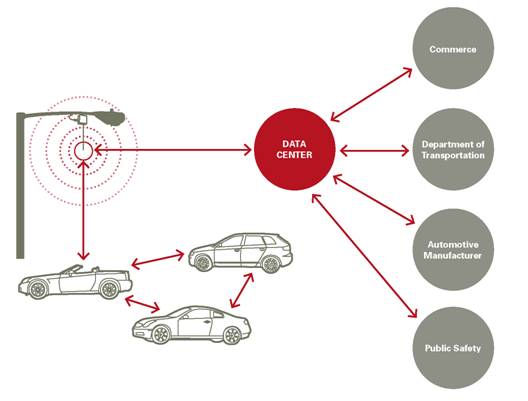
Figure 1. An X-Internet vehicle information and traffc control system will be able to provide sensing information that can improve traffc fow and safety on our roadways, while also providing information to oeMs and businesses that will help enhance customer relationships and maintain customer loyalty.
An important requirement for peer-to-peer awareness is the ability of networks to self-organize and self-maintain. as devices and objects of all kinds become part of the global X-internet, the number of potential nodes will grow by orders of magnitude compared to today’s internet. with billions of nodes coming online, many of them mobile, networked things will need the ability to sense available communication and control channels, automatically joining the appropriate subnets and applications, without human intervention.
Nodes also need the ability to intelligently establish communications with other nodes using the minimal number of “hops.” this could involve a relatively limited network, such as wireless peer-to-peer hopping across the sprinkler controllers in your yard. Or it could involve a global network in which a message takes a wireless hop or two to a nearby access point, then travels to another access point halfway around the world via the wired internet, and finally takes another wireless hop to reach the target device.
Peer-to-peer sensing and interaction must also be complemented by traditional, hierarchical control, when appropriate. Consider the example of an X-internet traffic control system (Figure 1). peer-to-peer awareness and autonomous action allow the system to instantly coordinate signals for optimum traffic fowl, without requiring human intervention. at the same time, hierarchical control enables the system to send information back to traffic engineers that helps them diagnose chronic traffic problems and plan future road projects accordingly.
Depending on the application, the X-internet will require a flexible mix of both autonomous and human-driven control
What It Means -- No. 4: If you are a Global 2,500 company, get ready for another round of change. This means: 1) overhauling the skills of your technologists; 2) destroying perfectly good Web sites in favor of the X Internet; 3) dumping Web-centric suppliers; and 4) retooling organizations. Change management will get a new test
| Are you interested in this topic.Then mail to us immediately to get the full report.
email :- contactv2@gmail.com |
