


Published on Feb 21, 2020
Voice quality (VQ) means different things, depending on one's perspective. On the one hand, it is a way of describing and evaluating speech fidelity, intelligibility, and the characteristics of the analog voice signal itself.
On the other, it can describe the performance of the underlying transport mechanisms. However, VQ is defined as the qualitative and quantitative measure of the sound and conversation quality of a telephone call.
As the telephone industry changes-that is, as new technologies and services are added-existing technologies are applied in different ways, and new players become involved. Thus, maintaining the basic quality of a telephone call becomes increasingly complex. Although VQ has evolved over the years to be consistently high and predictable, it is now an important differentiating factor for new voice-over-packet (VoP) networks and equipment. Consequently, measuring VQ in a relatively inexpensive, reliable, and objective way becomes very important.
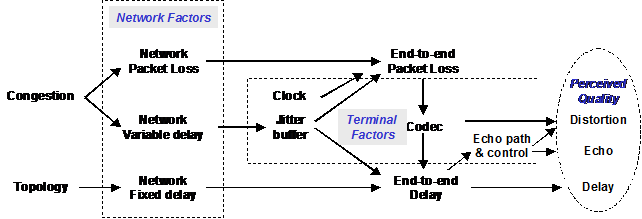
This tutorial discusses VQ-influencing factors as well as network impairments and their causes in a converged telephony and Internet protocol (IP) network, all from the perspective of the quality of the analog voice signal. Network performance issues will be discussed where appropriate, but the topic of VoP performance with regard to packet delivery is not covered in any real depth.
| Are you interested in this topic.Then mail to us immediately to get the full report.
email :- contactv2@gmail.com |
