


Published on Feb 21, 2020
Satellites have been used for years to provide communication network links. Historically, the use of satellites in the Internet can be divided into two generations. In the first generation, satellites were simply used to provide commodity links (e.g., T1) between countries.
Internet Protocol (IP) routers were attached to the link endpoints to use the links as single-hop alternatives to multiple terrestrial hops. Two characteristics marked these first-generation systems: they had limited bandwidth, and they had large latencies that were due to the propagation delay to the high orbit position of a geosynchronous satellite.
In the second generation of systems now appearing, intelligence is added at the satellite link endpoints to overcome these characteristics. This intelligence is used as the basis for a system for providing Internet access engineered using a collection or fleet of satellites, rather than operating single satellite channels in isolation. Examples of intelligent control of a fleet include monitoring which documents are delivered over the system to make decisions adaptively on how to schedule satellite time; dynamically creating multicast groups based on monitored data to conserve satellite bandwidth; caching documents at all satellite channel endpoints; and anticipating user demands to hide latency.
This paper examines several key questions arising in the design of a satellite-based system:
¢ Can international Internet access using a geosynchronous satellite be competitive with today's terrestrial networks?
¢ What elements constitute an "intelligent control" for a satellite-based Internet link?
¢ What are the design issues that are critical to the efficient use of satellite channels?
The paper is organized as follows. The next section, Section 2, examines the above questions in enumerating principles for second-generation satellite delivery systems. Section 3 presents a case study of the Internet Delivery System (IDS), which is currently undergoing worldwide field trials.
Can international Internet access using a geosynchronous satellite be competitive with today's terrestrial networks?
The first question is whether it makes sense today to use geosynchronous satellite links for Internet access. Alternatives include wired terrestrial connections, low earth orbiting (LEO) satellites, and wireless wide area network technologies (such as Local Multipoint Distribution Service or 2.4-GHz radio links in the U.S.).
We see three reasons why geosynchronous satellites will be used for some years to come for international Internet connections. The first reason is obvious: it will be years before terrestrial networks are able to provide adequate bandwidth uniformly around the world, given the explosive growth in Internet bandwidth demand and the amount of the world that is still unwired. Geosynchronous satellites can provide immediate relief. They can improve service to bandwidth-starved regions of the globe where terrestrial networks are insufficient and can supplement terrestrial networks elsewhere.
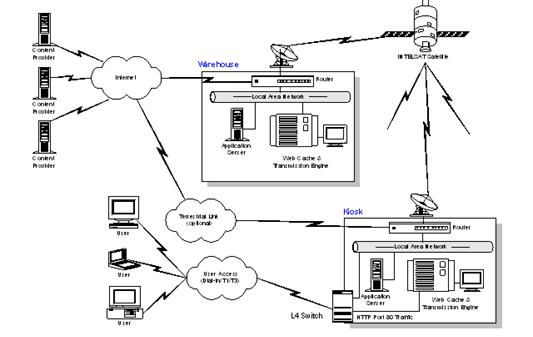
Intelligent controls reside in the warehouse and kiosk and are required to share limited satellite bandwidth among many users and to hide the quarter-second latency of a geosynchronous satellite. The controls are a distributed algorithm, in which part runs on warehouses and part runs on kiosks. All warehouses and kiosks must cooperate and must coordinate the use of satellite resources. Multicast groups are defined to allow communication between cooperating entities
| Are you interested in this topic.Then mail to us immediately to get the full report.
email :- contactv2@gmail.com |
